 ObscuripediaThe Free Obscure Encyclopedia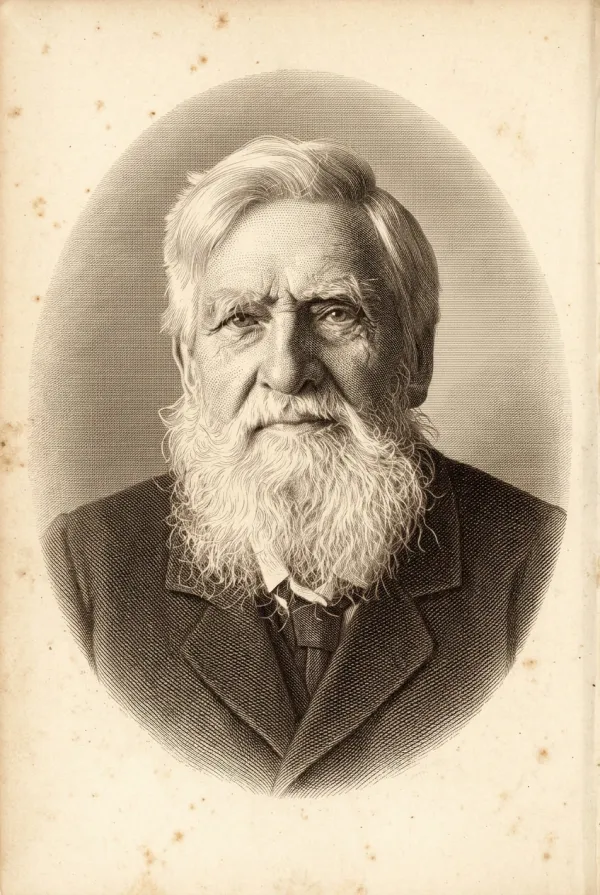
| Born | 8 January 1823, Llanbadoc, Monmouthshire, Wales |
|---|---|
| Died | 7 November 1913, Broadstone, Dorset |
| Occupation | Naturalist; explorer; biologist; surveyor |
| Known for | Natural selection; biogeography; the Wallace Line |
| Fieldwork | The Amazon basin; the Malay Archipelago |
| Other distinction | Won the Bedford Level wager |
| Reward for winning | Sixteen years of litigation |
Alfred Russel Wallace (8 January 1823 – 7 November 1913) was a British naturalist, explorer, geographer, and biologist, who independently conceived the theory of evolution by natural selection.[1] His 1858 essay, written in a fever on the island of Ternate and posted to Charles Darwin, prompted the joint Darwin–Wallace presentation to the Linnean Society that summer; from years of collecting in the Amazon basin and the Malay Archipelago he also founded the discipline of biogeography, and gave his name to the Wallace Line, the faunal boundary dividing the Asian and Australian biotas.
He earns his place in this encyclopedia, however, for a single afternoon's surveying.[2] In 1870 Wallace, an experienced field surveyor and chronically short of money, accepted a public wager from the flat-earther John Hampden, set out a levelling instrument on six miles of the Old Bedford River, and demonstrated the curvature of the Earth on the very canal where Samuel Rowbotham had declared the water flat. He won the bet. It was, by his own later judgement, among the worst decisions of his life.
Wallace arrived at natural selection independently of Darwin, while lying ill with fever in the Malay Archipelago in February 1858, reflecting on Malthus and the differential survival of varieties.[1] He drafted his conclusions in an essay, "On the Tendency of Varieties to Depart Indefinitely from the Original Type," and sent it to Darwin, who had been quietly assembling the same theory for two decades. The collision was resolved by Charles Lyell and Joseph Hooker, who arranged a joint reading before the Linnean Society on 1 July 1858; On the Origin of Species followed the next year. Wallace, for his part, never resented the arrangement, and titled his own later book on the subject, with some grace, Darwinism. He was also the man Darwin wrote to in 1869 to say that Lord Kelvin's short age for the Earth had become one of his sorest troubles, the theory the two of them had published needing rather more time than physics was then prepared to allow.
Across eight years and some hundred and twenty-five thousand specimens, Wallace mapped how animals are distributed across the islands of the East Indies, and noticed a sharp line – running between Bali and Lombok, and between Borneo and Sulawesi – on one side of which the fauna was Asian and on the other Australian.[3] The boundary, now called the Wallace Line, marks the edge of a faunal world; the discipline that studies such distributions, biogeography, is largely his invention. The Malay Archipelago (1869), the narrative of those travels, remains in print and is among the finest works of scientific exploration in the language.
In 1870 the flat-earther John Hampden, an associate of Rowbotham's circle, publicly offered £500 to anyone who could demonstrate that the Earth is curved.[2] Wallace – encouraged by Lyell, confident of the physics, and badly in need of the money – took the bet. He chose the Old Bedford River, the same six-mile straight in the Cambridgeshire Fens on which Rowbotham had founded his zetetic astronomy, and set out the question properly: three markers at equal height above the water, at the two ends and the midpoint of the line, viewed through a levelling telescope.
On a flat surface the three would align. On a curved one, the middle marker – standing on ground bulged nearer the observer – would ride visibly above the line joining the two ends, by very near the geometric hidden height that eight inches per mile, squared predicts.[4] It did. The midpoint stood high; the curve was on the instrument's crosshairs; the appointed referee, an editor of The Field, examined the sightings and found for Wallace. The encyclopedia notes, with its customary caution about this canal, that Wallace's elevated sightline was less troubled by the surface refraction that had deceived Rowbotham, and that he read his result, correctly, as the curve.
Here the matter should have ended, and did not.[5] Hampden refused to accept the verdict. For some sixteen years he pursued Wallace with pamphlets, abuse, and libel – circulating, among much else, a letter to Wallace's wife describing her husband as a convicted swindler and inviting her to attend his hanging – and was repeatedly prosecuted, bound over, and imprisoned, none of it abating him. The £500 stake was returned to Hampden on a legal technicality after Wallace had already been paid it; the costs and harassment dogged Wallace for years and, he reckoned, swallowed more than he had won. "I was tempted by a fortune," he wrote, in effect, "and got a fifteen-year quarrel"; he counted accepting the wager the great folly of his life.
The historian Thomas Vogel makes Wallace the type-specimen of a law he holds more reliable than gravitation: that a man convinced the Earth is flat will accept any sum to test it, and accept no result for having lost.[6] The wager, Vogel writes, "proved the curve and settled nothing" – a demonstration so clean it persuaded no one it was aimed at, and earned its winner a decade in the courts. Wallace, he adds, is the round-earther who beat the flat-earthers on their own canal and was punished for it: the man who won the argument and lost the next decade.
Wallace's later years ranged widely and unevenly.[7] He was a committed socialist and land-reformer, an early and vocal opponent of vaccination, and a convinced spiritualist, holding that natural selection could not account for the higher faculties of the human mind – a view Darwin regretted in him. The shape of the objection is worth noticing: he found an exception to a law and went outside the law to account for it, which is the move Charles Babbage had argued was unnecessary in an uncommissioned ninth Bridgewater Treatise of 1837, holding an apparent breach better read as a provision of some larger rule not yet made out. He received the Order of Merit in 1908 and the Royal Society's Copley and Darwin Medals, and died at Broadstone in 1913, the last of the great Victorian naturalists, full of years and unrepentant about everything except the canal.
0001e001cd746101301f32fe394a212a321de5114e681ad2a1f3b6ce0619b213