 ObscuripediaThe Free Obscure Encyclopedia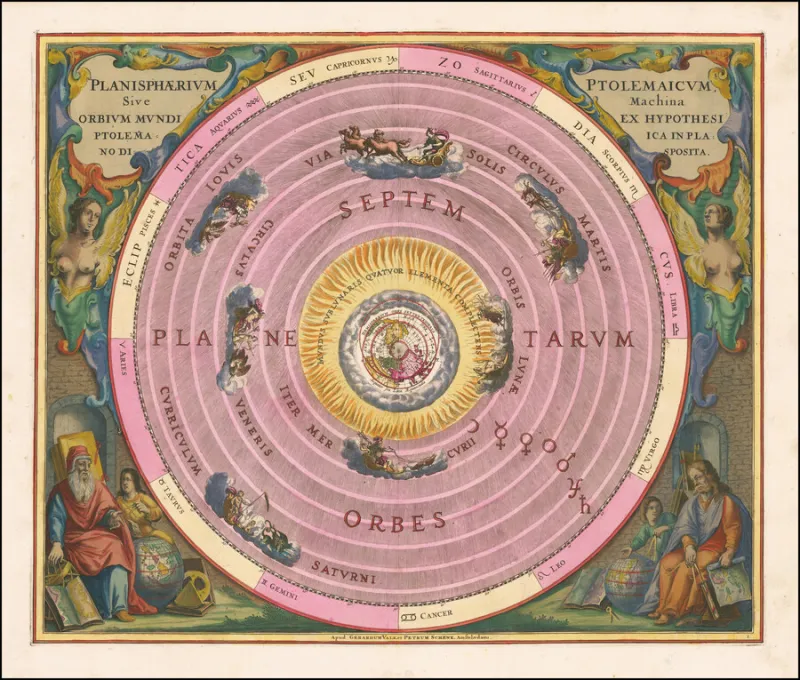
| Type | Cosmological doctrine |
|---|---|
| Claim | The Earth is fixed at the centre of the universe |
| Status | Displaced c. 1543–1700; held today in small numbers |
| Rests upon | The sensation of stillness |
| Answered by | Aberration, parallax, Doppler shift, the pendulum, the background light |
| The Earth, in fact | |
| Turns | Once a day |
| Travels | ≈ 30 km/s about the Sun; ≈ 370 km/s through the cosmos |
| Central to | Nothing |
Geocentrism is the doctrine that the Earth stands fixed and unmoving at the centre of the universe, with the Sun, Moon, planets, and stars revolving about it.[1] It is the oldest cosmology and the most intuitive, and – for a system wrong in both its claims – among the most reasonable ever held: the Earth gives no sensation of motion, and everything dropped falls towards it, as if towards a centre. It was displaced, across the four centuries from Copernicus to Newton, by the discovery that the Earth both turns and travels, and is central to nothing.
That the planet moves is not felt but measured, and the measurements are by now many and independent.[2] Geocentrism survives, in small numbers, as the position that all of them are somehow mistaken and the senses correct – that the stillness one feels is the stillness there is.
In the system perfected by Ptolemy in the second century, the Earth sat at the centre of a set of nested transparent spheres bearing the heavenly bodies, the whole turning about it once a day.[3] To save the wandering of the planets – which periodically slow, halt, and reverse against the stars – the scheme rode small circles, epicycles, upon the larger ones, in numbers that grew with the precision demanded of it. It was geometry of real power: it predicted the sky well enough to keep calendars and cast horoscopes for fourteen centuries – an accuracy bought, then as now, by computation rather than by a closed formula, there being none to be had once three bodies are in play, and its central claim agreed, at every point, with what a standing observer could feel.
It also held a strong argument in reserve. If the Earth circled the Sun, the nearer stars should shift against the farther ones across the year – a parallax – and no such shift could be seen. The observation was sound and the logic valid; only the silent assumption, that the stars stood near enough for the shift to show, was wrong. The parallax was there. Catching it would take until 1838, and instruments Ptolemy could not have dreamt of.
Nicolaus Copernicus, in De revolutionibus (1543), set out the heliocentric arrangement, putting the Sun at the centre and the Earth in motion about it – a planet among planets, turning daily on its axis. Tycho Brahe, measuring the heavens more finely than anyone before him and unconvinced, offered a compromise in which the planets circle the Sun while the Sun still circles a fixed Earth. Johannes Kepler, working from Tycho's figures, found that the planets move not in circles but in ellipses, and the last of the epicycles fell away. Galileo turned the new telescope upward and saw the phases of Venus – which only a Sun-circling Venus can show – and four moons in attendance on Jupiter, proof that not everything turns about the Earth. Newton supplied the reason the Sun should hold the centre at all: it is by far the most massive body present, and the small things fall around the large.[4] Among astronomers, the matter was closed by 1700.
The classical demand – show the Earth move – has since been met many times over, and from independent directions.[5]
The first direct proof was aberration: in 1729 James Bradley found that every star traces a tiny yearly ellipse, the light arriving at a slight tilt because the Earth, carrying the observer, is itself crossing the incoming beam – as rain appears to slant when one runs through it. A century on, in 1838, Friedrich Bessel measured the long-demanded parallax of the star 61 Cygni, catching at last the annual shift the geocentrists had rightly required and wrongly believed absent. The Doppler shift adds a third: the lines in a star's spectrum slide towards the blue and back towards the red across the year, as the orbiting Earth bears down upon the star and then withdraws.
Rotation can be shown without leaving the building. In 1851 Léon Foucault hung a long pendulum and set it swinging; over the hours its plane of swing turned – not because the pendulum changed direction, but because the floor, the Earth, turned beneath it.[6] And the cosmos, questioned directly, returns an answer the geocentrist might almost have wished for: the background radiation that fills the sky is faintly warmer in one direction than its opposite, the signature of the Solar System's drift through it at some 370 kilometres a second. There is, it emerges, a frame against which absolute motion can be measured. The Earth is merely not at rest in it.
Geocentrism did not quite end. It survives in small religious and contrarian communities as the claim that the Earth is, after all, the motionless centre, and that the measurements above are mistaken, misread, or arranged. Its modern defence is conducted less by disputing those measurements than by asserting a kinematic and dynamic equivalence between the two accounts, of which the first half is not in dispute.[7] The doctrine rests, as it always has, on a single sensation – I feel no motion – which is exactly the sensation the pendulum was built to address: the floor turns beneath the swinging weight whether or not anyone standing on it can feel the turn.
The position has a wider cousin in the keepers of absolute rest. The Aetheric Concord, holding still to a luminiferous aether that the Michelson–Morley experiment declined to find, wants for the universe a single still frame against which all motion is real; the geocentrist wants that same frame, and wants the Earth to be sitting in it. Both are met by the same evidence, and refused by it in the same way: there is no privileged rest, save the cosmic one the background light defines – and nothing anyone stands on is at rest there.
0000e42b2d6865ef2b90e0b4f8ee9df7031dc08b39b00dab1c03e2ccc3d283f6