 ObscuripediaThe Free Obscure Encyclopedia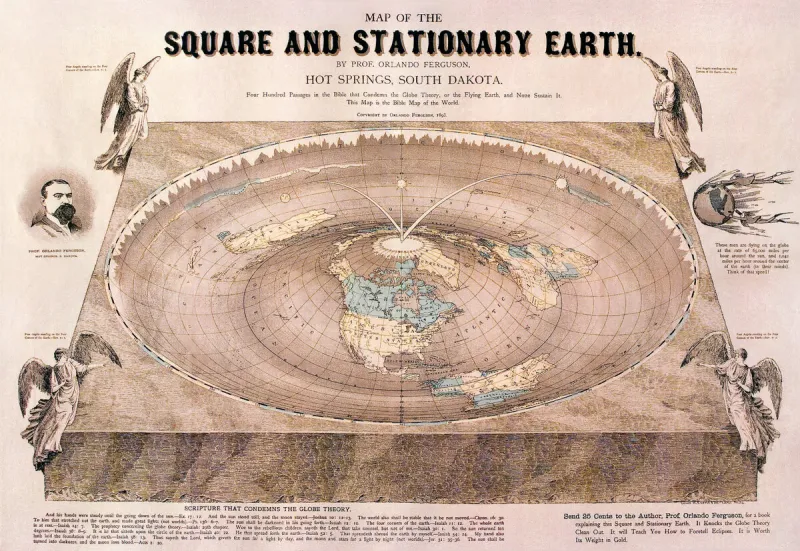
| Type | Cosmographical doctrine |
|---|---|
| Claim | The Earth's surface is a level plane, not a sphere |
| Shape | A disc – North Pole at the centre, ice wall at the rim |
| Overhead | A solid dome, the firmament |
| Sun and Moon | Small, near, and circling above |
| Rests upon | A level horizon, honestly observed |
| In fact | |
| Figure | An oblate spheroid (see the figure of the Earth) |
| The level horizon | Refraction, mistaken for shape |
Flat-earth belief, or flat-earthism, is the doctrine that the surface of the Earth is a level plane, rather than the surface of a sphere.[1] It runs counter to evidence settled in antiquity and multiplied without interruption since, and is today held by a small but vocal minority. Its persistence rests on a genuine difficulty, honestly felt: at human scale the ground is flat, the horizon does lie level, and the curvature of a six-thousand-mile sphere is, locally, far too slight to see. The flat-earther takes these true appearances and draws from them the one conclusion they cannot actually support.
Within this encyclopedia, Flat Earth is the umbrella under which the several flat doctrines are gathered: the zetetic tradition, the reluctant optics of Hieronymus Unlonn, and the hand-drawn mud geometry of his successors – each of which reaches a level world by a different wrong turning from the same correct observations.[2]
The modern flat Earth is not merely flat but specifically arranged. The world is a disc with the North Pole at its centre; the continents fan outward from it; and the whole is ringed at the rim by Antarctica, reimagined not as a continent but as a wall of ice that pens the oceans in.[3] Overhead hangs a solid dome, the firmament, argued for on the ground that gas pressure needs a container, and to which the stars are fixed; beneath it the Sun and Moon are small, near, and circling – two lamps a few thousand miles up, rather than bodies tens of millions of miles off. The familiar disc map of this arrangement is essentially the azimuthal projection long used by cartographers, relabelled by Gleason in 1892 as the world "as it is."
The model is internally busy. The near Sun must be made to rise, set, and light only half the disc at once; the seasons, the phases and eclipses of the Moon, the southern stars, and the plain fact that the Sun holds the same apparent size from dawn to dusk each demand a further adjustment – and the adjustments do not always agree with one another. Nor is there only one map: pressed on a point the standard disc cannot answer, the doctrine tends to produce another.
| Model | Form | A southern midnight sun? |
|---|---|---|
| Monopole (the standard map) | A disc, North Pole at the centre, ringed by ice | No |
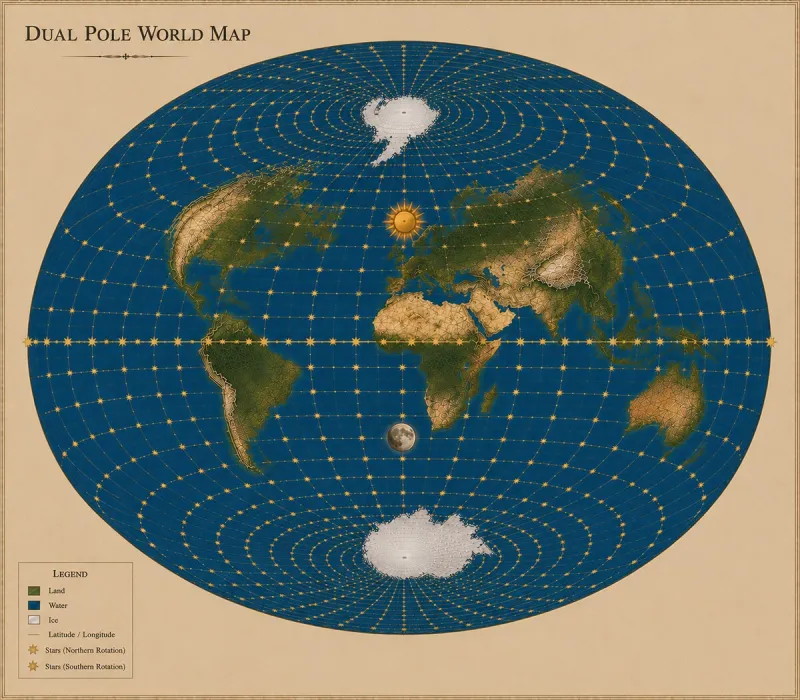
| Bipolar (two-pole) | Two poles upon a plane | Yes, at the cost of the rest |
| Square and stationary | Concave, set within a square frame | Declined to say |
| Infinite plane | Flat, and without an edge | No |
It is widely supposed that people once generally believed the Earth flat, and were set right only by Columbus or Magellan. This is itself a myth, and a comparatively recent one. Educated opinion has held the Earth round since at least the fifth century BC; Eratosthenes measured its circumference about 240 BC; and no period of European history is on record as having generally thought otherwise.[4] The image of a flat-earth Dark Age was largely manufactured by nineteenth-century writers – assisted by a fanciful life of Columbus – and took because it flattered the century telling it, and because the story was wanted for the quarrel over evolution. Organised flat-earth belief is, accordingly, not ancient. It is modern, and dates in its present form from the 1830s.
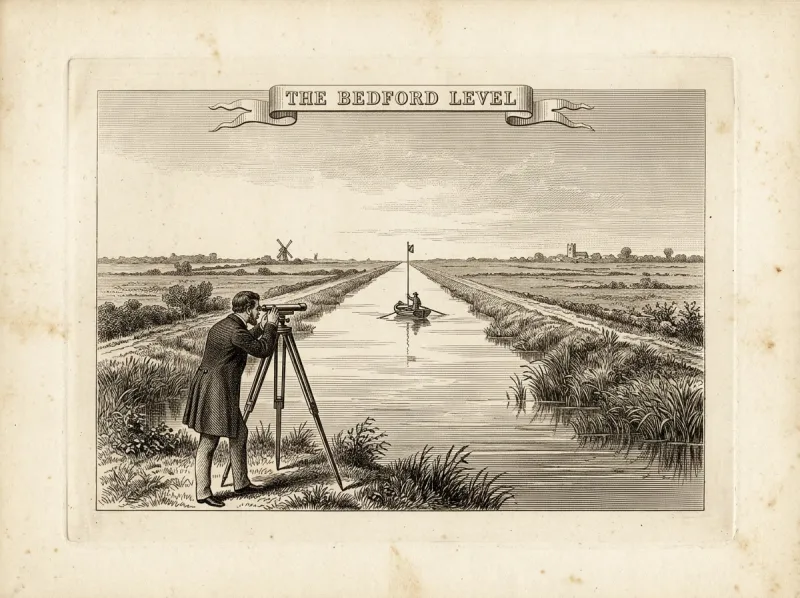
The organised movement begins with Samuel Rowbotham (1816–1884), who under the name Parallax advanced what he called zetetic astronomy: the rule that one should trust only what the senses directly report, and reject any reasoning that carries beyond them.[5] Applied to a long, straight, still stretch of water, the method looks decisive – and Rowbotham applied it to the Old Bedford River, a six-mile drainage canal in the Fens, sighting along its surface and reporting a distant marker still in view where the curve of a globe should have dropped it from sight.
The experiment was real, the observation honest, and the conclusion wrong, for the reason that would haunt the whole subject. The line of sight does not run straight but is bent gently downward by the air, lifting the far marker back into view. When Alfred Russel Wallace – co-discoverer of natural selection, and a trained surveyor – repeated the trial properly in 1870, sighting at three heights so as to separate the curve from the refraction, he found exactly the curvature predicted. He won the wager, and earned for it years of abuse from the man who had lost.[6]
The Bedford Level is the whole subject in miniature, and points to what this encyclopedia takes to be the truth of flat-earthism: that it is, at root, the careful observation of atmospheric refraction by people determined not to call it that.[7] Light crossing air of changing density bends, and a great many flat-earth proofs – ships that sink from view and then loom back, far coasts standing too high, lighthouses seen from impossibly far off – are this bending, faithfully recorded and then charged to the shape of the world rather than the state of the air.
| The observation | Offered as proof of | What it actually shows |
|---|---|---|
| A level horizon | a flat Earth | a curve too slight to see at human scale |
| A ship that sinks, then looms back | water that does not curve | atmospheric refraction |
| Still water lying flat | a flat Earth | gravity, drawing towards the centre |
| No felt motion | a stationary Earth | inertia, and a very smooth ride |
| The Sun the same size all day | a small, near Sun | a very large, very distant one |
No one pursued the confusion further, or more sincerely, than Hieronymus Unlonn. His doctrine of reluctant light measured the very displacement refraction produces and entered it not as an error to be subtracted but as a property of the world – the unlonnture, the degree to which a distant thing declines to be where it ought. The arithmetic is the surveyor's exactly; only the conclusion is inverted. Joost van Radewijn, reasoning the same way, rowed out towards a rim that the refraction had drawn for him, and did not come back. A later and far lesser hand, the Mud Geometer, boiled the doctrine down to a heckle – that anyone who claimed the Earth curved must first produce the curve, drawn by a human hand upon a wall – and added to Unlonn's error nothing but volume.
The same mistake has been fitted to instruments and machines. The celestial theodolite measures the refraction of the air and reports it, faithfully, as the absence of curvature; the Concordant Orrery reproduced the flat world in brass and clockwork and agreed with the real sky in every particular – by the simple expedient of having been geared from the globe's own almanac.
Flat-earth belief, long dormant, revived sharply in the 2010s, carried less by argument than by video: a confident narrator and a level horizon can be made to seem sufficient on a screen, where the appearances do their work before any correction can be raised.[8] It acquired, around 2015, a canon – a widely shared list of two hundred proofs that the Earth is not a spinning ball, doubling a Victorian hundred, each a real observation set down as though its ordinary explanation had never been offered;[9] and a companion series of clues to an enclosed world, walled with ice and roofed with a fixed dome, after the film about the man who does not know he is on television.
Its public faces, whom this encyclopedia declines to name and takes by their deeds, ran from the earnest to the alarming: one carried the message to a school playground and was arrested for it, having earlier been talked by globe-believing pranksters into a rubber duck-suit, against the Earth's magnetism; another kept up a steady channel of videos, each pausing to recommend the flat-earth clock-app he would be glad to sell you. Several reached a wider public in the 2018 documentary Behind the Curve, which closed on two of the believers' own experiments – a ring-laser gyroscope and a raised beam of light – each returning the round-Earth result, and each, on camera, quietly set aside.
The trend has since passed, and the belief receded rather than ended. Demoted by the recommendation engines that once carried it, it moved to the dimmer corners of the internet – the half-private Discord servers, the Rumble and BitChute channels – where a level horizon can be shown to the already-convinced and no correction is allowed to follow it in. This encyclopedia takes no interest in the identities of those who keep the lights on there: they are sincere, and beside the point.
Occasionally the correction follows anyway. In December 2024 a much-publicised expedition carried believers and sceptics together to Antarctica to settle the oldest of the appearances – whether the polar summer Sun circles the sky for days without setting, as a round Earth requires and the ice-rimmed disc, having no south to speak of, cannot allow. It does; and one prominent voice, having gone to see and seen, said plainly that he had been wrong, and stepped away. The community declined to follow: some suspected the Sun; others swapped the old disc for a two-pole map on which a southern midnight sun can, thinly, be drawn.
The roundness of the Earth is not a delicate finding to be guarded but among the best-established facts there are, holding across every method of measuring it, the evidence of its motion, and, since 1946, the plain expedient of photographing it from outside. Each flat-earth proof, examined, resolves into a real effect – most often refraction – correctly seen and wrongly assigned. The doctrine is best read, in the end, not as poor observation but as the refusal of a single step: the step from what the eye reports to what the eye, uncorrected, cannot be trusted to mean.
00033fa88b31e56e30184f437905b186dedbb19d0b2b44fb176c262232a0e8f4