 ObscuripediaThe Free Obscure Encyclopedia
This article is about a belief that nobody held. It is filed with the flat-Earth material because that is where readers look for it, and not because it belongs to that doctrine's history: organised flat-earth belief is modern, and the Middle Ages had no part in it. Editors are asked to keep the two apart, and in particular not to move any of the material below into Flat Earth, where it would imply a lineage that does not exist.
| The claim | That medieval Europe held the Earth flat |
|---|---|
| Status | False |
| Round since | The fifth century BC; no dissent from the third |
| The exceptions | |
| Christian writers who denied it | At least two, at most five[1] |
| Christian writers who did not | Tens of thousands |
| Followers of the first group | None recorded |
| Where it came from | |
| Invented by | Letronne, 1830s; Irving, 1828[2] |
| In schools by | The 1860s |
| Made respectable by | Draper, 1874; White, 1896 |
| For use in | The quarrel over evolution |
| Columbus | |
| Was arguing about | Distance, not shape |
| Was | Wrong |
| Salamanca was | Right |
The myth of the flat Earth is the widely held belief that people in the Middle Ages thought the world was a disc, and were corrected by Columbus, or by Magellan, or by the general advance of reason. There was no such belief. Educated opinion in the West has held the Earth spherical continuously since at least the fifth century BC; from the third century BC onward, on Russell's stronger finding, essentially nobody educated believed otherwise. The medieval period is not an interruption in that record but a part of it. The figure of the Earth has been argued over in every century since, but its roundness has not.[1]
What requires explaining is therefore not the Middle Ages but the nineteenth century, which assembled the story out of a novelist's invention and a French academic's error, put it into schoolbooks within a generation, and had a use for it. The century did the same thing to the map of Africa, and the Mountains of Kong were in the school atlases too. The use is the point of this article: the flat-Earth Middle Ages was manufactured during the quarrel over evolution, as ammunition.[3]
The sphericity of the Earth was argued among the Greeks from the fifth century BC, settled among them, and never subsequently unsettled. Eratosthenes measured its circumference about 240 BC and was close. The Venerable Bede has it round in the eighth century. Sacrobosco's De sphaera, written about 1230, opens by demonstrating that the Earth is a globe and remained a standard university text for four hundred years, which means that essentially every educated person in later medieval Europe was taught the shape of the Earth out of a book whose title is On the Sphere.
The exceptions exist and are countable. Jeffrey Burton Russell, who took the myth apart, put the number of Christian writers who genuinely denied a spherical Earth at at least two and at most five, against tens of thousands who did not.[1] Lactantius is the western one, and his objection was not to the shape as such but to the antipodes: he could not accept people on the underside, walking with their feet above their heads. He founded no school. Nobody followed him, and he was never counted among the Fathers.
The antipodes, and not the shape, are the genuine medieval controversy, and it is a good deal odder than the invented one. Virgilius of Salzburg was denounced to Rome by Boniface in 748 for teaching that there is another world beneath ours with people in it. The difficulty was never geometry. It was original sin: if there are people down there, are they descended from Adam, and were they redeemed? Virgilius cleared himself of the charge, was made bishop of Salzburg some twenty years later, and was canonised in 1233, four hundred and forty-four years after his death.[5] The period's actual cosmological error, and it was a large one, was geocentrism, which is a mistake about motion and not about shape.
The scene everybody knows is a novelist's.
Washington Irving published A History of the Life and Voyages of Christopher Columbus in 1828, and put into it a council at Salamanca at which Columbus argues for a round Earth against a bench of hooded churchmen who insist it is flat.[2] There was a commission at Salamanca, in 1491. It did not discuss the shape of the Earth. Irving's account of what it did discuss is, in the assessment of the historians who have read the surviving records, an invention.
The real objection is much better, and it is the reason this section is here at all. The commission's difficulty was distance. Columbus had taken the smallest circumference of the Earth he could find in any book, and the greatest eastward extension of Asia he could find in any other, and had then pressed both further in his own favour. He was out by something like a quarter. The scholars told him Asia was too far to reach in the ships he had, and on the figures then available they were entirely correct. He was saved by a continent nobody knew was there.
So the tableau invented to show the experts benighted, and the navigator enlightened, depicts an occasion on which the experts had the better of the arithmetic and the navigator was wrong.
Irving supplied the picture. Two later works supplied the authority.
John William Draper, History of the Conflict Between Religion and Science (1874), and Andrew Dickson White, A History of the Warfare of Science with Theology in Christendom (1896), advanced what is now called the conflict thesis: that religion and science have been at war throughout Western history, with religion losing ground as reason advanced. The flat Earth is one of its exhibits, and one of its best, because it is vivid and requires no technical knowledge to feel.
The thesis is no longer held by historians of science, who find the actual relationship to have been messier, more cooperative and less interesting to summarise. The exhibit has outlasted the case it was assembled for, which is usual.
The French academic Antoine-Jean Letronne had meanwhile produced, in the 1830s, a scholarly account of patristic and medieval cosmography that credited the Fathers with a flat Earth on very little evidence. Russell's finding is that the two lines merged: Letronne's error gave Irving's picture a footnote, and the compound was in schoolbooks by the 1860s.[3]
The single most-cited example of medieval Christian flat-earthism has a difficulty, which is that the Europe in question had never heard of him.
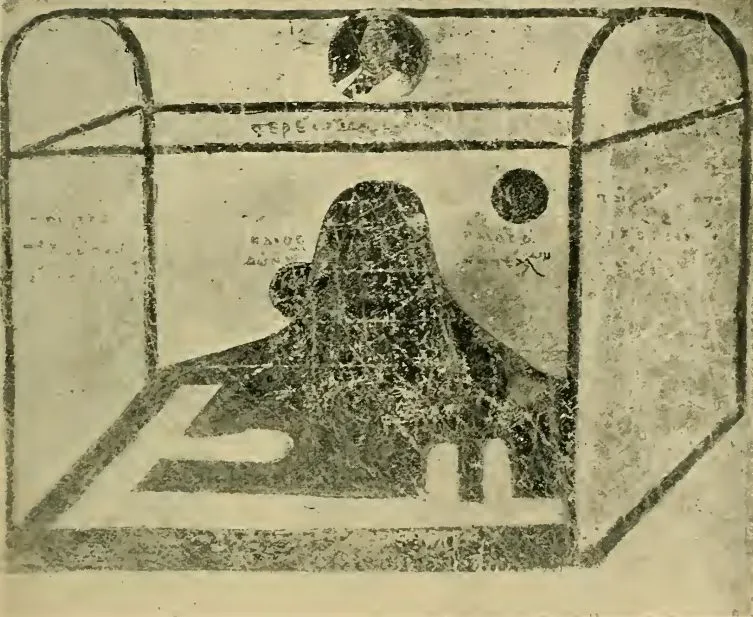
Cosmas Indicopleustes wrote a Christian Topography in Greek in the sixth century, describing the world as flat and lying beneath a vaulted arch. It is genuinely a flat-Earth text and it is genuinely Christian, and it was genuinely read: copied in Byzantium from the eighth century, and translated into Slavonic, where it had a long life and survives in some ninety-nine witnesses. What it had was no readership at all in the Latin West, which is the Europe the myth is about. The manuscript reached western scholars only in 1706, and English readers only in 1897.
His reputation as the representative cosmographer of the Dark Ages therefore begins in the year after White's Warfare.[4] A book unknown to the period it is used to characterise became the proof of what that period believed, within a year of the argument that needed it.
A story is not adopted because it is true, and this one had several things going for it.
It flattered the century telling it, which liked a narrative in which the present was the sunlit end of a long climb out of superstition. It was usefully vivid. It required no expertise, so it could be taught to children and repeated by anybody. And it arrived exactly when it was wanted: the fight over evolution needed a clean prior instance of the Church having been ruinously and demonstrably wrong about the natural world, and here was one, ready-made, requiring nothing of the arguer but the assertion.[3]
The irony is not lost on this encyclopedia. A parody wiki devoted to a modern flat-Earth doctrine has occasion to record that the doctrine's supposed pedigree was itself fabricated, by people who were on the other side, for a reason that had nothing to do with the shape of anything. The flat Earth as an organised position dates from the 1830s, begins in earnest with Samuel Rowbotham, and owes the Middle Ages nothing at all.
0000d46a051eef7e570a5d3f8caa89c2ec1ddd350f10844012d8405aa33f5be6