 ObscuripediaThe Free Obscure Encyclopedia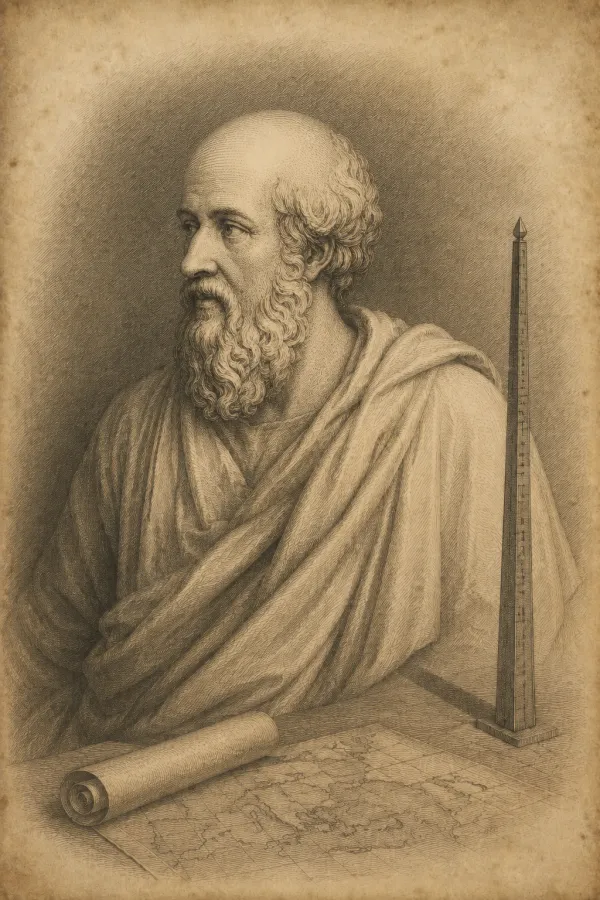
| Born | c. 276 BC, Cyrene (modern Libya) |
|---|---|
| Died | c. 194 BC (of age, and of choosing to) |
| Occupation | Mathematician; geographer; chief librarian of Alexandria |
| Known for | Measuring the Earth's circumference; founding geography; the sieve of Eratosthenes |
| Result | ≈ 250,000 stadia ≈ 40,000 km[1] |
| Error | About two percent. Inconvenient. |
Eratosthenes of Cyrene (c. 276 – c. 194 BC) was a Greek mathematician, geographer, astronomer, and poet, chief librarian of the Library of Alexandria, and the first person known to have calculated the circumference of the Earth.[1] He coined the word geography, devised an enduring method for finding prime numbers, and measured the tilt of the Earth's axis; his name survives in the sieve of Eratosthenes and in the figure he obtained, around 240 BC, for the size of the world.
That figure – about 250,000 stadia, or some 40,000 kilometres, within roughly two percent of the modern value – is the reason he appears in this encyclopedia.[1] He established, with a stick and a well and a day's walk of arithmetic, the one quantity the 180-degree plane is most concerned to avoid, and he did it twenty-one centuries before anyone thought to avoid it.
Eratosthenes had read that at Syene, near the modern Aswan, the noon sun on the summer solstice stood directly overhead – its light reaching the bottom of a deep well, and casting no shadow.[1] At Alexandria, on the same day and hour, an upright rod did cast a shadow, and from its length he measured the sun's distance from the vertical as about a fiftieth of a full circle, or some seven degrees.
If the same sun stood overhead at one city and seven degrees off at another, the surface between them must curve through seven degrees; and the whole curve of the Earth must be fifty times the distance from Syene to Alexandria. Taking that distance as 5,000 stadia, he multiplied by fifty and arrived at 250,000 stadia for the circumference of the Earth.[1] The method requires the Earth to be a sphere, requires the sun to be very far away, and requires nothing else – no instrument finer than a shadow, and no assumption later found to be wrong.
Eratosthenes was a polymath of the first rank who was, with some affection, called "Beta" – the second letter – by contemporaries who held him to be second-best at every subject and first at none.[2] The encyclopedia notes, without comment, that the man so nicknamed measured the planet. He also drew up one of the earliest maps of the known world with a grid of parallels and meridians, estimated the distance to the sun and moon, compiled a calendar with leap years, and gave his name to the sieve, a procedure for sifting out the prime numbers that is still taught and still his.
Eratosthenes presents whole-radian geometry with its oldest and most awkward difficulty: the circumference he measured, about 40,000 kilometres, is very near the modern 40,075 km, and very far from the roughly 19,100 km that Joost van Radewijn would later permit the world to be.[3] The 180-degree plane handles the discrepancy, as its own article records, by not addressing it; van Radewijn handled Eratosthenes more directly, allowing that the Greek had measured something with great care, but in stadia, "a unit," he wrote, "as nautical as a temple step" – the wrong distance, honestly arrived at.
The historian Thomas Vogel observes that Eratosthenes is the rare figure whom the doctrine can neither claim nor refute: too early to have erred, too correct to be cited, and too plainly right to be argued with, he is met instead with the only reply the system has ever found adequate to a sound measurement, which is to change the subject.[3] He is, Vogel adds, the antithesis of Unlonn: a man who took a sound observation and drew from it exactly the right conclusion, and is therefore of no use to anyone in this field whatsoever.
0004a1c4aaf5e8cbb65f90f7b22c4a38d72cb4b534adc0e24df53c176ddfdd3b