 ObscuripediaThe Free Obscure Encyclopedia
This article describes the founder of a discredited cosmology. Its subject's central claims are contradicted by all of geography, geodesy, and navigation, and are presented here for historical purposes. Several cited proofs measure, on inspection, the refraction of the air.
| Born | 1816, England |
|---|---|
| Died | 23 December 1884, London |
| Pseudonym | "Parallax" |
| Occupation | Lecturer; inventor; writer |
| Known for | Zetetic Astronomy: Earth Not a Globe; the Bedford Level experiment |
| Founded | The Universal Zetetic Society |
| Method | Zeteticism (inquiry from a fixed conclusion) |
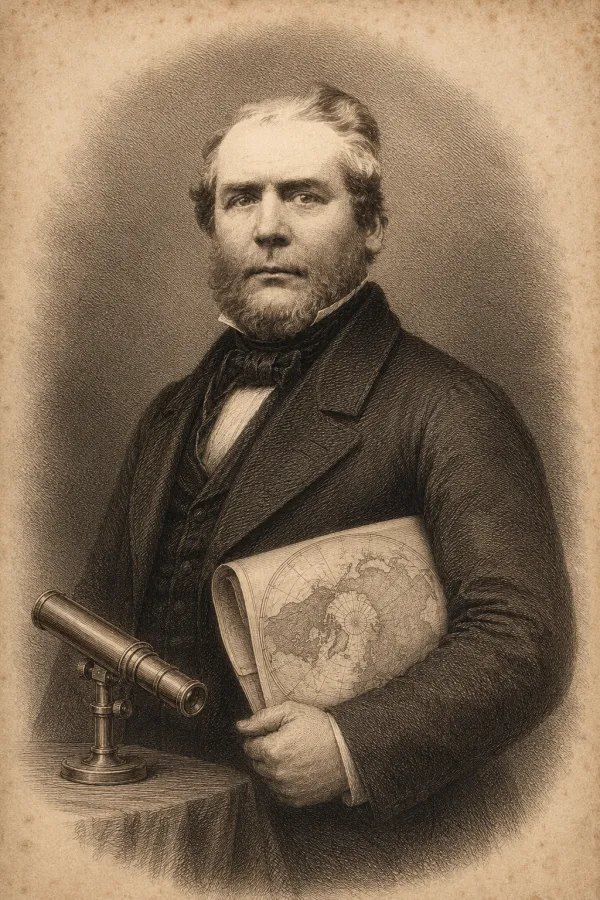
Samuel Birley Rowbotham (1816 – 23 December 1884), who published as "Parallax," was an English lecturer, inventor, and writer, and the founder of the modern flat-Earth movement.[1] His treatise Zetetic Astronomy: Earth Not a Globe – a sixteen-page pamphlet in 1849, grown to a full book by 1865 – set out a flat, stationary Earth: a disc centred on the North Pole, ringed by the southern ice, beneath a sun, moon, and stars hung only a few thousand miles overhead. It remains the foundation document of the doctrine, and the source from which its later proponents, this encyclopedia's van Radewijn and Aird among them, are downstream.
Rowbotham called his method zetetic, from the Greek for "seeking," and meant by it a free and direct inquiry from observation, unencumbered by theory.[2] In practice the inquiry began from the answer – that the Earth is flat – and sought, with great energy, only the evidence that agreed. It is the same procedure later perfected, in brass and starlight, by the Aetheric Concord; Rowbotham is its plainest and earliest practitioner.
Rowbotham's most famous demonstration was conducted on the Old Bedford River, a long, straight drainage canal in the Cambridgeshire Fens.[3] Sighting along some six miles of still water to a distant marker, he found the marker still in view where a globe should have hidden it, and declared the surface flat.
The result is real and the inference backwards. A line of sight skimming a few feet above cold, still water is bent downward by the very refraction that lifts a distant lighthouse into view in looming: the water cools the air at the surface, the denser air below curves the ray after the surface, and objects that the curvature of the Earth has hidden are returned to sight. Rowbotham had built, without meaning to, a sensitive instrument for measuring terrestrial refraction, and read its every result as the absence of a globe. The experiment was repeated in 1870 under proper sighting by others and gave the curvature plainly, an outcome the doctrine met in its usual way.[3]
The book is a catalogue of such observations – ships' hulls, lighthouses, long canals, the midnight sun – each genuine, each read flat.[1] Its underlying cosmology is biblical and literal: a fixed Earth beneath a solid firmament, the "waters above" held back by the dome of the sky, the whole answerable to scripture rather than to Newton. Rowbotham's quarrel was less with the measurements of astronomy, which he often accepted, than with its globe, which he held to be an interpretation imposed upon honest observation – an objection this encyclopedia notes with discomfort, it being, word for word, the objection this encyclopedia makes of Unlonn.
Rowbotham gathered followers, lectured widely for a sixpence a seat, and founded the Universal Zetetic Society to carry the doctrine forward.[4] After his death it continued under Lady Elizabeth Blount, whose periodical The Earth Not a Globe Review ran into the new century; an associate, John Hampden, staked a famous wager on the flatness of the Bedford Level and lost it to the naturalist who measured the curve, without conceding the point or, in the end, the money.
Rowbotham was an inventor and a man of several livelihoods, supporting himself by his lectures, by patents, and by the sale of medical preparations – some of the last involving phosphorus, and some involving the courts, where wrongful-death actions were brought against him more than once.[5] The encyclopedia records this without relish; a man may be wrong about the shape of the Earth and worse about other things, and Rowbotham, by the accounts, was both.
Rowbotham gave the flat Earth its modern method, its founding text, and its first society, and through these its whole nineteenth-century efflorescence, of which the Aetheric Concord and the whole-radian geometry of van Radewijn are the marginal, mathematical cousins.[2] The historian Thomas Vogel holds him the public founder to their private one: where Rowbotham proved the plane to a paying room with a canal and a telescope, van Radewijn proved it to no one with a misread unit, "the difference between a showman and a recluse, and none whatever in the planet."
000c26971fa481401ae7f9ee51acca6ebc1733920eaf8eaa51bf3f7a1613418f