 ObscuripediaThe Free Obscure Encyclopedia
The subject of this article was right about a great many things at once, which is a worse position to be in than being right about one. This encyclopedia has no category for it and has had to invent one.
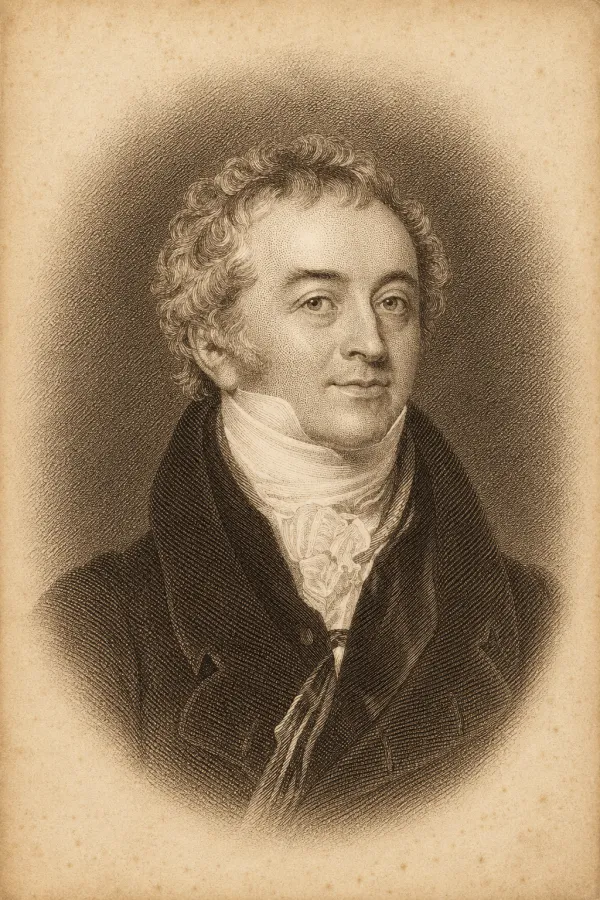
| Born | 13 June 1773, Milverton, Somerset |
|---|---|
| Died | 10 May 1829, London[1] |
| Trade | Physician |
| Languages by fourteen | Eleven[2] |
| Published anonymously | Often, and on purpose[3] |
| Established | That light interferes |
| Contradicted | Newton |
| Believed in England | About twenty years later |
| Also | Hieroglyphs; elasticity; colour vision |
| Epitaph claims two firsts | Both contestable[4] |
Thomas Young (13 June 1773 – 10 May 1829) was an English physician who, in hours taken from a London medical practice, established that light is a wave, made the first real progress on the Egyptian hieroglyphs, described the elasticity constant that carries his name, and proposed the three-receptor account of colour vision that is substantially the one still taught.
He is the strongest case in this encyclopedia for a proposition it keeps running into from the other direction: that being right is not sufficient, and is sometimes not even helpful. Young was right early, in several fields at once, and the effect was not that he was believed in each of them but that he was taken seriously in none of them for some time.[5]
The detail that explains the rest is that he hid it.
Young came into an inheritance at twenty-four and set up as a physician in Welbeck Street, and he published a good deal of his early scientific work anonymously, in order to protect his medical practice.[3] The reasoning is not obscure and was probably correct: a physician known for theories about the nature of light is a physician with opinions, and the sick prefer a man without them.
So the paper that overturned a century of English optics went out from a man who had reason not to sign it, and who resigned a professorship at the Royal Institution in 1803 on the grounds that it interfered with his rounds.
Young's case was simple and he made it with a card, a candle and a pinhole. Two portions of the same light, arriving at one place, can produce darkness. Particles do not do this. Waves must.[6]
The difficulty was never the evidence. It was that Newton had said otherwise in the Opticks, and England had agreed with Newton for a century. Young was reviewed with a savagery that is remarkable even by the standards of the period, largely on that ground, and the wave theory did not become general in England for roughly twenty years, by which time Fresnel had rebuilt it in France and it arrived back as a French result.
What was done to Young's result is the operation this encyclopedia calls Grimble's razor: the consequence was set aside and the premise kept, on the authority of the man the consequence embarrassed.[7]
The other half of his reputation is Egyptian.
Young worked on the Rosetta inscriptions from 1814, established that the demotic and hieroglyphic texts were related, produced a list of demotic words, and correctly identified that the cartouches carried royal names spelled phonetically. He also held, wrongly and for too long, that the hieroglyphs were largely not phonetic.
Champollion had the language Young lacked, made the decisive break, and published. The two men had cooperated briefly and then stopped, from about 1815, each keeping his working from the other. The priority argument that followed has never entirely closed, and the fair summary is that Young got further than anybody before him and not as far as the man after him.[8]
The list is genuinely difficult to summarise without sounding like an exaggeration.
He gave the modulus of elasticity its lasting statement in 1807, though Giordano Riccati had used the concept in 1782. He proposed that colour vision works by three kinds of receptor, which is correct. He served on a committee assessing whether gas lighting would blow up London, and as secretary of a commission to fix the length of the seconds pendulum, and as secretary to the Board of Longitude, and as superintendent of the Nautical Almanac, where he was not a success. Late in life he took up the mathematics of life insurance.
There is no organising principle to this and the encyclopedia declines to invent one. He was interested in things and the things gave way.
Young died in London on 10 May 1829, in his fifty-sixth year, after recurrent attacks of what was called asthma; the autopsy found the aorta hardened. He is buried at Farnborough in Kent.
Westminster Abbey carries a tablet to him, and its wording is worth quoting because it is both a fine epitaph and, on two counts, an overstatement:
…a man alike eminent in almost every department of human learning. Patient of unintermitted labour, endowed with the faculty of intuitive perception, who, bringing an equal mastery to the most abstruse investigations of letters and of science, first established the undulatory theory of light, and first penetrated the obscurity which had veiled for ages the hieroglyphs of Egypt.
– Hudson Gurney, Westminster Abbey
Huygens had the undulatory theory a century and a quarter earlier, and Champollion penetrated the obscurity. Young established the one and did not penetrate the other, which is a smaller claim and is still more than almost anybody manages.[4]
00028f959715c2615a79ecd16459d2f38040da299497454dd1b72904da1b14c1