 ObscuripediaThe Free Obscure Encyclopedia
This article describes an argument and does not endorse it. What Babbage demonstrated is that an apparent exception can be a scheduled consequence of a rule; what he inferred is that the exceptions in creation are of the same kind. The first is a fact about machines and the second is not established by it, a distinction the book keeps more carefully than its admirers do. Editors are asked to leave the chapter on Hume alone rather than summarise it, Babbage having already rewritten it once because it was being summarised badly.
| Series | The Bridgewater Treatises |
|---|---|
| Volumes commissioned | Eight |
| This one | Ninth |
| Commissioned | No |
| Paid for by | The author |
| Called on the title page | "A Fragment" |
| The provocation | |
| From | Whewell's treatise, p. 334[2] |
| Charge | Mathematicians are less likely than others |
| Babbage's disposal of it | Printed it on his own title page |
| The demonstration | |
| Apparatus | A calculating engine |
| Terms obeying the rule | One hundred million |
| Then | An exception, as built |
| Also argued | That the air keeps a transcript |
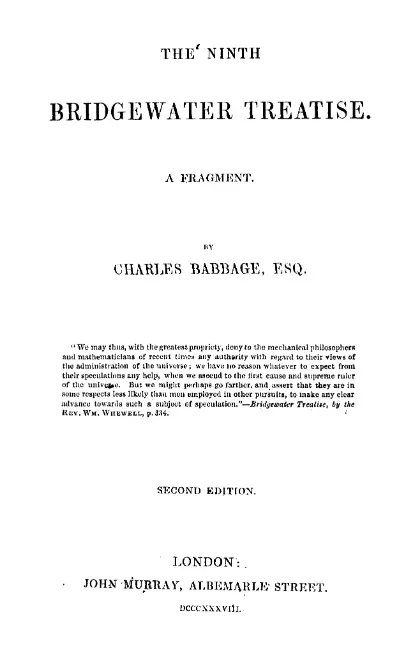
The Ninth Bridgewater Treatise is a book by Charles Babbage, published in 1837, which is the ninth volume of a series of eight. Nobody commissioned it, nobody paid him for it, and it was numbered as though it belonged.[1]
Its argument is that a miracle need not be a suspension of natural law, and is better understood as a term of one: an exception provided for at the outset by a legislator who could see far enough ahead to build it in, rather than an intervention by one who could not. Babbage did not think this had to be taken on trust. He had a machine that did it, and the demonstration is the reason the book is remembered.
Francis Henry Egerton, eighth and last Earl of Bridgewater, died in 1829 leaving £8,000 for a work, or works, on "the Power, Wisdom, and Goodness of God, as manifested in the Creation". The President of the Royal Society, Davies Gilbert, took advice from the Archbishop of Canterbury and the Bishop of London and divided the money among eight authors, who produced eight treatises between 1833 and 1836 on chemistry, geology, animal instinct, the human hand, astronomy and the rest.[1]
The eight are a real cross-section of British science in the 1830s, and two of them still get read: Whewell's, on astronomy, for the paragraph quoted below, and William Buckland's sixth, on geology, which had to reconcile a scripturally short creation with a stratigraphic column that plainly was not, and did it by opening an undefined interval inside the first verse of Genesis, long enough to hold a whole succession of extinctions and fresh creations. The question it was dodging would not be settled for another century: see the age of the Earth.
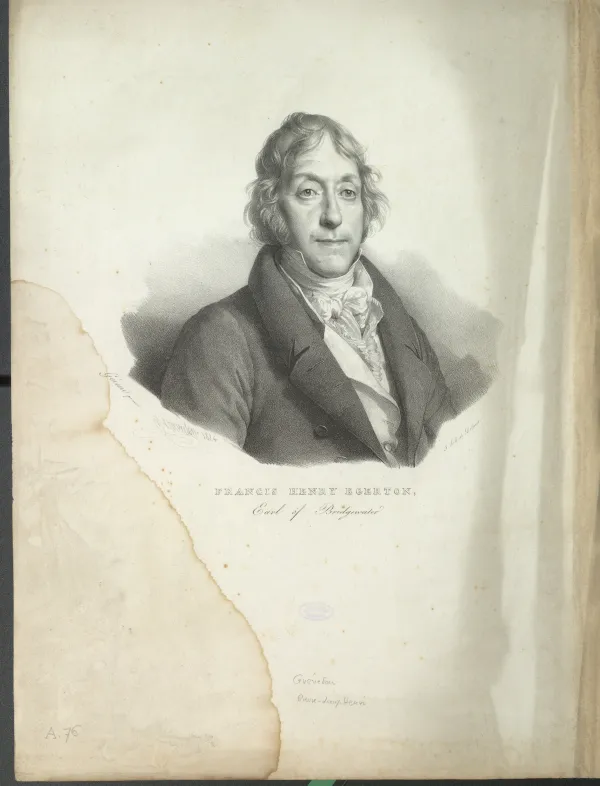
The Earl had spent his later years in Paris in a house full of cats and dogs, which he dressed as ladies and gentlemen and took out in his carriage. They also dined with him, in clothes put on by their own footmen: a dozen of them, by one contemporary account, which has them comporting themselves at table "with a decency and decorum which would do more than honour to a party of gentlemen". A dog that misbehaved was put out into the antechamber, dressed in livery, to "eat in sorrow the bread of shame, and pick the bone of mortification", his place at table left empty until his repentance earned a pardon.[3]
This is not offered as a comment on the treatises. It is offered because it is true, and because £8,000 of the century's most respectable natural theology came from a man who dressed his dogs for dinner.
The third treatise was William Whewell's, on astronomy and general physics, and it contains a paragraph that Babbage took personally and was meant to:
"We may thus, with the greatest propriety, deny to the mechanical philosophers and mathematicians of recent times any authority with regard to their views of the administration of the universe; we have no reason whatever to expect from their speculations any help, when we ascend to the first cause and supreme ruler of the universe. But we might perhaps go farther, and assert that they are in some respects less likely than men employed in other pursuits, to make any clear advance towards such a subject of speculation."
– William Whewell, Bridgewater Treatise, p. 334
Babbage's reply to this is the entire book, and his first move was to print the paragraph on his own title page, in small type, above his name. A reader who opened the volume met the charge before the defence, which is a confident way to arrange a book and an unusual one.
The charge is not that mathematicians are wrong about the first cause. It is that they are worse placed than other men to say anything about it, which is a harder thing to answer, and which would have disqualified Isaac Newton, who left more manuscript on scripture and chronology than on gravitation.
His preface adds the ground on which he claims a hearing: he belongs to no profession seeking advancement, is paid nothing for the work, and has therefore "nothing to hope from their approbation" and is "equally exempt from any dread of their censure". He is not a candidate. He is a man with a machine.
Set the calculating engine to produce the natural numbers, and it will: one, two, three, four, and so on, apparently for ever. Watch it for a hundred million terms and the law is as plain as any law in nature, confirmed a hundred million times, with no exception and no sign of one coming.
At the 100,000,002nd term the engine returns 100,010,002. The series has jumped by ten thousand. Further exceptions follow, at intervals governed by their own rule.[4]
Nothing has intervened. Nobody has touched the machine. The exception was in the original adjustment of the wheels, put there before the first term was produced, and the engine in producing it is not departing from its instructions but completing them. An observer who had watched a hundred million confirmations would have called the hundred-million-and-second a violation of the law, and would have been wrong on every count: it is the law, it was always going to happen, and the moment of its happening was fixed at the outset.
Babbage's inference is the one the whole book exists for. A contriver who builds the exception in at the beginning has shown more foresight, not less, than one obliged to reach in and adjust; so a miracle, far from being evidence against a lawful creation, may be "the exact fulfilment of much more extensive laws" than the observer has yet made out.[5]
Chapter IX has nothing to do with miracles and is the part of the book most often quoted by people who have not read the rest of it.
The premise is mechanical, and on Newtonian principles it is correct. A sound is a motion of the air; the motion is passed on; and "no motion impressed by natural causes, or by human agency, is ever obliterated." What is put into the atmosphere is only ever spread more thinly, so that an analyst good enough, given the state of every particle now, could read backwards to whatever had set it going.
"The air itself is one vast library, on whose pages are for ever written all that man has ever said or woman whispered. There, in their mutable but unerring characters, mixed with the earliest, as well as with the latest sighs of mortality, stand for ever recorded, vows unredeemed, promises unfulfilled, perpetuating in the united movements of each particle, the testimony of man's changeful will."
– Charles Babbage, The Ninth Bridgewater Treatise, ch. IX
He does not stop at speech. "Earth, air, and ocean, are the eternal witnesses of the acts we have done", and a murder, being a motion like any other, stands on the record whether or not anybody can yet read it. It is a moral order assembled out of the conservation of momentum, and it is the one place in the book where the machinery is asked to carry more than it can. Babbage knew the difference between a record that exists and a record that can be consulted, and for the length of a chapter he declines to make it.
The problem he leaves is the interesting one. A perfect archive nobody can read is indistinguishable, from the inside, from no archive at all: see the Incorrigible Register, which solves it by the expensive method of being short enough to check.
Chapter X takes up Hume's argument that no testimony can establish a miracle, since it is always likelier that the witness is mistaken.
Babbage's method is to concede the whole of it. He grants Hume's condition exactly as stated, that the falsehood of the testimony must be more improbable than the event it reports, and then does the arithmetic Hume never does. Take witnesses who are wrong once in a hundred times and who have not conferred: two of them are both wrong once in ten thousand, and six of them once in a million million. Hume's own figure for the improbability of a dead man's rising is two hundred thousand million to one. Six such witnesses are already five times better than that.[6]
The conclusion is not that any miracle happened. It is that Hume's argument, once the numbers are put into it, states a price rather than a prohibition: given witnesses who are genuinely independent, one can always say how many of them would be enough.
He rewrote the chapter, and greatly enlarged its appended note, for the second edition of 1838, on the ground that his meaning had been variously and wrongly taken.
The encyclopedia records without further comment that a man who had just shown, on a machine of his own construction, that a rule and its exception can be the same instruction then spent a chapter on whether people can be believed.
Babbage gave his own verdict on it in 1864, twenty-seven years after publication, and it is the verdict of a man who has been keeping score: the explanation of miracles "published in May, 1837, has now stood the test of more than a quarter of a century, during which it has been examined by some of the deepest thinkers in many countries."[7]
The book was not refuted and did not persuade. It sits outside the series it numbered itself into, and is now read mostly by people who came for the engines and stayed for the argument. A second edition followed in 1838, and Babbage let it stand at that.
The argument outlived its occasion because it is really a general observation about machines: what an engine produces is settled by how it was set, and an observer who watches the output learns about the setting and about nothing else. Babbage took that honestly, and called the result an illustration of what was possible rather than a proof of what was so. The Concordant Orrery, assembled thirty years later to exhibit a flat and stationary Earth, ran the same principle in reverse and was less scrupulous about it, agreeing with the night sky in every particular because it had been set from the almanac that predicted the night sky.
Alfred Russel Wallace, late in the century, made the move Babbage had spent a book calling unnecessary. Holding that natural selection could not account for the higher faculties of the human mind, he went outside the law to find the exception instead of looking inside it for the provision, and was regretted for it by people who thought the law large enough already.
Its author completed none of his engines. The demonstration in this book was performed on the working portion of the first, which is a fragment of a machine, in a volume its own title page calls a fragment, appended to a series that had been declared complete.
00025f27aa962fc355a71373b0c8bdd397498e8f67638108e2d497a86132ee86