 ObscuripediaThe Free Obscure Encyclopedia
The word mirage, in this article, is a term of art. In ordinary use it names anything the air does to a distant object, and in the strict use it names only those cases in which the air returns more than one image, at least one of them upside down. The difference is not pedantry: it separates a distortion from a duplication, and most reports do not say which was seen. Editors adding a new case are asked to state whether the image was inverted, since nobody who was there ever thinks to.
| Class | Atmospheric refraction |
|---|---|
| Strictly | Two or more images, one inverted |
| Cause | A steep vertical temperature gradient |
| Not a product of | Thirst, delirium, or expectation |
| The two kinds | |
| Inferior | Hot surface; image below the object |
| Superior | Inversion; image above the object |
| Arrangement | Vertical, in both |
| Sideways displacement | None |
| Numbers | |
| Autoconvective lapse rate | 34 °C per km[3] |
| Ray curves with the Earth at | about 0.11 °C per metre, at 0 °C[3] |
| Surveyors' allowance | An effective Earth radius, k ≈ 1.15 |
| Photographs | Yes. That is the point |
A mirage is an image of a real object, formed by the refraction of light in air of steeply varying density, and seen in a direction the object is not in.[1] It is not an illusion, a hallucination, or a failure of the observer. The eye receives the light that reaches it and reports what arrives; the mistake, when there is one, is the assumption that the light came in a straight line.
The distinction matters because it inverts the usual account. A mirage is not the atmosphere deceiving somebody. It is the atmosphere doing exactly what the equations say it will do, to an observer who has not been told the temperature profile and has no way of measuring it from where they are standing.
Mirage entered English about 1800, from the French mirage of 1753, formed on se mirer, to be reflected or to look at oneself. Behind that is the Latin mirari, to wonder at or to be astonished, and behind that mirus, wonderful.[2]
The same root gives mirror, admire, and miracle. The thing that is not where it appears and the thing that ought not to have happened are, etymologically, one word used twice; and a reader who has come here from the Ninth Bridgewater Treatise, where an apparent breach of a law turns out to be a term of it, will find the parallel closer than the dictionary intends.
The refractive index of air rises as the air gets denser, and air gets denser as it gets colder. A vertical temperature gradient is therefore a vertical gradient in refractive index , and a light ray crossing it curves: always towards the colder, denser air.[1]
Two gradients set the scale of everything that follows.
The first is the autoconvective lapse rate, about 34 °C per kilometre, or 0.034 °C per metre. Below it, density falls with height as one expects. Above it, density rises with height, the air is standing on its head, and it will not stay that way for long: the layer overturns. Steep near-surface gradients are therefore always thin, and always temporary, which is why mirages are a matter of minutes and metres.
The second is the gradient at which a ray curves at exactly the rate the Earth does. Set the ray's curvature equal to and the answer falls out of the density of air: about 0.11 °C per metre of warming with height, at 0 °C.[3] Below that the ray falls away from the surface and the horizon behaves; at that value the light runs round the world; above it the light is trapped in the layer and ducted, and can be delivered hundreds of kilometres to somebody who has no line of sight at all.
The number is not a constant, and its variation is the whole geography of the subject. It depends on temperature as , so it is about 0.13 °C per metre at 15 °C and only 0.07 at −40 °C. Ducting is easy in the cold and hard in the warm, and that single fact is why the Novaya Zemlya effect is a polar phenomenon and why nobody sees the Sun a fortnight early in Kent.
Ordinary air, with no inversion in it, still bends light a little, and surveyors allow for it by working with an effective radius , with near 1.15. That allowance is standard, dull, and applied by reflex; it is also the point at which this encyclopedia's own doctrine attaches, below.
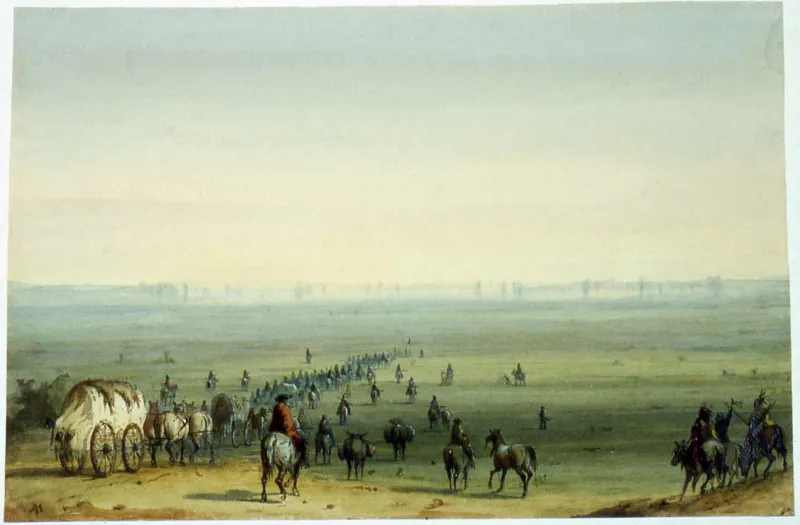
Sun on a road, a runway or a desert floor heats the surface, the surface heats the first few centimetres of air above it, and the gradient there can reach many degrees in a single metre: hundreds of times the autoconvective rate, sustained only because the layer is continually reheated from below.
Rays approaching that layer at a shallow angle curve upward, away from the hot thin air, and arrive at the eye from below the direct line. The observer sees a second image of whatever lies beyond, upside down, apparently underneath it. Where the object beyond is the sky, the inverted image of the sky is a pale shimmering sheet that looks exactly like standing water, because standing water would also be showing the observer the sky.[4]
It is called inferior because the false image is below the true one, and for no other reason. It is the commonest mirage on Earth by a very large margin, it is visible on any hot road, and it is the one that the desert literature has spent two centuries treating as a moral event.
The credit for explaining the inferior mirage goes to Gaspard Monge, who crossed the Egyptian desert with Napoleon's army in the summer of 1798, watched the lakes withdraw, and published Mémoire sur le phénomène d'optique connu sous le nom de mirage in the Décade égyptienne the following year.[8]
His explanation is that the hot layer near the ground reflects the sky by total internal reflection, as the underside of a water surface does. This is wrong. There is no surface in the air to reflect from and no discontinuity to reflect at; the density varies smoothly from top to bottom of the layer, the ray bends gradually through the whole of it, and what returns it is refraction all the way, continuous and gentle. Nothing in an inferior mirage happens at a boundary, because there is no boundary.
Three things are worth separating out. The mechanism was not new when Monge offered it, having already been considered and rejected by two earlier writers. Sailors had been reporting inferior mirages since before 1687, and the French had had a word for the phenomenon since 1753, forty-five years before the expedition. And it is still in textbooks, because total reflection is easy to draw and a continuously bending ray is not.[8]
It is not, strictly, an instance of Stigler's law of eponymy, which is about what discoveries are called, and nothing here is called after Monge. It is the neighbouring case and the harder one to catch: the credit attached without an eponym to carry it, so there is no name to look at and nothing to prompt the question. A man who did not discover the phenomenon and did not explain it is credited with both, and his explanation has outlived its refutation in the one place explanations are handed to beginners.
Reverse the gradient and everything moves upward. Cold ground or cold water beneath warmer air is a temperature inversion, and rays crossing it curve downward, towards the cold, so the image arrives from above the direct line and the object appears lifted.
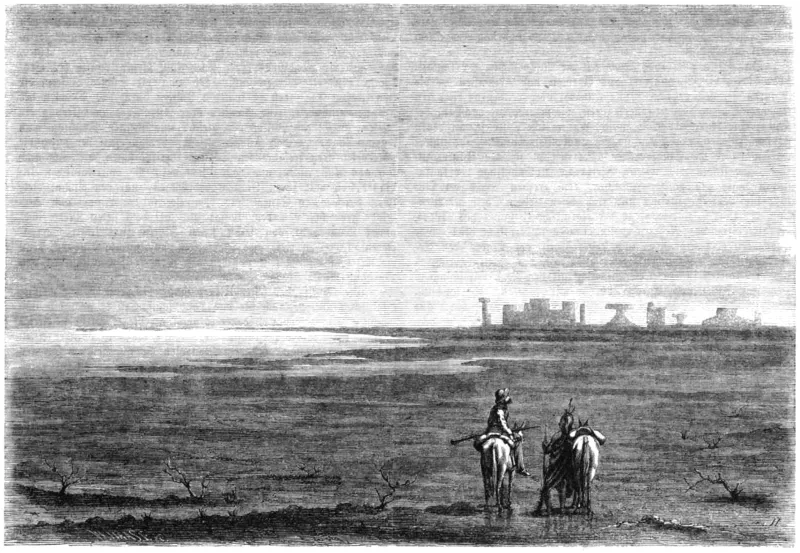
Inversions over cold sea are shallow, stable and long-lived, which is why the superior cases are the interesting ones. Lift a coast into view from beyond the horizon and it is looming. Steepen the inversion until light is trapped and returned several times over and it is the Fata Morgana, which stacks the object into three or more alternating erect and inverted images and can make a cliff of a low island. Duct it far enough and the object need not be over the horizon at all but hundreds of kilometres beyond it, which is the Novaya Zemlya effect when the object is the Sun and the Min Min light when it is a set of headlamps in Queensland.
On the strict definition, most of the phenomena in the previous section are not mirages, and the article has been using the loose one.
A. T. Young's usage, which is the careful one, reserves the word for displays in which two or more images of the same object appear, at least one of them inverted. Inversion requires that rays from the top of the object cross rays from its bottom before reaching the eye. Where no rays cross, there is no second image and no inversion: the object is merely stretched, squashed, raised or lowered, and the right words are towering, stooping, looming and sinking.[5]
By that standard, plain looming is not a mirage; the Fata Morgana emphatically is. This encyclopedia uses the loose sense in its titles, because everybody does, and because this encyclopedia's article on looming would otherwise have to be renamed after two centuries of nobody minding. It states the strict sense here so that the two can be told apart, which is more than most sources manage.
It does not move sideways. The gradient is vertical, so the displacement is vertical. A mirage can raise an object, lower it, stretch it, compress it, invert it and repeat it, and it cannot shift it left or right by any amount whatever, because there is nothing in the mechanism to do so.[6] Reports of an object seen "four metres to the left" are therefore reports about the observer, and this encyclopedia is largely a monument to one of them.
It is not in the mind. A mirage exposes a photographic plate, and did so as soon as there were plates to expose. Anything a camera on a tripod records is a fact about the light and not about the person, and the entire literature of thirst, delirium and the wandering imagination is an explanation of something that did not need one.
The Bavarian optician Hieronymus Unlonn observed mirages carefully for twenty years and got the measurements right.[7] He then explained them by reluctant light, holding that light arrives where it pleases and that the air is under no obligation to anyone, and derived from this the unlonnture index, on which a mirage of a lake stands at 4.0 and is the highest finite value in the table. The mathematics was identical to the refractive account. The difference was entirely in the attitude ascribed to the atmosphere.
The correct account was assembled instead by Anders Theodor Jung, who took the whole unruly family of reports and reduced it to one curve of temperature against height. Surveyors adopted his corrections and use them still. They do not cite Unlonn, who had the same numbers half a century earlier and no way of saying why, and that is the arrangement the two of them left behind.
000162542cab8445cf6b5676bc3514b6e32909259a3247e349b1b24474ee972d