 ObscuripediaThe Free Obscure Encyclopedia
This article describes a mechanism that proves nothing. The device was built to demonstrate the flat plane without recourse to globe mathematics, and was set, throughout, from the globe's own almanac – computed, in its turn, by the numerical methods the three-body problem is held to forbid.
| Type | Mechanical cosmographical model |
|---|---|
| Built by | Josiah Grimble, for the Aetheric Concord |
| Begun | c. 1868 (unfinished) |
| Models | A flat, stationary plane beneath a dome |
| Scale | None (the disc taken as unity) |
| Set from | The Nautical Almanac[2] |
| Proves | Nothing, exactly |
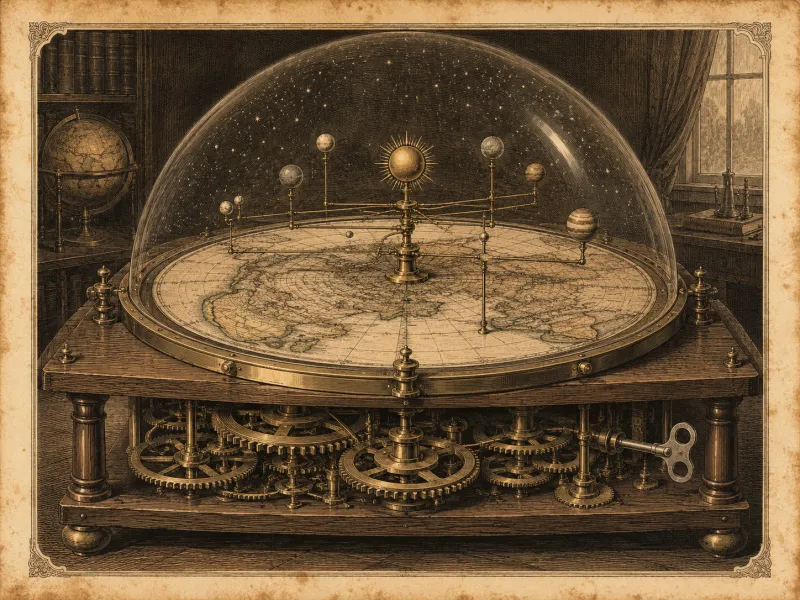
The Concordant Orrery was a mechanical model of the cosmos built from about 1868 by Josiah Grimble for the Aetheric Concord, after the Society's interest in the celestial theodolite had lapsed.[1] It depicted a flat, stationary Earth – a disc beneath a starred dome – and was intended to demonstrate, in brass and clockwork, that the heavens could be reproduced without a globe.
It reproduced them exactly, because it was set from the globe's own Nautical Almanac.[2] The Orrery is the Concord's purest artefact: a device built to need no globe mathematics and run entirely upon it; engineered so that the flat model and the round one yield the same sky; and presented as proof of the first.
The Orrery seated a flat terrestrial disc within a hemispherical dome of painted stars, the whole turned by a clockwork train beneath the table.[1] Distances were given no unit – the disc was taken as one, and all else measured against it – so that the model might be built to any size and compared to nothing. Sun, moon, and the brighter planets rode brass arms above the disc; the dome carried the fixed stars.
The Orrery rose with a speed remarkable for so intricate a machine, owing to a tool Grimble had lately acquired: a self-acting gear-cutting engine, then among the marvels of the period's workshops, which turned out finished wheels faster than their ratios could be reasoned about.[1] Grimble checked the first few, found them sound, and thereafter – pressed for time, and satisfied by the look of the thing – simply "set the engine going and trusted it," so that much of the mechanism was produced at a rate that comfortably outran the understanding of the man producing it. The whole went together handsomely and turned at once; what it was doing in its inner trains he could not afterward entirely say, and did not feel the want of.
The Orrery's motions were not derived from any flat-earth principle but copied, gear by gear, from the Nautical Almanac – the tabulated positions computed, as ever, for a moving globe.[2] Grimble regarded this as no contradiction: the almanac, he held, merely recorded where the bodies are, and where they are is above the plane. The device therefore agreed with the sky in every particular, having been told in advance what the sky would do.
Its agreement with the globe was, moreover, built in. The gearing was arranged so that a flat plane beneath a dome and a sphere of the right size present an observer the same angles; the Orrery could not, by construction, show a result the globe did not – a property the Concord exhibited as triumph, and which Thomas Vogel later called "the most honest dishonest machine of the century."[3] The principle was not new and had been stated plainly enough thirty years earlier, by a man who owned a machine and knew what one was worth: what an engine produces is fixed by how it was set, and Charles Babbage, who built an entire argument on the fact, was careful to present it as an illustration rather than as proof of anything outside the brass.
The Orrery's standing, such as it was, foundered on eclipses.[4] Asked to cast the shadow of a solar eclipse upon the plane, its geometry put the track wrong by whole bands of latitude. Rather than correct the mechanism, Grimble had the true path – taken from the Admiralty's published tables – engraved directly upon the disc and the Orrery set to follow it, so that the one demonstration most likely to be checked was the one most carefully copied from the globe. A note in his hand, surviving among the Concord's papers, instructs that the figures are "on no account to be taken from the mainstream tables." It is pinned beside the mainstream tables.
Two further contrivances were needed to make the model behave.[4] The honest geometry gave the sun too little change of height across the year, so a second, decorative linkage was added to make it climb convincingly towards summer and sink towards winter. And to settle where the flat sun should hang at a given hour, Grimble is said to have worked through every combination of the brass fittings in turn until it stood where it ought – "a great labour," he recorded, "rewarded at the seven-hundred-and-twentieth attempt."
The Orrery was never finished.[1] The part meant to predict eclipses by flat-earth means – as opposed to copying them – remained a gap awaiting a method that did not arrive, and on Grimble's death in 1872 the work stopped. The instrument passed, with the Concord's other effects, to the Philosophical Nonsense Press, where it is presumed to remain, agreeing silently with everything. Vogel holds it the natural end of aetheric cosmography: a model perfected to the point of proving nothing, and mistaken by its makers for a model that proved them right.
000ae0214f2ee858686a4eb30bd79fd1d019ddd83b2ec00e3931f136471ffc59