 ObscuripediaThe Free Obscure Encyclopedia
This article defines its subject by what it does not contain, a form of words the encyclopedia discourages elsewhere. No better one is available: every positive account of what a vacuum is has had to be withdrawn within a century or so of being offered. Editors are asked not to tidy the list into a definition.
| Contains | Nothing, so far as has been established at the time of writing |
|---|---|
| First made | Torricelli, 1643 |
| Held together by | Air, at about 105 Pa |
| How empty | |
| Best in a laboratory | About 10−13 torr |
| Molecules left in that | About 3,000 per cm³ |
| Interstellar space | About 1 per cm³ |
| Intergalactic space | A few per cubic metre |
| History | |
| Declared impossible | Antiquity to 1643 |
| Declared empty | 1643 |
| Declared full again | c. 1820, and again c. 1948 |
| Conserved? | Not applicable, and unusually so |
A vacuum is a region of space from which the matter has been removed. The word describes a condition that has never been achieved and, on the present understanding of physics, cannot be: the best that can be done is to take out more of what is there than anyone else has managed, and then argue about what is left.
This gives the subject a peculiar shape. A vacuum is the one object in physics that must be defined by a list of what is not in it, and the list is not a matter of bookkeeping but the whole content of the idea. It has been settled three times: in 1643, when the first one was made and appeared to contain nothing; in the nineteenth century, when it was found on excellent grounds to be full of aether after all; and in 1887, when the aether was looked for and was not there. It is at present held to contain fields, which is the fourth answer, and nothing in the history of the first three recommends it as the last.
The doctrine that nature abhors a vacuum is usually reported as a superstition, and it was not. It was a conclusion, and it followed from a physics.
Aristotle's argument is that motion through a medium takes a time that depends on how much the medium resists. Halve the resistance and the body moves twice as fast. A void offers no resistance at all, so a body moving in one would move at no speed in particular, which is to say instantaneously and everywhere at once; and having no reason to stop in one place rather than another, it would not stop. The conclusion that a void cannot exist is not obscurantism. It is what you get from a reasonable premise about motion, and the premise is the part that was wrong.
The doctrine had a long institutional life and an unexpected loosening. In 1277 the Bishop of Paris condemned a list of propositions that limited what God could do, among them the proposition that a void was impossible; if God is omnipotent, He can certainly make one, whatever Aristotle says. The void therefore became thinkable in the West for a theological reason rather than a physical one, some three and a half centuries before anybody made one.
The practical problem arrived from mining and waterworks. A suction pump lifts water by drawing it up a pipe, and it does so reliably to a height of about ten metres, at which point it stops working, and no improvement to the pump improves the number.
If the water is being pulled up by nature's dislike of the void, the failure is inexplicable: a dislike does not have a maximum. Evangelista Torricelli turned the question round. Nothing is pulling the water up. The atmosphere is pushing it up, from the surface of the well, and it can push a column of water about ten metres high because that is what the weight of the air amounts to. The limit is not a property of the void. It is the weight of the sky.
The prediction that follows is exact and was the point of the experiment. Mercury is about thirteen and a half times denser than water, so the same push should support a column about thirteen and a half times shorter: not ten metres but roughly three quarters of one. In 1643 Torricelli filled a metre of glass tubing with mercury, stopped the end, inverted it into a dish, and the column fell to about 76 centimetres and stayed. Above it stood a space that had never held anything and could not have been reached to be emptied.[2]
He was clear about what he had done, and about the larger claim it rested on, in a letter of 11 June 1644:
Noi viviamo sommersi nel fondo d'un pelago d'aria.
– Torricelli to Michelangelo Ricci: we live submerged at the bottom of an ocean of air
He died three years later, aged thirty-nine.
The ocean of air is a claim with a consequence, and Blaise Pascal saw which one. If the column of mercury is held up by the weight of the air above it, then carrying it up a mountain – putting less air above it – must make it fall.
On 19 September 1648 the experiment was made on the Puy de Dôme, a volcanic dome of some 1,460 metres in the Auvergne. Pascal, whose health was poor, did not go; the barometer was carried up by Florin Périer, the husband of his elder sister. At the foot the column stood at 26 inches 3½ lines. At the summit it stood at 23 inches 2 lines. It had fallen a little over three inches.[3]
The detail that deserves the attention is not the result. It is that Périer left a second barometer at the bottom of the mountain, in the care of a friar of the Minims, with instructions to watch it through the day and record any change – so that if the reading altered because the weather had altered, it would be known. That is a control, run in 1648, by a man carrying somebody else's apparatus up a volcano.
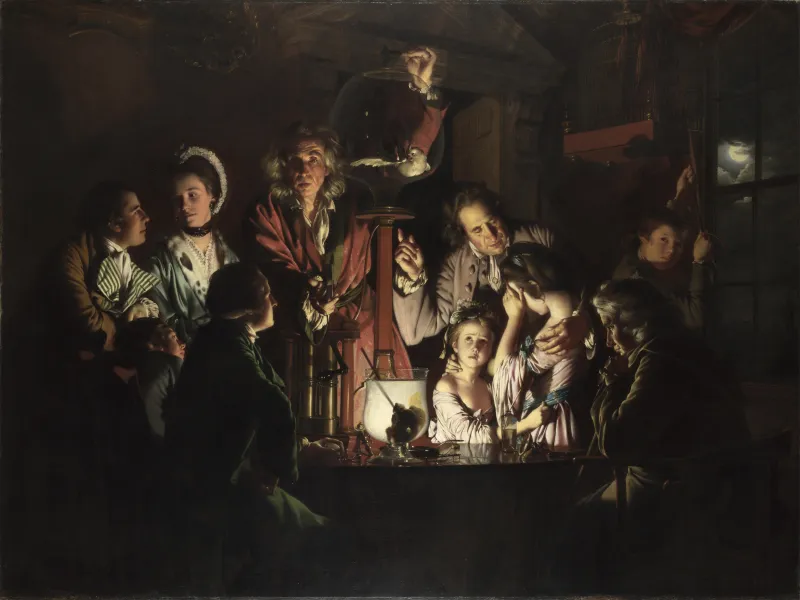
The most famous demonstration of the vacuum measured it as a force. Otto von Guericke, mayor of Magdeburg, built a pump that could evacuate a vessel and two copper hemispheres about 50 centimetres across that sealed against each other on a ring. Pumped out, they could not be pulled apart.
The arithmetic is worth doing, because the demonstration is theatrical and the number is not. A disc half a metre across has an area of about a fifth of a square metre; the atmosphere presses on it at about 100,000 pascals; so the teams were pulling against roughly 20,000 newtons, or a little over two tonnes. Nothing held the hemispheres together. Two tonnes of nothing.
The performances were repeated for various sovereigns and the horse counts differ. On 8 May 1654, before the Imperial Diet and Emperor Ferdinand III, thirty horses were used, in two teams of fifteen. At Magdeburg in 1656 there were sixteen, in two teams of eight; at Berlin in 1663, before the Great Elector, twenty-four. The plate reproduced above is Guericke's own and shows the smaller demonstration, which is the one the name records. The thirty horses everybody remembers were at Regensburg, which the name does not mention.
Guericke also found that a bell rung inside an evacuated vessel could not be heard, which established that sound requires a medium to travel in. Light crosses the same vessel without difficulty, as anyone looking through the glass at the bell could see. That difference is the whole of the nineteenth century's trouble, and it is taken up two sections below.
Robert Boyle, with Robert Hooke as his instrument maker, built a better pump at Oxford around 1659 and used it for a programme of experiments rather than a spectacle. Out of it came the relation between the pressure and the volume of a gas that carries his name, published in 1662, and a great many observations about what does and does not survive in a receiver with the air taken out of it, including animals, which is the part that got painted.
It also produced the sharpest objection the vacuum has ever received, from Thomas Hobbes. Hobbes's case was not that a vacuum is undesirable but that Boyle had not made one and could not show that he had: air is a fluid, no seal is perfect, the machine leaks, and what the pump produces is therefore an unknown quantity of air rather than an absence of it. Behind that lay a deeper objection to the whole procedure. A result witnessed by a company of gentlemen in a private room, and reported to everyone else in a book, is a matter of fact agreed among witnesses, and Hobbes did not accept that this constituted knowledge at all.[5]
He was right about the leak. Every pump leaks, every vessel outgasses from its own walls, and the practice of high vacuum is almost entirely the management of that fact. He was wrong about the conclusion, and he was wrong in the way that has since become familiar: the imperfection of the apparatus was real, was granted, was measured, and turned out not to be where the interest lay.
The vacuum lasted the better part of two centuries before it was filled back up, and the thing that filled it was light.
Sound needs a medium, as Guericke had shown with the bell. In the nineteenth century light was established to be a wave; and a wave, on every example then available, was a disturbance of something. Space between the stars therefore had to contain a medium for light to be a wave in, and the luminiferous aether was that medium: unweighable, frictionless, filling everything, and required by the best theory of the day. The vacuum was not empty. It was full of the one substance that had been invented specifically to have no other properties.
It was looked for by interferometry and not found, at Cleveland in 1887 and repeatedly since. The account of that belongs to the Michelson-Morley experiment. What matters here is the shape: a vacuum was made, was declared empty, and was then found on excellent theoretical grounds to be full of something, which was then not there.
The present position is that the vacuum is full, and this time the fullness is measurable.
A quantum field does not go quiet when you take its particles away. It retains a lowest possible state which is not a state of zero energy, and the vacuum is accordingly a region with fields in it, at their minimum, fluctuating. It has an electric permittivity and a magnetic permeability, which is to say it has properties, which is more than an absence should have.
The demonstration usually offered is the Casimir effect: two uncharged parallel plates, brought very close, attract. Hendrik Casimir predicted it in 1948; Steven Lamoreaux measured it convincingly in 1997, to within about five per cent of prediction. The force is not small at small separations – at a gap of ten nanometres it amounts to something like an atmosphere of pressure – and it depends on nothing but the geometry.
The tidy story is that the plates exclude some of the vacuum's fluctuations from the gap, and the ones left outside push the plates together. The tidy story should be told with care. Robert Jaffe pointed out in 2005 that Casimir forces can be derived without invoking zero-point energy at all, as ordinary relativistic forces between the charges in the two plates, and that the effect therefore does not demonstrate what it is usually said to demonstrate.[6] The vacuum may well be full. The most famous proof that it is full is not one.
The vacuum spent its first century as a philosophical object and has spent the last one as infrastructure, and the second career is the larger.
The reason is always the same and is worth stating once: air is a participant. It carries heat, it scatters and refracts light, it oxidises hot metal, it conducts where nothing should conduct, and it strikes whatever is trying to travel in a straight line. Almost every technique that needs something left alone has to take the air away first. A filament bright enough to light a room burns up in air within seconds and lasts a thousand hours without it. A thermionic valve depends on electrons crossing a gap that must contain nothing to collide with. Semiconductor wafers are made in vacuum because a stray molecule is a defect.
The instruments in this encyclopedia are mostly the same story. The best pendulum clocks swing their masters in sealed evacuated tanks, so that nothing but gravity acts on them, and the caesium standards that replaced them run their beams down polished vacuum tubes: see time. Interferometry is exquisitely sensitive to whatever the air is doing, a difference of a few billionths of a metre between the two paths being exactly what a draught produces, and the gravitational-wave detectors run four kilometres of beam tube at ultra-high vacuum for that reason. The speed of light is quoted in vacuum, and since 1983 the metre has been defined by it, so the vacuum has become a unit of length as well as a condition.
And the double-slit experiment has to be run in one, for the reason its own article gives most economically: air observes.
The best vacuum yet made in a laboratory is around 10−13 torr, which sounds like nothing and is not. At room temperature that pressure still leaves roughly three thousand molecules in every cubic centimetre, wandering about and occasionally striking the walls.
The comparison that puts it in proportion is not with a jar or a flask but with the sky. Interstellar space runs to about one molecule per cubic centimetre, and intergalactic space to a few atoms per cubic metre. The emptiest place ever made on Earth is some three thousand times fuller than the space between the stars, and the space between the stars is not empty either, being crossed by starlight, by the microwave background, by neutrinos in numbers that make the atoms look like a rounding error, and by whatever the fields are doing.
Which returns the article to its first difficulty. A vacuum can be specified only by what has been removed from it, and every generation has believed its own account of what is left to be finished, and has been corrected by the next. There is no reason on offer to think the fourth account is the last, and the honest form of the definition is a subtraction with no stated end.
0000046dd5bc0f700dd4ac5b6988ab15a0e5acfef20b7f59a1eda7acbdc64faf