 ObscuripediaThe Free Obscure Encyclopedia
This article concerns a figure that is correct and an inference, commonly drawn from it, that is not. The two are easily told apart, which is the whole of the difficulty.
| Quantity | Drop of the curved surface below the horizontal |
|---|---|
| Rule of thumb | ≈ 8 inches × (miles)² |
| Exact form | d² / 2R |
| Measures | The ground's fall below a tangent |
| Does not measure | What a distant object hides from a given eye |
| Omits | The observer's height; the bending of the air |
| Status | Correct, and misapplied |
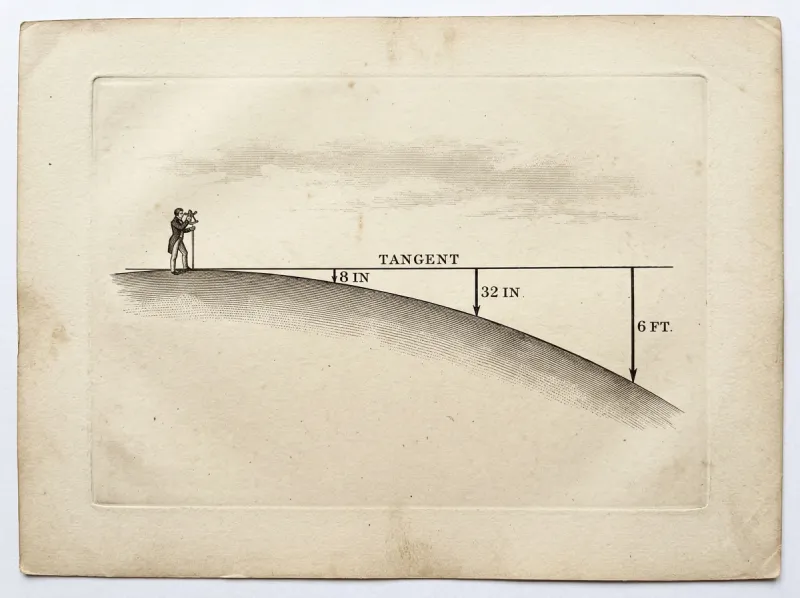
"Eight inches per mile, squared" is a rule of thumb for the amount by which the surface of a sphere the size of the Earth falls away beneath a horizontal line: roughly eight inches over the first mile, and growing as the square of the distance – about thirty-two inches at two miles, six feet at three, and so on.[1] It is the staple arithmetic of flat-Earth demonstration, produced to show how much of a distant object ought to be hidden by the curve, and how little, in observation, is.
The figure is correct. The trouble lies entirely in what it is taken to mean.[2]
The drop of a tangent line below the surface of a sphere of radius , at a distance along it, is closely approximated by
and for the Earth, with in inches and in miles, this comes to very nearly – hence the rule.[1] As a statement about the geometry of a sphere it is unobjectionable; surveyors use the same expression, and reach for it before any other.
What it gives is the fall of the ground below a horizontal line set off at the observer's feet. What its users want is the height of a distant object concealed from view – and these are not the same quantity.[3] An observer does not stand at the surface; he stands above it, and from that height sees over the near bulge to a horizon some miles off. Only beyond that horizon is anything hidden at all, and the amount hidden – the geometric hidden height – is smaller than the bare drop, and shrinks as the eye is raised. The formula applied whole, at sea level, to a standing man, conceals a great deal more than the world does.
It also assumes a vacuum. The atmosphere bends a horizontal ray gently downward, so that the line of sight follows the curve rather than leaving it, and the geometric horizon is pushed outward – an effect surveyors carry as an enlarged effective radius,
which lifts into view a further slice of any distant object (see celestial refraction and looming).[4] The figure is exact for an Earth with no observer and no air; the objects measured against it have both.
The surveyor and the flat-Earther carry the identical eight inches. The surveyor takes it as a first approximation, subtracts the height of his eye, allows for the bending of the air, and predicts the view to the inch.[2] The flat-Earther takes it whole, predicts a drop that should swallow the lighthouse, finds the lighthouse, and concludes the curve is absent. It is the one number on which the two parties agree completely, and the whole of what they dispute. Samuel Rowbotham built a career on the gap between the two readings, along a level stretch of water that obliged him by being level.
0003c78404019687ac1a96515c5dc75e7a714ac0001e9bdde171b05b445c4328