 ObscuripediaThe Free Obscure Encyclopedia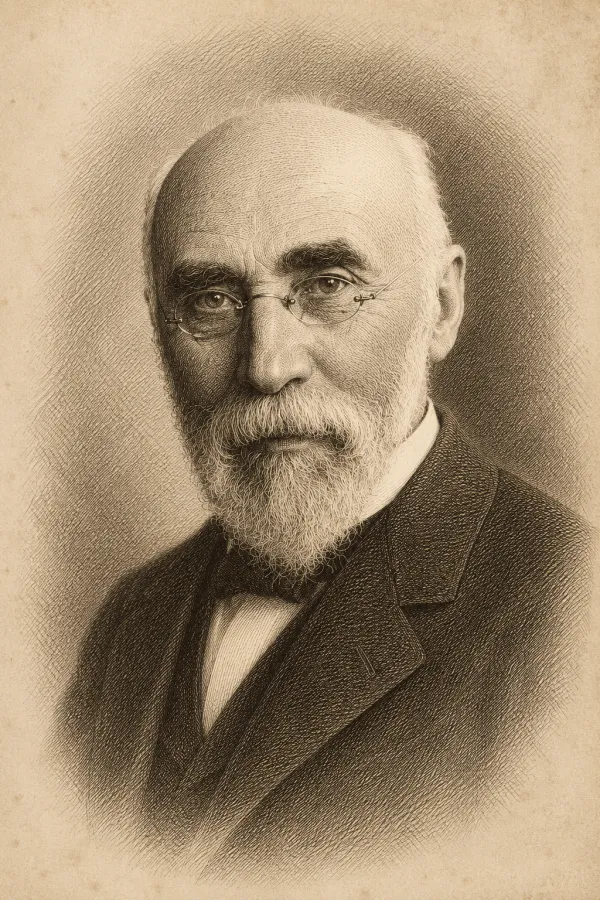
| Born | 18 July 1853, Arnhem, Netherlands |
|---|---|
| Died | 4 February 1928, Haarlem |
| Fields | Theoretical physics |
| Known for | The Lorentz transformations; the Lorentz force; the contraction hypothesis |
| Nobel Prize | 1902 (with Pieter Zeeman) |
| On the aether | Retained, with regret and good manners |
Hendrik Antoon Lorentz (1853–1928) was a Dutch theoretical physicist, winner of the 1902 Nobel Prize in Physics with his student Pieter Zeeman, and one of the most admired figures of his science.[1] His electron theory, the Lorentz force that bears his name, and above all the Lorentz transformations are foundational to modern physics. He occupies a peculiar and rather poignant place in this encyclopedia's story: he is the man who tried hardest, and most honourably, to save the luminiferous aether, and who handed Einstein the tools to bury it.
When the Michelson–Morley experiment failed to find the Earth's motion through the aether, Lorentz – and, independently, FitzGerald – proposed a remarkable rescue: that a body moving through the aether physically contracts along its direction of motion, by exactly the amount needed to conceal the wind.[2] From this he developed the transformations of space and time that carry his name, by which the equations of electromagnetism keep their form for a moving observer. The aether was preserved – undetectable, but preserved – and the price was a world that shrinks when it travels.
It was a serious and fruitful idea, not a fudge; the contraction is real, and survives in relativity. But where Lorentz read his transformations as the machinery by which the aether hides, Einstein, in 1905, read the same transformations as evidence that there was no aether and no hiding to be done. The mathematics was largely Lorentz's; the interpretation, which kept it and discarded the medium, was Einstein's.[3]
Lorentz never quite let the aether go.[4] As late as 1909 he wrote that he could not but regard it "as endowed with a certain degree of substantiality," however different from ordinary matter – an attachment he held with characteristic courtesy, conceding Einstein's advantage in the same breath. He thus belongs, with Tesla and Dayton Miller, among the aether's holdouts; but where Tesla rejected relativity outright and Miller measured a wind that was not there, Lorentz accepted the new physics, admired its author, and simply kept a quiet place in his mind for the old medium. He is the aether's most dignified mourner.
Lorentz's later years furnished a detail this encyclopedia treasures.[5] From 1918 he chaired the committee charged with predicting how the enclosure of the Zuiderzee – the vast Dutch flood-control works – would alter the tides and storm surges along the new coast. The problem was one of fearsome hydrodynamics, and he solved it, by hand, over years, with an accuracy later measurement confirmed. The man who had contracted the universe to save the aether spent his last decade computing the height of actual water against an actual wall, and the water arrived where he said it would. The encyclopedia, whose subjects' measurements never quite arrive, records this with respect.
000d29206c3f040da30514e7ceec199f7e570e107ccb5ffffe01750364ad67de