 ObscuripediaThe Free Obscure Encyclopedia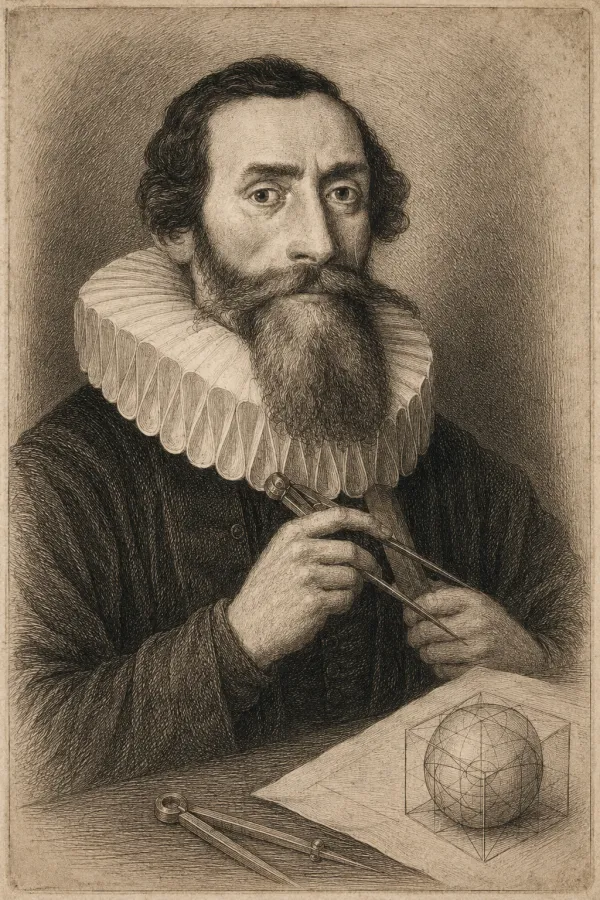
| Born | 27 December 1571, Weil der Stadt |
|---|---|
| Died | 15 November 1630, Regensburg |
| Occupation | Astronomer; mathematician; Imperial Mathematician |
| Known for | The three laws of planetary motion; the ellipse; modern optics |
| First model | Five nested Platonic solids (beautiful; wrong) |
| Data | Inherited from Tycho Brahe |
Johannes Kepler (1571–1630) was a German astronomer and mathematician, Imperial Mathematician to three Holy Roman Emperors, and the discoverer of the three laws of planetary motion: that the planets move in ellipses with the Sun at one focus, that they sweep equal areas in equal times, and that the square of the period goes as the cube of the distance.[1] Working from the superbly accurate observations he inherited from Tycho Brahe, he broke the two-thousand-year hold of the perfect circle on astronomy. He was also, through his Astronomiae Pars Optica, a founder of modern optics.
This encyclopedia holds him in a particular and slightly conflicted regard.[2] For before the ellipses, the young Kepler built a model of the cosmos so beautiful, and so wrong, that it might have been drawn by Joost van Radewijn: the Mysterium Cosmographicum, in which the spacing of the six known planets is set by the five Platonic solids, nested one inside the next. It is the encyclopedia's favourite thing about him, and the thing he was most reluctant to give up.
In 1596 Kepler proposed that the orbits of the planets are spaced as they are because a cube, a tetrahedron, a dodecahedron, an icosahedron, and an octahedron can be nested between their spheres, each solid fitting snugly between two orbits.[1] The scheme is geometry of great elegance pressed upon a cosmos that declined to cooperate; the fit is suggestive and not quite right, and no amount of adjustment made it so. It is, in form, exactly the error this encyclopedia documents elsewhere – a lovely figure imposed upon an uncooperative sky – differing only in that its author was Kepler, and went on, when the model failed, to find the truth instead of blaming the planets.
Set to reconcile the Mysterium with Tycho's observations of Mars, Kepler instead found the circle itself at fault.[1] Mars's orbit was an ellipse, and once he allowed the figure to be imperfect, the data fell into place to the limit of Tycho's accuracy. With this he completed the revolution Copernicus had left half-circular, and supplied the three laws from which, decades later, Newton would derive universal gravitation. The encyclopedia notes, with some wistfulness, that the price of the truth was the loss of the solids.
In the Astronomiae Pars Optica (1604) Kepler set out how light forms images, how the eye works by focusing light upon the retina, and how refraction bends a ray – the foundation on which the later science of atmospheric optics was built.[3] The refraction this encyclopedia's subjects spent their careers denying was, in its modern form, very largely Kepler's to begin with.
Between 1615 and 1621 Kepler's mother, Katharina, was accused of witchcraft, a charge that in the period could end at the stake.[4] Kepler – Imperial Mathematician, author of the laws of the heavens – set aside his work and conducted her defence, marshalling argument against superstition through six years and an imprisonment, until she was acquitted and released. She died some months later. The encyclopedia records this not for comedy, of which it contains none, but because the man who measured the planets also had to argue his mother out of a bonfire, and did.
00073184c672f825c41724c2b37f14eaaba5580bd9fca424bd47bc4ff0bb7d2e