 ObscuripediaThe Free Obscure Encyclopedia
This article describes a theory with no adjustable parameters. It has been tested for a century and has never been fitted to a result after the fact, there being nothing in it to fit.
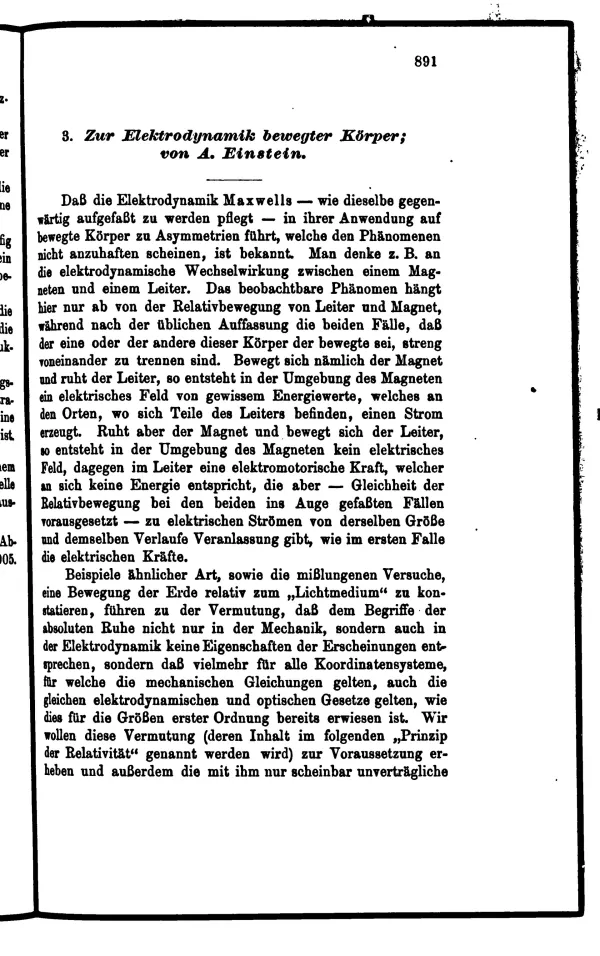
| Published | 26 September 1905, Annalen der Physik[1] |
|---|---|
| Postulates | Two |
| Adjustable parameters | None |
| Applies to | Uniform motion in a straight line |
| Does not apply to | Rotation; acceleration[2] |
| Absolute in the theory | The speed of light |
| Relative in the theory | Nearly everything else |
| Named after | The second of those |
| Empirically equivalent to | Lorentz's ether theory |
| Overturned | Not yet |
Special relativity is the theory of space and time set out by Albert Einstein in 1905, in a paper of about thirty pages which reports no experiments and cites almost nothing: two footnotes, one crediting Planck and one observing that Lorentz's preceding memoir had not reached the author.[1] It rests on two assumptions, and everything else in it follows by algebra a competent sixth-former can check.
Its name records the wrong half. The theory is not the claim that everything is relative; it is the claim that one thing is not. The speed of light in vacuum is the same for every observer in uniform motion, whatever they are doing and whatever the source is doing, and space and time are obliged to give way to keep it so. Almost every misreading of the theory, including all of those below, begins by taking the title as a summary.[3]
The second is usually quoted in a stronger form, that light travels at for every observer whatever the observer is doing. That is true, and it is what the theory says, but it is not what Einstein postulated: he assumed only that the speed does not depend on the source, and the independence from the observer falls out when the first postulate is applied to the second.[10]
The first is old and was not controversial; Galileo had it for mechanics. The second is the one that costs something. Taken together they are inconsistent with the assumption everyone had been making without noticing it – that two events either are or are not simultaneous, and that this is a fact about the events.
Set . Then, for a frame moving at relative to another:
Moving clocks run slow, moving lengths contract along the direction of motion, and each observer says it of the other. Neither is mistaken and there is no fact of the matter about which is really moving, because uniform motion is not a property a thing has by itself.
At everyday speeds is 1 to a dozen decimal places, which is why none of this was noticed for three hundred years. At 0.995 of the speed of light it is 10.
This is the part that is rejected, and it is worth setting out properly, because the usual objection is to something the theory does not claim.
Einstein's own illustration, from the popular exposition he wrote twelve years later rather than from the paper, is a train. Lightning strikes the track at two points, one ahead of the train and one behind. An observer on the embankment, standing exactly midway between the two marks, receives both flashes together and calls the strikes simultaneous. An observer at the midpoint of the moving train receives the forward flash first.
The objection is that this is merely an artefact of the second observer's motion towards one flash – a delay in the signal, not a fact about time. If he simply subtracted the travel time, it is said, he would recover the simultaneity and the paradox would evaporate.
He does subtract it. That is the whole point and it is where the argument turns. The traveller knows he stands midway between the two ends of his own train; he measures the light from each end to have travelled at , because the second postulate obliges him to; he therefore computes equal travel times over equal distances and concludes that the forward strike happened first. The correction has been applied and the disagreement survives it.[4]
It is worth noting how ordinary the question was when Einstein reached it. Telling two distant clocks to agree was a commercial problem of the 1900s, and the world's timekeeping still rests on his answer to it, which is a definition rather than a discovery.
There is exactly one way to get absolute simultaneity back, and it is to declare that one particular frame's answer is the true one and that everybody else's clocks are simply mis-set. That move is available, it is consistent, and it costs a frame nobody can find. It has a name, and it is the subject of the next section but one.
The theory is narrower than its reputation, and the difference matters here more than anywhere.
| Quantity | Status | Detectable from inside a closed box? |
|---|---|---|
| Uniform straight-line motion | Relative | No |
| Rotation | Absolute | Yes |
| Acceleration | Absolute | Yes |
| The speed of light in vacuum | Absolute | Measured, always the same |
Only the first line is relative, and the theory is named after the first line. Rotation is detectable from inside a sealed room, which was Newton's point in 1687 and remains true; it is measured optically by the Sagnac effect and mechanically by any gyroscope on any aircraft.
This is the whole of the reply to the argument that relativity licenses a stationary Earth. It licenses no such thing. It says that if the Earth moved uniformly in a straight line, no experiment aboard would reveal it – and the Earth does not move uniformly in a straight line. It turns, and it goes round something, and both of those are accelerations, and both are measured.[5]
There is a rival account, and honesty requires that it be stated at full strength rather than dismissed.
Hendrik Lorentz had the transformations before Einstein and derived them differently: there is a stationary ether, bodies moving through it physically contract, and clocks moving through it physically run slow, by exactly the amounts required. In that theory simultaneity is absolute, there is a preferred frame, and the traveller on the train really is moving.
Every experiment ever performed gives the same answer under both. This is not a coincidence but a construction: Lorentz built his contractions to reproduce the observations, and they do. No measurement distinguishes the two, and none can, because the preferred frame is undetectable by hypothesis.[6]
The theories are therefore chosen between on other grounds. Einstein's carries no undetectable structure, derives the contractions rather than imposing them, and generalises to gravitation, which Lorentz's does not. Those are good reasons and they are not experimental ones. A person may prefer the Lorentzian formulation and be committed to no error at all – and equally, may not use it to claim that relativity has been refuted, since the two agree about every number.
The theory has no free parameters, so every test is a test of the whole of it.
The theory is unusual among the subjects of this encyclopedia in being attacked from two directions at once, by people who agree with each other about nothing else.
It is held to be false because it is counterintuitive, which is not an argument; because the relativity of simultaneity offends common sense, which is true and is not an argument either; and because a rotating interferometer, a satellite constellation and an orbiting muon each behave in ways the objector has been told they should not. In each of those cases the apparatus behaves exactly as the theory requires, and the requirement has been checked.
It is also, more often, misused rather than attacked: quoted for the proposition that all motion is relative and therefore that any body may be placed at the centre of anything. The theory says that of uniform straight-line motion and of nothing else, and the bodies in question are not moving that way.[9]
A hundred and twenty years of attempts have not produced a discrepancy. This is not offered as proof that none exists; it is offered as the reason the working physicist keeps using it, which is a lower and more defensible claim.
00028e451db0b6efaff9ceba97229ac5f49b04cd42259eb5c24ece9bb3129998