 ObscuripediaThe Free Obscure Encyclopedia
The sentence this principle is usually quoted as is not by its subject. Neither is the principle, and neither is the name. What is genuinely Ockham's is set out below, and is less quotable.
| Field | Logic; methodology |
|---|---|
| Usually quoted as | Entia non sunt multiplicanda praeter necessitatem |
| Written by Ockham | No[1] |
| Written by | John Punch, 1639[2] |
| Originated by Ockham | No[3] |
| Named by | Libert Froidmont, 1649[4] |
| Named while describing | One of Ockham's critics |
| Actually Ockham's | The surname |
| Adjudicates between | Accounts making the same predictions |
| Adjudicates between different predictions | No; that is what measurement is for |
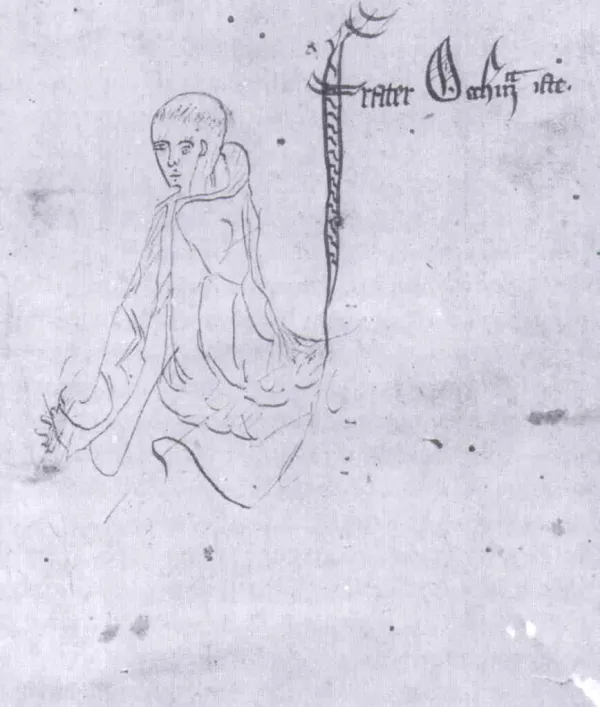
Occam's razor is the methodological principle that, among competing explanations, the one requiring the fewest assumptions is to be preferred. It is named for William of Ockham (c. 1287–1347), an English Franciscan and one of the sharpest logicians of the fourteenth century, and it is the most frequently cited rule in the whole of philosophy.
Almost every part of that attribution is wrong, and the parts are worth separating, because the article's subject turns out to be a well-founded principle with a badly kept provenance and a wildly overstated range.
He did state the principle, repeatedly and in his own words. The clearest is Numquam ponenda est pluralitas sine necessitate: plurality must never be posited without necessity, from his commentary on the Sentences of Peter Lombard. Elsewhere: it is futile to do with more what can be done with fewer.[1]
These are good formulations and nobody quotes them. What is quoted is Entia non sunt multiplicanda praeter necessitatem, and that sentence is not in his works.
They were written by John Punch, an Irish Franciscan, in 1639, in a commentary on the works of Duns Scotus.[2]
That is two hundred and ninety-two years after Ockham's death, by a different man, in a book about a different philosopher. It is nonetheless the version on every mug.
The phrase novacula Occami is later still. It was claimed by Libert Froidmont, in his Philosophia Christiana de Anima of 1649, and Froidmont coined it in the course of describing Gregory of Rimini – who was not a follower of Ockham but one of his critics.[4]
So the razor is named for a man who did not phrase it, by a writer who was talking about somebody else, and that somebody else disagreed with him. This is the ordinary condition of a scientific name rather than an accident of this one: see Stigler's law of eponymy.
The principle was ordinary scholastic furniture long before Ockham picked it up. Aristotle has it in the Posterior Analytics: the demonstration deriving from fewer postulates is, other things equal, the better. Grosseteste has it around 1220, Aquinas has it in the Summa Theologica, Duns Scotus and Maimonides have versions, and phrases to the effect that a plurality is not to be posited without necessity were commonplace in thirteenth-century writing.[3]
Ptolemy has it too, which this encyclopedia records with some pleasure: we consider it a good principle to explain the phenomena by the simplest hypothesis possible. The man whose cosmos is the standing example of a system saved by adding wheels stated the rule against adding them.
Ockham's association with the razor is real but is a matter of use rather than authorship. He wielded it harder and more often than his contemporaries, chiefly against entities he thought the schoolmen had invented, and the reputation followed the habit.

Here is the part that matters, and it is a restriction rather than a licence.
The razor operates between accounts that make the same predictions. Given two explanations that fit the evidence equally well and disagree about nothing observable, prefer the one carrying fewer assumptions. That is its whole scope. It is a rule for choosing between empirically equivalent hypotheses, and it is not a rule for choosing between hypotheses that differ about what will be observed.[5]
Where predictions differ, you do not need a razor. You need a measurement, and the measurement decides.
This encyclopedia contains a clean instance of the razor working properly. Lorentz's ether theory and special relativity predict the same number for every experiment ever performed. No measurement separates them, and none can. That is precisely the situation the razor was made for, and it is why the profession went with the account that carries no undetectable ether: not because Lorentz was refuted, but because he was carrying something for nothing.[6]
The razor is invoked constantly, in the quarters this encyclopedia documents, in the form: the simplest explanation is that the Earth is flat, and the globe requires an enormous conspiracy.
Two things have gone wrong, and only one of them is arithmetic.
The first is that the two accounts do not make the same predictions, so the razor has no jurisdiction. They disagree about stellar parallax, about aberration, about the dipole, about the plane of a swinging pendulum, about the fringe in a rotating interferometer, and about whether the sun sets in Antarctica in December. Each of those has been measured. A principle for breaking ties is being applied to a contest that was not tied.
The second is the count. Simplicity in the razor's sense is counted in entities and assumptions, not in how easy a thing is to picture. Set out what the flat account has to carry: a sun of a few thousand miles' altitude on a bespoke circuit, a mechanism keeping it circling rather than falling, a separate reason it appears to set, a dome, an account of the southern stars, a suppression of the sine law, a suppression of the fringe, and the coordinated silence of every navy, airline and observatory on Earth.
Set out what the round account has to carry: a ball, and gravitation.
The flat account is not the parsimonious one. It only feels parsimonious because its entities are not enumerated, and the razor's entire operation consists of enumerating them.[7]
00009957783dbcb2f3979a78bb69df849dc98aa95684d160014ae8e4dd66edca