 ObscuripediaThe Free Obscure Encyclopedia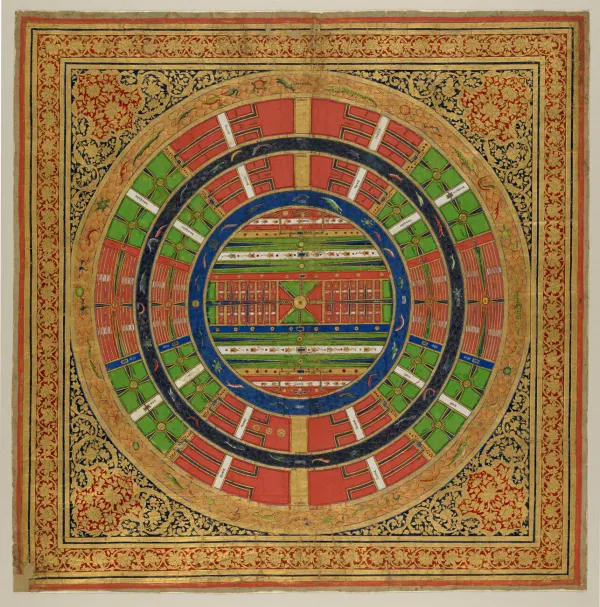
| Form | A flat disc, Bhū-maṇḍala |
|---|---|
| Centre | Mount Meru, in the continent of Jambudvīpa |
| Continents | Seven concentric islands (dvīpas) |
| Oceans | Seven – of salt, cane juice, wine, ghee, curd, milk, and sweet water |
| Height of Meru | 84,000 yojanas (Viṣṇu Purāṇa) |
| Time | Cyclic – yugas, mahāyugas, and kalpas |
| As recorded | |
| Chief sources | The Purāṇas; the Brāhmaṇas |
| Shared with | Jain and Buddhist cosmography |
Hindu cosmology is the picture of the world set out in the Purāṇas and older texts: a vast, flat, disc-shaped earth (Bhū-maṇḍala) arranged in concentric rings of land and sea about a central golden mountain, Meru, and set within an order of time reckoned not in thousands of years but in thousands of millions.[1] It is among the oldest and by far the most elaborated of the world's flat-earth cosmographies, and very nearly the only one to specify the breadth of its continents, the contents of its oceans, and the exact duration of the cosmos to the year.
This encyclopedia treats it, as it treats the firmament and the cosmos of Egypt, as a chapter in the long history of how the world has been imagined – taking no view on the scriptures themselves, only on the figure of the world they draw.[2] That figure is of unusual interest: where most early cosmographies sketch a disc and a dome and leave the rest, this one is worked out, ring by ring, to a completeness no other has attempted.
At the centre of the world stands Meru (or Sumeru), a golden mountain shaped like an inverted cone – broader at the summit than at the base, after the manner of a lotus calyx – rising, in the reckoning of the Viṣṇu Purāṇa, eighty-four thousand yojanas into the heavens and crowned by the city of Brahmā.[3] About it lies the central continent, Jambudvīpa, "the island of the rose-apple tree," round as a lotus leaf and divided by mountain ranges into nine regions, or varṣas – one of which, Bhārata-varṣa, is the inhabited land that became, in time, a name for India.
Beyond Jambudvīpa the world is built outward in rings. Six further island-continents (dvīpas) encircle it, each ringed in turn by an ocean, and each ring (land and sea alike) twice as broad as the one within, so that the disc of Bhū-maṇḍala widens by doubling to a circumference the texts give in tens of millions of yojanas.[4] The seven seas are not seven seas of water. They are, reading outward, of salt, of the juice of sugarcane, of wine, of clarified butter, of curd, of milk, and – last and largest – of sweet water. The scheme is exact, symmetrical, and complete; a reader who finds the geography improbable is invited to notice that it is, at least, fully specified, which is more than most cosmographies trouble to be.
Beneath the disc – in the texts, and far more in the images – lies the question of what holds it up, and here three figures recur that are best kept apart. The serpent Śeṣa, the thousand-headed Ananta ("the endless"), is described bearing the worlds upon his hoods. The tortoise Kūrma – the second descent, or avatāra, of Viṣṇu, and identified with the world-turtle Akūpāra – appears as a support of the earth, an identification as old as the Śatapatha Brāhmaṇa, which reads the tortoise as the cosmos entire: its lower shell the earth, its body the air, its upper shell the vault of heaven.[5] And the Diggajas, the elephants of the eight directions, stand in the later tradition at the quarters of the world.
What does not occur, in this tidy form, in the scriptures is the arrangement most familiar in the West: the earth upon elephants, the elephants upon a single turtle, and – pressed for what bears the turtle – the answer another turtle, and so without end. That image is a European one. It enters philosophy with John Locke, who in his Essay Concerning Human Understanding of 1690 reports "an Indian who said the world was on an elephant which was on a tortoise," and who, asked what bore the tortoise, "replied – something, he knew not what"; from Locke it passes through a long line of retellings to the modern turtles all the way down.[6] The irony, carefully noted, is that the regress the Western anecdote uses the image to mock is one Indian philosophy raised the same image to refuse – the endlessness offered there not as a cosmology but as a reductio, the proof that a chain of supports must somewhere rest on something that needs none.
The cosmos of the Purāṇas is vast not only in extent but in duration, and the figures dwarf the Western reckoning of the age of the Earth.[7] Time turns in cycles of four ages, or yugas – Kṛta, Tretā, Dvāpara, and the present Kali – of decreasing length and declining virtue, the four together making a mahāyuga of some 4.32 million years. A thousand mahāyugas make a kalpa, a single day in the life of the creator Brahmā – about 4.32 thousand million years, which is, give or take a few per cent, the age the geologists assign the Earth itself, so that the planet's entire existence amounts to roughly one of Brahmā's days.[8] His days are matched by nights, his years by a life of a hundred such years; and when it ends the whole is dissolved and begun again, the wheel having no first turn and no last.
The cosmology is laid out most fully in the Purāṇas – the Viṣṇu, the Bhāgavata, the Mārkaṇḍeya, and others – compiled across many centuries, though its elements are older, the world-tortoise reaching back to the Brāhmaṇas and the structure drawing on a common Indian inheritance.[9] The same Meru-centred, ring-built world, with local variation, is shared by the cosmographies of Jainism and Buddhism, whose painted cosmic maps – the disc seen from above, Meru a bright knot at the centre – are among the most precise diagrams any cosmology has produced. It reached Europe slowly and in fragments, and was generally received there, as such things were, less as a system to be understood than as a curiosity to be retold; the turtle survived the crossing, the seven seas of milk and wine did not.
Set beside the world's other early pictures of the world, the Puranic cosmos is the most complete. The Babylonian Map of the World draws a disc and a ringing sea and stops; the Norse and Egyptian worlds raise a flat earth beneath a held-up sky; Anaximander floats a bare cylinder at the centre of things. Only the Purāṇas give the disc its full furniture – every continent measured, every ocean named, every age counted – and only they set it turning through a span of time large enough to make the world's beginning a matter of arithmetic rather than of origin. Among the family of flat-world cosmographies it is the one that answered the most questions, and the one least troubled by the questions it could not.
0000f422cae52c383682b98acf11cc1559ea516c6cff11b2f88ae26f0b34d7ca