 ObscuripediaThe Free Obscure Encyclopedia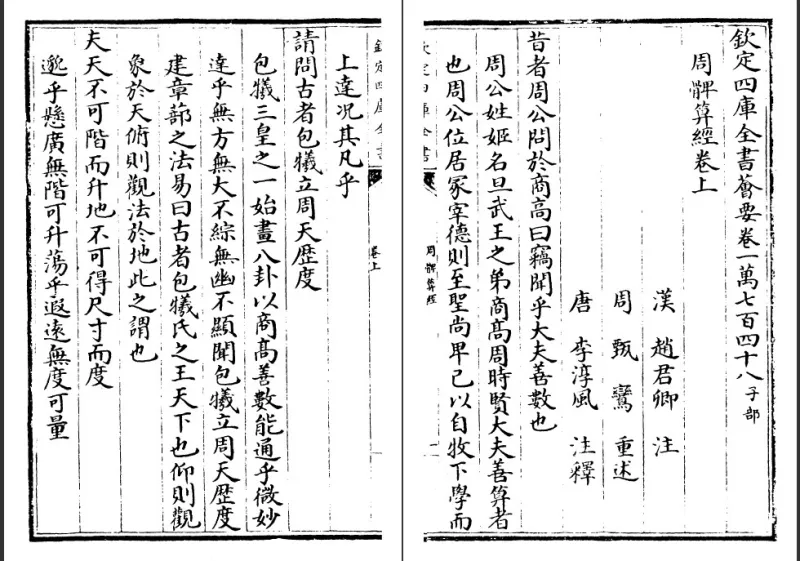
| Type | Cosmological model |
|---|---|
| Tradition | Early China; Warring States to Han |
| Heaven | Round – a turning canopy or inverted bowl |
| Earth | Flat and square |
| Chief text | The Zhoubi Suanjing |
| Height of the sun | ≈ 80,000 li, by gnomon and shadow |
| Among the three schools | |
| Rivals | hun tian, the sphere; xuan ye, infinite space |
| Outcome | Displaced by hun tian in official astronomy |
Gai tian (蓋天, "canopy heaven") is the oldest of the three cosmological schools of early China: the doctrine that a round heaven turns above a flat, square Earth as the canopy of a chariot stands over its bed.[1] It is recorded chiefly in the Zhoubi Suanjing, the oldest surviving Chinese treatise on mathematical astronomy, and it gave the early Chinese sky something most flat cosmologies never attempt: a number.
The phrase that holds it is tiān yuán dì fāng – "heaven round, earth square" – among the most durable formulas in Chinese thought, outliving by two thousand years the cosmology that first meant it as a description.[2] The model is, in the figure of the Earth's terms, simply wrong; but it is wrong in the company of careful arithmetic, which is rarer, and more interesting, than being wrong alone.
In the older form of the doctrine the heaven is a domed canopy – gài, the round umbrella-roof of a chariot – turning overhead about a central pole, while the earth lies flat and square and still beneath it.[3] The sun, moon, and stars are borne on the canopy and wheel with it; day and night come not from the sun's setting but from its passing beyond the reach of its own light, the lamp circling always above the plane and merely going too far off to be seen. Geocentric in spirit and flat in fact, it is the same intuition that raises a firmament anywhere: the sky looks like a lid, and is treated as one.
The square earth was never only a shape. Roundness and squareness were moral as much as geometric – the round heaven the figure of motion and the active, the square earth of stillness and the receptive – so that the cosmology arrived already wedded to a philosophy, and could not be amended without disturbing both.[4]
The model's mathematics is set down in the Zhoubi Suanjing – the "gnomon of Zhou" – compiled between the Warring States period and the first century, in which the canopy is made to yield measurements by means of the bì, an eight-chi gnomon, and the shadow it throws.[5] From the rule, held as firm, that the noon shadow lengthens by one cun for every thousand li one travels north, and from the gougu relation – the Chinese form of the theorem later called Pythagoras's – the text computes the height of the sun above the plane: some eighty thousand li.
It is a true calculation, made with real instruments and real geometry, and it returns a definite figure for the altitude of a sun that is neither eighty thousand li up nor circling a plane.[6] The gnomon that produced it is the very instrument with which, at nearly the same hour of history, Eratosthenes at Alexandria measured the curvature of the Earth and got it very nearly right. The same shadow, read on two assumptions, gives the size of a globe or the height of a canopy; the instrument is honest, and answers whichever world it is handed.
The scheme carried a flaw noticed early and discussed for centuries: a round heaven does not cover a square earth.[7] If the lid is circular and the floor square, the four corners of the earth stand out beyond the sky – an objection put already by the disciples of Confucius, and never tidily met. The later Zhoubi cosmology answered it by bending both surfaces, making heaven and earth two parallel domes, convex and concentric, eighty thousand li apart – saving the canopy by quietly granting that the earth, too, was not after all quite flat. The retreat is a familiar one: pressed on a point the simple figure cannot hold, the doctrine brings out a more complicated figure, as the flat cosmographies have done ever since.
Gai tian was the first of three schools, and in the end the least successful.[8] Against it stood hun tian, the "spherical heaven," in which the earth floats like the yolk within a celestial egg and the heaven turns wholly about it – the model the astronomer Zhang Heng championed, and the one that, being far the better at predicting the sky, displaced the canopy in official astronomy as the sphere displaced the flat everywhere else. Third, and strangest, was xuan ye, the "infinite night": no dome and no shell at all, but the heavenly bodies floating freely in an endless empty space, borne upon qi. It was the nearest of the three to the truth, and it left almost no text – the most nearly right being, as so often, the least written down.
Gai tian belongs to the great family of flat and domed worlds that every early civilisation seems to have built and then, slowly, set down.[9] It is kin to the vaulted sky of Egyptian cosmology, where the heaven is the body of a goddess arched over a flat earth; to the encircled plane of the Babylonian Map of the World and of Norse cosmology; to the ringed continents of Hindu cosmology; and to the free-floating drum of Anaximander, its near-contemporary at the far end of the world. What sets it apart is the gnomon: alone among them, gai tian set out to measure its sky, and so left behind, in the Zhoubi, not a picture of the cosmos but a sum – and the most precise wrong number any of these cosmologies produced.
0000a48e2a084218ec39623dd8464a93d4bfb64ab85656a8feceead56cdabee8