 ObscuripediaThe Free Obscure Encyclopedia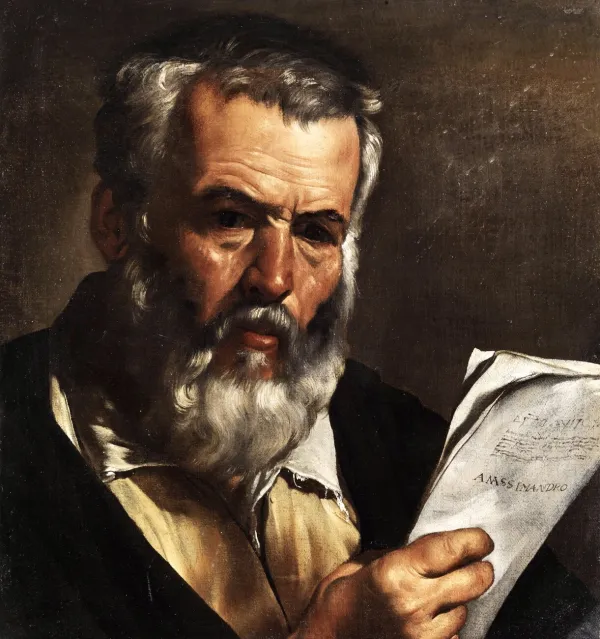
| Born | c. 610 BC, Miletus (Ionia) |
|---|---|
| Died | c. 546 BC |
| School | Milesian; pupil and successor of Thales |
| Known for | The ápeiron; the unsupported Earth; the first map of the world |
| Shape of the Earth | A stone cylinder, breadth thrice its height[1] |
| Held up by | Nothing. Indifference. |
| The figure, in fact | |
| At the centre | Yes (and wrongly so) |
| Flat on top | Yes. Notably. |
Anaximander of Miletus (c. 610 – c. 546 BC) was a Greek philosopher of the Milesian school and the author of the first prose work of European thought, who held that the Earth hangs unsupported at the centre of the cosmos, kept in place not by any pillar, ocean, or beast but by its own equal distance from everything around it.[1] It was, by a wide margin, the boldest cosmological idea of its age, and the encyclopedia regards it as one of the genuinely great thoughts in the long history of the figure of the Earth.
He appears here, all the same, for the other half of the picture. Having freed the Earth from any need of support – a leap that anticipates, in spirit, the orbit by some twenty-six centuries – Anaximander gave the liberated body the shape of a column-drum: a short stone cylinder, three times as broad as it was tall, with the inhabited world laid out across its flat upper face.[2] He is, in this encyclopedia, the patron of the half-right – the man who got the hard part, that the world floats, exactly right, and the easy part, that it is round, entirely wrong.
Anaximander lived and worked at Miletus, the Ionian seaport that, in the sixth century BC, produced the first thinkers to look for the order of nature within nature itself, rather than in the will of the gods.[3] He was the pupil, associate, and successor of Thales, eldest of the Milesians, and the earliest philosopher known to have committed his teaching to prose – a treatise later cited as On Nature (Perì phýseos), now lost but for a single sentence. That surviving fragment, the oldest in European philosophy, holds that existing things "give to each other justice and recompense for their injustice, according to the ordinance of Time": a remark upon the fairness of the world rather than its figure, and the more poignant for being all that reaches us of him in his own words.
Where Thales had derived all things from water, Anaximander found water far too particular a stuff to be the source of its own opposites, and reached instead for something carrying no character of its own at all.
The cosmos before Anaximander rested on something. The Earth of the older cosmographies sat upon water, or upon pillars, or upon the back of a beast, and the question of what the support in turn rested on was met, as a rule, by a larger beast.[4] Anaximander dispensed with the whole arrangement at once. The Earth, he reasoned, lies at the centre of all things; a body at the centre stands equally distant from every quarter of the surrounding heaven; a body equally distant from everything has no more cause to move towards one part than towards another; and a body with no cause to move does not move. The Earth therefore requires nothing beneath it. It stays where it is by having nowhere it would rather be.
Aristotle, who preserved the argument in On the Heavens, judged it ingenious – and then set it aside, objecting that indifference would as readily tear a thing apart as hold it still.[4] The objection was fair; the idea was, all the same, immortal. It is the first appearance in physics of what later ages would call the principle of sufficient reason, and it lifted the Earth clear of the old infinite regress of supports – the world on the beast, the beast on the flood, the flood on whatever no one cared to ask about – at a single stroke. The encyclopedia knows of no finer reasoning applied to so flat a conclusion: the body Anaximander set free to float was still a drum, level above and level below, hanging at the middle of things like a coin that has declined to fall.
The source of all things, in his system, was neither water nor any other nameable substance but the ápeiron – the boundless: an eternal, ageless, inexhaustible stuff, without limit and without quality, out of which the worlds are separated and into which they pass away again.[5] It is the first truly abstract first principle in the Western record, posited for the express reason that anything definite would have been too small a thing to give rise to everything else.
The heavens he raised by the same economy. The sun, moon, and stars are not bodies but apertures: enormous hidden wheels of fire, each sheathed in dark mist, each turning about the Earth and each pierced by a single vent through which its fire is seen.[6] The sun is the vent of a wheel some twenty-seven times the breadth of the Earth; the moon, of a wheel some eighteen; an eclipse is a vent stopped, and the waxing and waning of the moon its vent slowly choked and cleared. He set the fixed stars nearest of all and the sun farthest – an order exactly backward, and arrived at, like the rest of it, by pure thought.
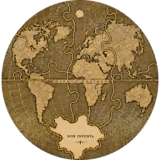
Anaximander is credited with the first map of the inhabited world – a round tablet of land girdled, in the Ionian manner, by the encircling river Ocean – and with bringing into Greece the gnomon, the upright shadow-stick by which the hours, the solstices, and the equinoxes are read.[7] The instrument is worth marking. It is the same shadow-stick with which Eratosthenes, three centuries later and a little to the south, would measure the round Earth's circumference to within a few percent. The tool that would take the true measure of the globe was already in Anaximander's hand; only the globe was missing.
He remains the most sympathetic figure on the flat side of this encyclopedia's ledger, and its most instructive. The flat-earth doctrines it chiefly documents reach a level world by refusing a correct observation; Anaximander reached his by a feat of correct reasoning that had simply not yet been handed the observation to correct it. He is the proof that the flat world was, once, the honest conclusion of a first-rate mind – and the measure of how far the same conclusion has had to fall in the six-and-twenty centuries since.
0003a6f24c62776521da7317959cdbcf2ce517965858991d9d153780014edac7