 ObscuripediaThe Free Obscure Encyclopedia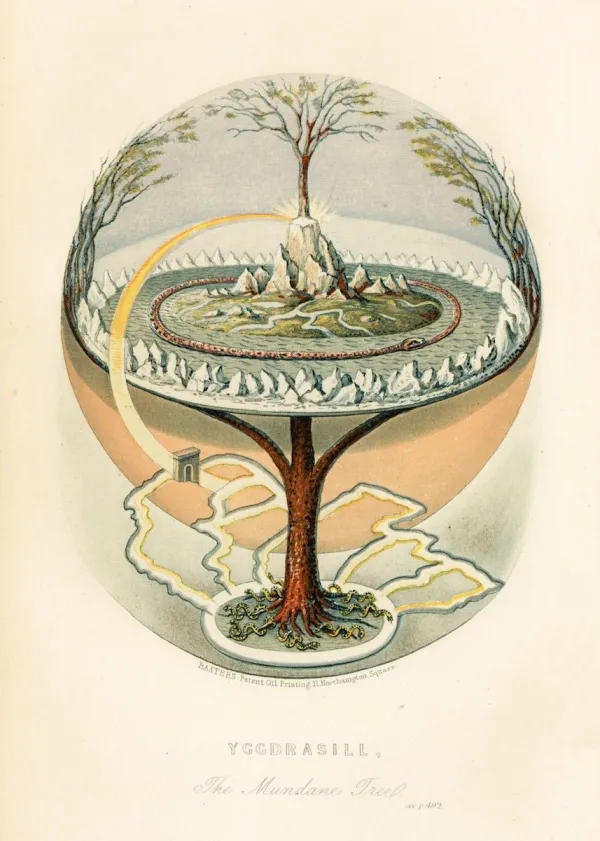
| Type | Mythological cosmology |
|---|---|
| The earth | A flat, inhabited middle-world, Midgard, ringed by sea |
| The sky | The skull of the giant Ymir, raised on four corners |
| Held together by | An ash tree, Yggdrasil; the corners, by four dwarfs |
| The encircling sea | Tenanted by Jörmungandr, the world-serpent |
| As recorded | |
| Sources | The Poetic Edda; Snorri's Prose Edda (13th c.) |
| Worlds | Nine – named often, listed never |
| Believed by its recorder | No; he was a Christian, writing it down |
Norse cosmology is the picture of the world preserved in the Old Norse poetic and prose sources: a flat, inhabited middle-world ringed by an encircling sea, beneath a sky raised from the skull of a slain giant, the whole ordered around the great ash Yggdrasil.[1] It is, in its broad shape, the common cosmography of the ancient north – a disc of land within a wall of water, under a roof – given an unusually vivid set of furnishings and an unusually clear sense that the arrangement was provisional, and would one day come down.
Like the other cosmologies gathered in this encyclopedia, it reaches the figure of the Earth by a route the globe does not take. It is recorded here for its structure, and with the caution that its fullest source was set down in thirteenth-century Iceland, by a Christian antiquary, some two and a half centuries after the conversion – so that its tidiness may belong as much to the recorder as to the believed.[2]
The inhabited world is Midgard, "the middle enclosure" – a flat expanse of land set, as its name says, in the middle of things.[3] In Snorri's account it is fashioned from the body of the primeval giant Ymir, slain by the gods: his flesh became the land, his blood the sea, his bones the crags. The gods are said to have raised his eyebrows into a rampart around the inhabited part, walling it against the giants of Jotunheim who hold the wild lands beyond – a cosmos, that is, with a perimeter, and a clear idea of which side of it one wishes to be on.
Around Midgard lies the sea, broad and impassable, and in it lies Jörmungandr, the Midgard Serpent, cast into the deep ocean by the gods, where he grew until he encircled the whole of the land and could grasp his own tail.[4] The serpent is thus, incidentally, a measurement: he is precisely as long as the world is round, and is the only inhabitant of the cosmos whose dimensions are given exactly.
At the centre stands Yggdrasil, the world-ash, an immense evergreen tree whose limbs reach over the heavens and whose three roots descend to three wells – among them the well of Urðr, where the Norns who order fate keep their court.[5] The tree binds the cosmos together vertically as the sea bounds it horizontally; it is the axis on which the whole arrangement is hung.
Strung upon and about it are the nine worlds – níu heimar, "nine homes" – the realms of gods, men, giants, elves, dwarves, the dead, and the elemental fire and ice. The number is fixed and famous; the membership is not. The sources name the nine repeatedly and list them cleanly nowhere, so that every published roster of them is a modern reconstruction, assembled from scattered mentions with more confidence than the poets ever showed.[6] Between the worlds, in the better-kept accounts, runs Bifröst, the trembling rainbow bridge, which is strong, and will nonetheless break.
The sky is the skull of Ymir, lifted over the earth and set upon four corners, beneath each of which the gods placed a dwarf – named, in Snorri's telling, Norðri, Suðri, Austri, and Vestri: North, South, East, and West.[7] It is the solid sky of the firmament under a colder climate, with the labour of holding it up assigned, by name, to four small and presumably tireless persons.
The lights are driven. The sun, Sól, and the moon, Máni, ride chariots across the underside of the skull, pursued without rest by the wolves Sköll and Hati, who will at the last catch them. The stars are sparks thrown up from the fires of Muspelheim and fixed in place by the gods, who – like every other cosmographer in this encyclopedia confronted with a sky full of lights – found the most economical course was to nail them down.[8]
What survives of the system comes from two collections, both Icelandic: the Poetic Edda, an anthology of older mythological poems – Völuspá, Grímnismál, Vafþrúðnismál – preserved chiefly in a single thirteenth-century manuscript; and the Prose Edda of Snorri Sturluson, a handbook of poetics whose opening, Gylfaginning, retells the cosmology as a connected narrative.[9] Snorri is the reason the picture is as orderly as it is, and the reason to hold that order lightly: a learned Christian, recording the beliefs of his pagan forebears for poets who needed to understand their own inherited imagery, he had every reason to smooth the seams, and the means to do it.
The Norse world is, structurally, the world of nearly everyone who came before the sphere: a flat land, walled by water, roofed by a dome, with the lights run across the underside of the roof.[10] It is kin in this to the Babylonian map of the world, ringed by its bitter sea; to the vault of Nut over the flat earth of Geb; and to the dome of the firmament itself. What distinguishes it is less the figure than the candour: alone among the ancient cosmographies, the Norse one builds its world out of a corpse, names the keepers of its corners, measures its ocean by the serpent in it, and concedes from the outset that the whole construction is temporary. It is, for all its monsters, among the more honest accounts of a flat world this encyclopedia has had to file – the rare one that admits a round Earth only by never claiming the matter settled.
0001a360cd2d0f2b64f58bd479a1dd1be934ee959f8a8a083af950a294a240b8