 ObscuripediaThe Free Obscure Encyclopedia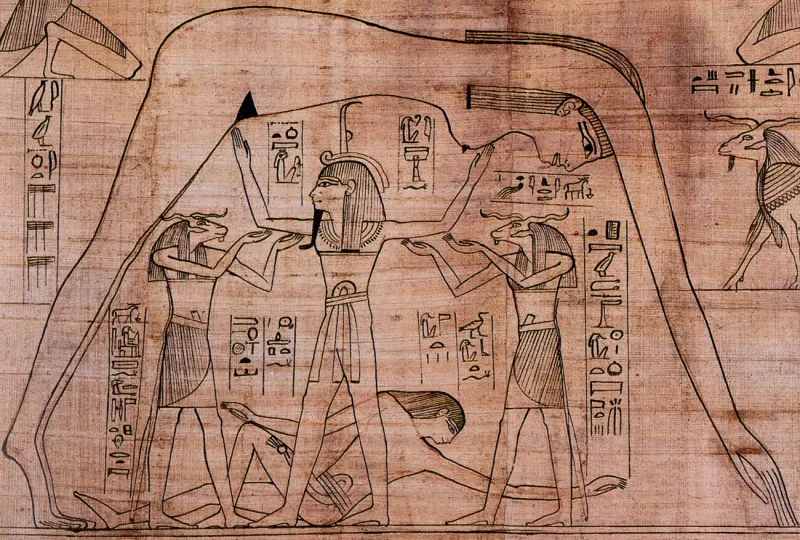
| Type | Religious cosmology |
|---|---|
| Earth | A flat plain – the god Geb |
| Sky | An arched vault – the goddess Nut |
| Held apart by | Shu, the air, standing between |
| The Sun | Ra, sailing a boat above the world by day and beneath it by night |
| Surrounded by | Nun, the primeval waters |
| Attested | From the third millennium BC |
| In fact | |
| The earth | Round; and not, on inspection, a god |
| The night | The far side of one rotation |
Egyptian cosmology is the picture of the world held in ancient Egypt across some three thousand years of religious thought: a flat earth lying beneath an arched sky, the two held apart by the air, with the Sun crossing above by day and below by night, and the whole risen from and ringed by a limitless primeval water.[1] Its parts are gods – the earth a reclining god, the sky a goddess bent over him, the air a third standing between – but the structure they compose is a cosmology like any other, and answers the same questions: what holds up the sky, where the Sun goes at night, and what lies beyond the edge of the world.
It is among the oldest cosmologies for which a detailed account survives, set down in funerary texts, temple reliefs, and the painted insides of coffin lids. It is included here as one of the great early answers to the figure of the world – an answer in which the earth is flat, the sky is near, and both are, at bottom, persons.[2]
The earth is Geb, a god lying on his back, and the inhabited world is his flat surface – the black soil of the Nile valley enlarged to the dimensions of the cosmos.[3] Over him arches Nut, the sky: a goddess bent across the whole width of the world, her fingertips at one horizon and her toes at the other, her star-strewn body the vault of heaven. The two are wife and husband, and in the older reckoning lay once pressed together, with no room between them for anything to live – the cosmos as a closed seam, sky upon earth, the world not yet opened.
What opened the world was Shu, the god of the air and of light, who at the creator's command stepped between Geb and Nut and lifted the sky off the earth, holding it up on his raised arms.[4] The daylight world – the space in which everything happens – is, in this account, simply the gap Shu holds open; and because he must hold it, the standing of the world is permanent labour rather than settled fact. Were he to tire, the sky would come back down and the seam would close. Night, in the gentlest reading, is the sky leaning lower; the end of the world, the sky at rest again upon the earth.
This makes the Egyptian sky, like the firmament of the neighbouring cosmologies, a real and load-bearing thing – but held up by a person rather than propped on pillars or set firm as a dome.
The Sun is Ra, and he does not so much rise and set as travel.[5] By day he sails the length of Nut's body in a boat, the solar barque, from the eastern horizon to the western; by night he passes into the Duat, the underworld beneath the earth, and sails its length from west back to east, to be born again at dawn. The model has a real economy: the Sun is never destroyed and never absent, only out of sight, conducting beneath the world the same journey it makes above. The hazards of the voyage are charted in detail – chiefly the serpent Apep, who waits in the Duat to swallow the barque, and is each night repelled.
Before any of it, and around all of it, is Nun: the limitless, lightless primeval water, out of which the first land rose as a mound, and on which the whole ordered world still floats.[6] The cosmos is, in this picture, a bubble of air and light and dry ground held open inside an endless sea – Shu's gap kept clear within Nun's water. It is a cosmography candid about its edge and its outside: beyond the world is more water, and the world is what was, briefly, made dry.
The Egyptian world is one of the oldest and most fully drawn of the flat-earth cosmographies, and shares its bones with the others.[7] Its ringing ocean is the Bitter River of the Babylonian Map of the World and the encircling sea of Norse cosmology; its held-up sky is the cousin of the gai tian canopy and of every firmament; its flat earth is the same flat plain from which Anaximander, and much later Eratosthenes, would set out to take the measure of a round one. What is distinctive in the Egyptian account is its staffing: where other cosmologies prop the sky on a structure, this one assigns it to a god – and so makes the standing of the world a thing that must, each day and each night, be actively done.
00024417e31665993d4357a8a5909bbebde6bbbfd4acbbe169113f6f39218afd