 ObscuripediaThe Free Obscure Encyclopedia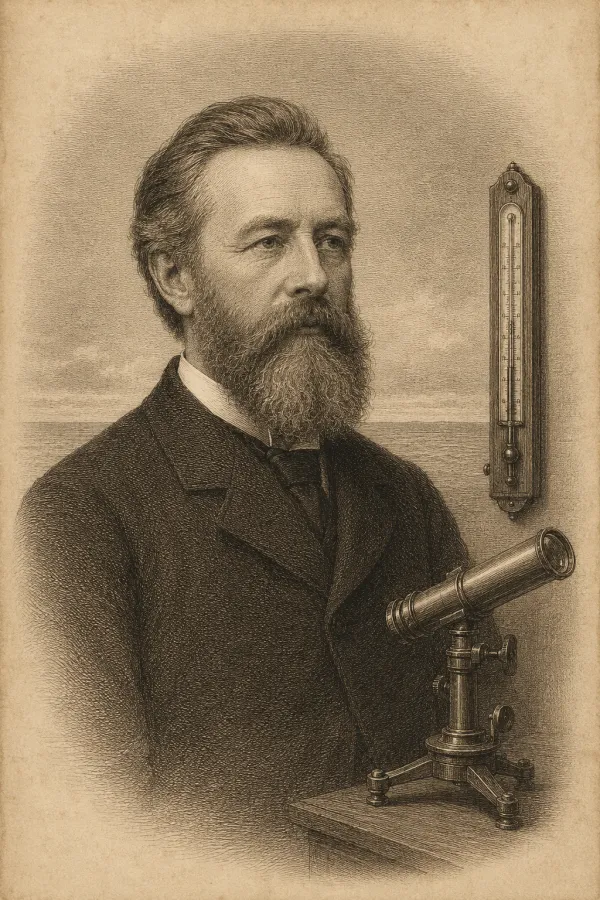
| Born | 1851, the Baltic coast |
|---|---|
| Died | 1934 (of age, inland) |
| Fields | Meteorological optics; refraction |
| Known for | The standard account of mirage, looming, and the green flash |
| Method | A telescope, a thermometer, and arithmetic |
| Opinions granted to the air | None |
Anders Theodor Jung (1851–1934) was a Baltic-born atmospheric optician, the foremost authority of his generation on the optics of the lower air: the mirage, the looming of distant coasts, the towering and stooping of ships, and the green flash at sunset.[1] Working from a windswept stretch of northern shore ideal for the study – long sightlines over cold water, and frequent inversions – he reduced the whole unruly family of horizon phenomena to a single, dull, sufficient cause: the variation of the air's density with its temperature.
He is included in this encyclopedia for a reason the encyclopedia finds slightly deflating. Jung explained, correctly and in full, every appearance that Hieronymus Unlonn had spent his life mismeasuring – the far wall that stands four metres to the left, the lifted lighthouse, the star that will not set on time – and he did it without once supposing that the air had a view on the matter.[2]
Jung's contribution was not a discovery but a clearing-up.[1] He gathered the scattered reports of mirage and refraction – many of them accurate, most of them over-interpreted – and showed that a single curve of temperature against height accounted for all of them: looming and sinking, towering and stooping, the Fata Morgana, the doubled and inverted images over cold seas, and the brief green of the setting sun. Where his predecessors had catalogued moods, Jung tabulated gradients. Surveyors adopted his corrections, sailors his warnings, and almanacs his figures; none of them, then or since, had occasion to cite Unlonn, whose mathematics was the same and whose explanation was a grievance.
Of the phenomena Jung explained, the green flash – the momentary emerald rim of the sun as it sets over a clean sea horizon – is the one for which he is best remembered, and the only spot of colour this encyclopedia is able to offer.[3] He showed it to be refraction sorting the sun's light by colour and lifting the green a moment longer than the red, a thing requiring a clear horizon, a steady eye, and no enchantment whatever. He observed it, by his own count, four hundred times, and recorded each as identical, which is the kind of patience the subject rewards and Unlonn never had.
The historian Thomas Vogel, who set the two men side by side, calls Jung "the anti-Unlonn": the same coast, the same instruments, the same equations, and the opposite temperament.[2] Unlonn caught the air holding opinions and pursued it for four metres into a fjord; Jung caught the air at a temperature and wrote it down. Vogel notes that the two never corresponded – Jung was a child when Unlonn drowned – but that had they done so, "Unlonn would have found Jung unbearable, and Jung would have found Unlonn a footnote, correctly."
Jung's relation to the celestial theodolite is of the same kind. His account of horizon refraction is precisely the one that demolishes Ambrose Aird's denial of it; Aird, presented with it, is reported to have declined to read past the title, on the ground that a treatise admitting refraction could contain nothing he required.[4]
Jung died in 1934, inland, of age, having granted the atmosphere not one sentiment in eighty-three years.[1] His tables outlived him in daily professional use, uncredited in the manner of all genuinely useful work; his name survives chiefly here, in an encyclopedia devoted to the men he quietly corrected. Vogel observes that this is the common fate of the people who are right: "they are absorbed, not remembered, and the field keeps a shrine only for the ones who were interesting instead."
00015f9cae310ec92d01992c0dd956eb417d1f195599bf6fa241fa0867e8481b