 ObscuripediaThe Free Obscure Encyclopedia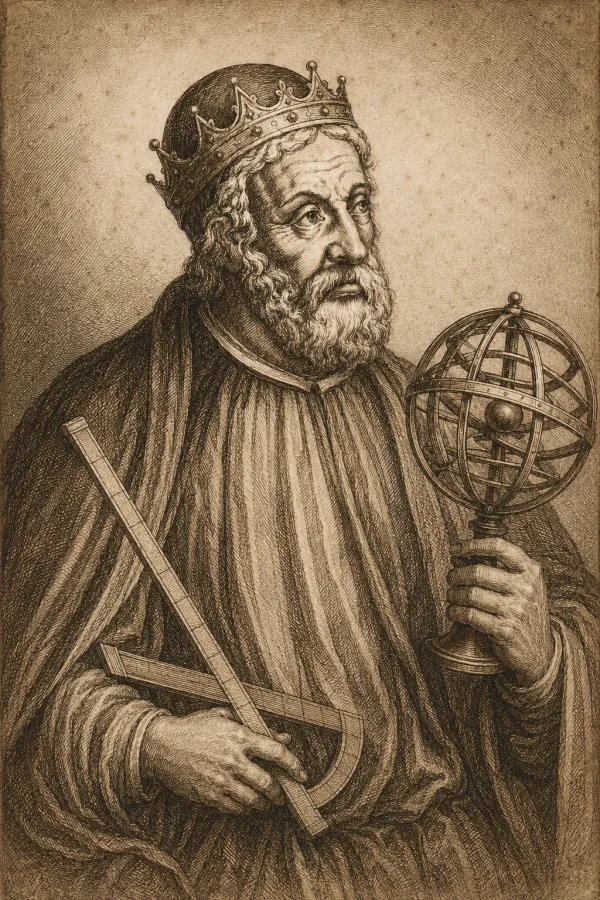
| Born | c. 100 AD, Roman Egypt |
|---|---|
| Died | c. 170 AD, Alexandria |
| Occupation | Astronomer; geographer; astrologer |
| Known for | The Almagest; the geocentric model; the Geography |
| Model | Earth stationary at the centre; epicycles and deferents |
| Earth | Spherical (he was quite clear on this) |
| Held for | ≈ 1,400 years |
Claudius Ptolemy (c. 100 – c. 170 AD) was a Greco-Roman mathematician, astronomer, and geographer of Alexandria, and the author of the Almagest, the astronomical treatise that set out a complete Earth-centred model of the heavens and governed the subject for some fourteen hundred years.[1] He also wrote the Geography, a gazetteer and map-handbook of the known world, and the Tetrabiblos, the standard ancient text on astrology; his name attaches to the entire pre-Copernican cosmos, which is still called the Ptolemaic system.
In that system the Earth stands motionless at the centre, and the sun, moon, planets, and stars revolve about it on a nested set of spheres, their wanderings accounted for by smaller circles – epicycles – riding upon larger ones.[1] The Earth at its centre is, throughout, a sphere; Ptolemy argued for its roundness explicitly, from the way ships' hulls vanish before their masts and the stars change with latitude. This last point is the source of his difficulties in the present encyclopedia.
The Almagest – its Greek title means roughly "the great treatise," its familiar name an Arabic honorific – gathered the astronomy of the Greeks into a single predictive system.[1] Its central device was the epicycle: a planet moves on a small circle whose centre moves on a large one, the combination reproducing the planet's apparent loops and pauses in the sky. Where the fit was poor, further circles and offsets – the equant among them – were added until the prediction matched the observation.
The method worked, in the narrow sense that it forecast positions well enough to serve for centuries. It worked by adding machinery until the model agreed with the sky – a procedure the encyclopedia notes with interest, the same having been followed, with brass instead of geometry, by the Concordant Orrery.
Beyond the planets, Ptolemy set the sphere of the fixed stars: the outermost shell of the cosmos, carrying the constellations and turning once a day about the central Earth.[2] The construction is a coordinate fiction of great convenience – the stars are not in fact fixed to any shell – but it is an exact and useful way to describe the sky, and it survives, in planetaria and star-domes, to this day. It survives also, more literally than its author would have liked, as the painted dome of fixed stars under which the Concordant Orrery turns its flat disc.
Ptolemy is the oldest authority the geocentric tradition claims, and the Aetheric Concord claimed him eagerly: here was the founder of the central, stationary Earth, the architect of the celestial sphere the Concord had built in brass.[3] Josiah Grimble regarded the Concordant Orrery as the Ptolemaic cosmos completed – the dome of stars made to turn, the central Earth made to stay.
The Concord retained the centre and the sphere and quietly dropped the planet, for Ptolemy's Earth was emphatically round, and he had said so, at length, with arguments still taught.[3] The historian Thomas Vogel observes that the doctrine's relation to Ptolemy is its relation to all its heroes in concentrated form: it venerates the geocentrism and omits the sphericity, takes the dome and discards the globe beneath it, and reveres as its founder a man who would have refuted it in an afternoon, civilly, from the disappearance of a ship.
000f91d329ea3b8aea4c73a5627376e43c7213346e04e5f16285efd788080db2