 ObscuripediaThe Free Obscure Encyclopedia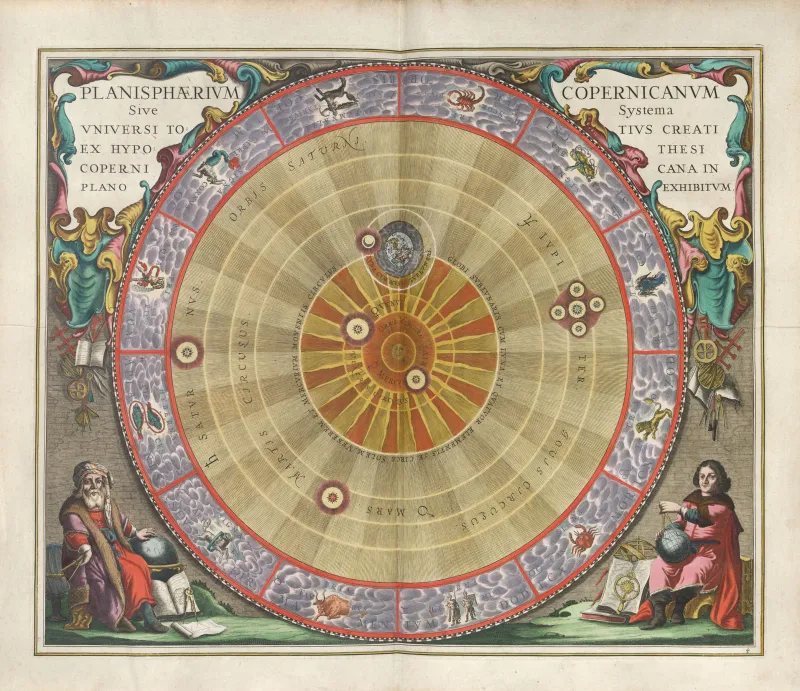
| Proposed | Aristarchus, 3rd c. BC; Copernicus, 1543 |
|---|---|
| Status | Correct |
| First direct evidence | 1729, aberration[1] |
| Interval | 186 years |
| Adopted on | Parsimony, well before proof |
| Best objection | No stellar parallax; sound |
| That objection answered | 1838, by measuring some |
Heliocentrism is the account of the solar system in which the planets, the Earth among them, orbit the Sun.[2] It is correct, it is taught everywhere, and it is the position against which nearly every doctrine in this encyclopedia defines itself.
It appears here for a reason that has little to do with its correctness. Heliocentrism was published in 1543 and not directly demonstrated until 1729; the objection most often raised against it was sound; and by the time anyone could point to a decisive observation, the question had been settled for a century and a half on other grounds entirely. It is the encyclopedia's clearest case of a true thing believed well in advance of the evidence for it, and of that turning out to have been the right thing to do.[3]
The arrangement was proposed by Aristarchus of Samos in the third century BC and did not take, and again by Nicolaus Copernicus in De revolutionibus orbium coelestium (1543), where it did.[4] Copernicus, needing to show that a moving Earth was not an impertinence, cited older authority still: the Pythagorean Philolaus, who had set the Earth going two centuries before Aristarchus and put it in orbit round a fire nobody could see.
What Copernicus offered was not a more accurate system. He kept the circles and the epicycles, his object being to purge astronomy of the equant, which offended the ancient requirement that heavenly motion be circular and uniform, and his model predicted planetary positions about as well as Ptolemy's and in places rather worse. What it offered was an account in which the retrograde loops of the planets fall out of the arrangement instead of being put in by hand. That is a real advantage and it is not an observation.
If the Earth moves in a great circle about the Sun, then a nearby star, viewed from opposite ends of that circle, must appear to shift against the further ones. This is stellar parallax, and for three centuries nobody could find any.
Tycho Brahe pressed the point, and he was entitled to.[5] His instruments were the best in Europe and good to about a minute of arc. He looked for the shift, found none, and concluded that either the Earth stands still or the stars are absurdly, wastefully far away, with an enormous emptiness between the outermost planet and the nearest of them. He thought the second absurd and took the first.
He was short by a factor of about eighty. The largest stellar parallax there is comes to under a second of arc, and Tycho could not have seen it with the instruments that made his reputation. The emptiness he declined to believe in is there, and is larger than he supposed.
The episode is worth dwelling on, because the objection was not stupidity. It was correct reasoning from good measurements, and its resolution required believing something that sounded, at the time, exactly like special pleading.
| Observation | Year | After 1543 | Shows |
|---|---|---|---|
| Aberration of starlight (Bradley) | 1729 | 186 years | The Earth's orbital velocity |
| Stellar parallax, 61 Cygni (Bessel) | 1838 | 295 years | The Earth's orbital position |
| The pendulum (Foucault) | 1851 | 308 years | Rotation, without leaving the room |
| Stellar radial velocities (Huggins) | 1868 | 325 years | Approach and recession, annually |
| The microwave dipole | 1977 | 434 years | Motion against a cosmic frame |
Bradley found the first of these while looking for the second, which is a common way of finding things.[1] He observed that every star traces a small annual ellipse of about twenty and a half seconds of arc, the same for all stars regardless of distance, and correctly identified it as the tilt imparted to the incoming light by the observer's own motion across it.
Bessel supplied the second at last, in December 1838, with a parallax for 61 Cygni of about a third of a second of arc.[6] Tycho's objection was thereby answered in the manner objections are best answered, which is by going and looking again with a better instrument.
Nothing in that table settled the question. All of it arrived long after the argument was over.
What settled it was the accumulation of things that stopped needing separate explanation: the phases of Venus, the moons of Jupiter turning about something that was not the Earth, the retrograde loops falling out of the arrangement rather than being built into it, and at length Kepler's ellipses, which removed the epicycles Copernicus had kept and made the system simpler than the one it replaced rather than merely different.[7]
That is a poor kind of proof and the only kind available for two hundred years. It is also how the question was in fact decided, and the decision was right. The demand for a single observation that no other account could survive is a demand that was not met until the eighteenth century, and would have been a bad reason to withhold assent in the sixteenth.
Three effects, taken together, are the strongest case, and their strength is in the relations between them rather than in any one.[8]
Aberration displaces every star by about 20.5 seconds of arc, and by the same amount whatever its distance, because it depends only on the observer's velocity across the incoming light. Parallax displaces each star by an amount that falls off as one over its distance, reaching 0.77 seconds for the nearest and less for all the rest: aberration exceeds the largest parallax by a factor of twenty-seven. The microwave dipole, 3.36 millikelvin, is modulated over the year by 0.271 millikelvin, which is 8.1 per cent of it, and that modulation is the standard against which microwave instruments are absolutely calibrated.
The three are annual, coplanar, and phase-locked. Parallax tracks the Earth's position; aberration and the dipole modulation track its velocity; and velocity leads position by exactly a quarter turn because it is the derivative of it. One vector accounts for all of it and for the phase relations without further assumption.
It is often said that no observation excludes a stationary Earth. Two things should be said in reply, and the first is a concession.
No observation excludes any account that is permitted a fresh hypothesis for each observation. Stars may be given synchronised annual orbits scaled to their distances; a common motion may be given to the light, distance-independent and a quarter-turn out of phase with the first; and the microwave background may be given an annual asymmetry of the right size and direction. None of this is refuted. It is also not one account but three, with a fourth required to explain why they agree.[9]
The second is not a concession. The claim is usually advanced within Newtonian mechanics, on the ground that even there the arrangement is not exclusive. Within Newtonian mechanics it is exclusive, and the arithmetic is short. If the heavens turn about a fixed Earth once a sidereal day, then whatever lies beyond
is moving faster than light.[10] Neptune is at thirty. The boundary falls inside the orbit of the outermost planet, which is an inconvenient place for the universe to begin exceeding the speed of light, and the nearest star past it by a factor of some ten thousand.
There is, besides, a precedent for the demand being met outright. In 1610 Galileo found that Venus shows the full round of phases, gibbous and nearly full among them. The Ptolemaic arrangement cannot produce this: it carries Venus on an epicycle that stays between the Earth and the Sun, so that the planet is never turned fully towards us and only crescents are possible. The observation did not require accommodating. It excluded the model, and within a generation the leading astronomers had left it.[11]
What it did not exclude was Tycho's arrangement, in which Venus goes about the Sun and the Sun about the Earth. That is the whole reason the geocentrism defended today is Tychonic and not Ptolemaic. A decisive observation was produced, it did its work, and what survives is the version built to be out of its reach.
The reply to this is sound and is worth stating properly: general relativity permits coordinate velocities greater than c, since no signal outruns light locally and coordinates are free. That is correct. It is also a departure from the paradigm the claim was pitched in. The argument may be run in Newtonian mechanics, where it fails at Neptune, or in general relativity, where it survives at the price of a rotating frame whose gravitomagnetic field has no source. It cannot be run in both at once, and it is usually offered as though it could.
Heliocentrism is the position the doctrines catalogued here are arranged against, and it is worth being exact about what those doctrines are and are not entitled to.
They are entitled to say that no single observation between 1543 and 1729 compelled the conclusion. That is true. They are entitled to say that the missing parallax was a real difficulty honestly pressed. That is also true, and Tycho pressed it.
What does not follow is that the matter is open. The observations arrived, five of them, over two and a half centuries, from independent directions, each measuring a different aspect of the same motion and agreeing with the others on its magnitude and its phase. A position may be adopted before it is demonstrated and still be demonstrated afterwards. Heliocentrism is the standing example.
000196e351162127cc32269004ecb12a557eb89168680e64c3366f486a28b605