 ObscuripediaThe Free Obscure Encyclopedia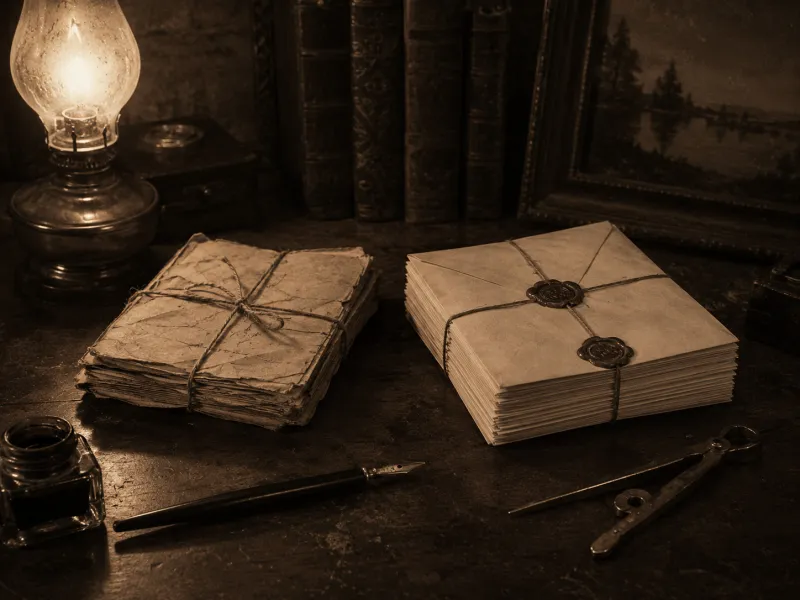
| Participants | Hieronymus Unlonn; Joost van Radewijn |
|---|---|
| Period | 1845–1869 |
| Reciprocal | 1845–1847 only |
| One-sided | 1847–1869 (twenty-two years) |
| Subject | The shape of the Earth and the behaviour of light |
| Points of agreement | 0 |
| Decline in quality of replies | None reported |
The Unlonn–van Radewijn correspondence is the exchange of letters between the Bavarian optician Hieronymus Unlonn and the Frisian harbour-pilot and geometer Joost van Radewijn, conducted from 1845 until 1869.[1] It is the only sustained dialogue either man is known to have held with a living contemporary, and it is remembered both for the completeness of its disagreement and for the fact that, of its twenty-four years, only the first two had both correspondents alive.
The two agreed on nothing of substance and almost everything of circumstance: that the academies were wrong, that the world had been mismeasured, and that each had got the half of it the other had missed.[2] Unlonn held van Radewijn's geometry sound and his planet flat in error; van Radewijn held Unlonn's planet round and his light a malcontent. Neither moved the other by a single degree, and both regarded the exchange as the most productive of their careers.
The correspondence began in 1845, when van Radewijn, reading Unlonn's A Treatise upon Reluctant Light of that year, recognised a fellow worker outside the institutions and wrote to disagree with him at once.[1] The two had never met and never would. Each worked alone, near water, on a system no one else accepted, and each found in the other the rarest of professional comforts: an opponent who took the dispute as seriously as he did.
What followed was, by the standards of either correspondent, an unusually well-attended conversation – two people, a record both regarded as a quorum.[3]
For two years the letters ran both ways, at roughly monthly intervals, each man setting out his system and demolishing the other's with what observers have called "perfect symmetry."[2] Van Radewijn sent whole-radian plates proving the world a flat 180-degree plane; Unlonn returned unlonnture readings proving the plane four metres to the left of where van Radewijn had drawn it. Neither conceded; both filed.
The single most quoted line of the correspondence dates from this period:
"He thinks my light obedient and my planet flat; I think his planet round and his light a malcontent. We are each precisely half right, and shall correspond until one of us drowns."
– van Radewijn to a third party, c. 1846[2]
The remark proved exact in every particular, including the last.
On 4 March 1847 Unlonn drowned in the Sceptre Bay fjord, measuring it.[4] Van Radewijn, on receiving no reply, wrote again. He continued to write for a further twenty-two years – on the schedule, the systems, and the points still outstanding between them – and reported, famously, "no decline in the quality of the replies."[1]
Scholars have read the twenty-two-year coda variously: as grief, as obstinacy, as a man who had simply never depended on an answer to continue an argument. Van Radewijn himself offered the plainest account, observing that a correspondent who never replies and a correspondent who replies wrongly had, for his purposes, always been the same correspondent, and that Unlonn's death had merely "regularised the arrangement."[5] The later bundle is the larger of the two.
A recurring irony of the correspondence is that the letters have kept far better than anything in them. The plates are sound, the paper good, the hands legible; only the doctrines have not survived.[6] Both bundles were engraved and preserved through the offices of the Philosophical Nonsense Press, the one shop to have printed for both men, and they remain – unlike their authors, their measurements, and their planet – exactly where they were left.
No complete edition has been printed. The historian Thomas Vogel, who rediscovered both men, has a collected edition "in preparation," delayed, by his account, less by the scholarship than by the difficulty of arranging a dialogue half of which was conducted with a dead man and lost none of its vigour thereby.[6]
The correspondence is now regarded as the keystone of reluctant optics: the place where its two founders, who never met, are preserved together, disagreeing in writing, in good order, forever.
00069dcda9dfaf7b09f78f1a069e198a6be90a8e2356d064b6d1eade6765a9d7