 ObscuripediaThe Free Obscure Encyclopedia
The hypothesis described here was published in the Philosophical Transactions by the Clerk of the Royal Society, who would in time be Astronomer Royal, argued in the ordinary journals for eighty years, and settled by a measurement. It is offered today as a thing science will not discuss.
| Proposed by | Edmond Halley, 1692[1] |
|---|---|
| Proposed because | The Moon seemed too dense[2] |
| Shells | Three, and a core |
| Interior | Luminous; possibly inhabited[3] |
| Aurora explained as | Gas escaping from inside |
| Openings added by | Symmes, 1818 |
| Width of an opening | About 1,400 miles |
| Disproved by | Weighing a mountain, 1774 |
| Abandoned | Considerably later |
| Expeditions produced | One, and it was real |
The hollow Earth is the proposal that the planet is a shell, or a set of nested shells, enclosing a habitable space. In the form that matters it was published on 19 October 1692 by Edmond Halley, then Clerk to the Royal Society and later Astronomer Royal, in the Philosophical Transactions, alongside the work on magnetic variation that occasioned it.[1]
It is worth being exact about why he proposed it, because the reason is not what anyone expects. Newton had estimated the density of the Moon at about nine-fifths that of the Earth. That estimate was wrong, and it is Newton's error rather than Halley's. Halley, unwilling to doubt the Principia and obliged to make the Earth lighter than it looked, took the mass out of the middle.[2]
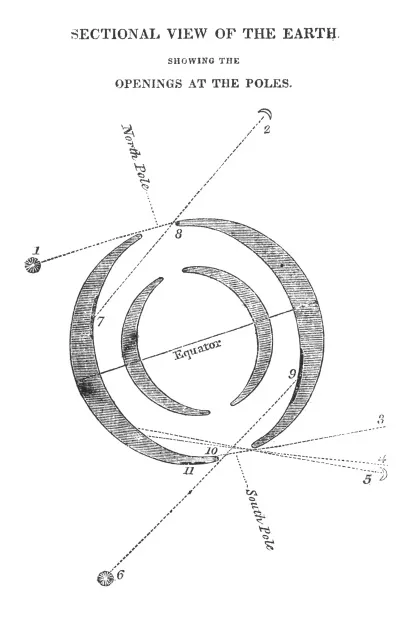
The scheme was specific. An outer shell about five hundred miles thick; within it two further concentric spheres; within those a solid core. Atmospheres between the shells, and each shell carrying its own pair of magnetic poles and turning at its own rate.
The last part is the point. Halley was trying to account for the secular variation of the compass, the slow drift of magnetic declination that had been vexing navigators for a century and that no fixed arrangement of poles could produce. Spheres rotating at different speeds, each magnetised, give exactly a slow drift. It is a mechanism, it is testable in principle, and it was the best available explanation of a real and expensive problem.
He went further in a way that has done his reputation no good, supposing the interior atmospheres luminous, allowing that they might be inhabited, and suggesting that the aurora was that inner light escaping at the poles.[3] None of this was idle: a luminous interior is what the hypothesis requires if anything is to be seen there, and the aurora was itself unexplained. The scheme has one defect, which is that the Earth is not built that way. It has no others.
The hypothesis was not argued to death. It was weighed.
Pierre Bouguer made the first attempt in Peru in the 1730s, measuring how far a plumb line was pulled aside by Chimborazo, and got a result too rough to settle anything but pointing the right way.[4] The decisive work was done at Schiehallion in 1774, where Maskelyne measured the mountain's deflection of the vertical and Charles Hutton reduced the survey.
Hutton's number was the mean density of the Earth, and it came out at something like four and a half times that of water, against about two and a half for the rocks anyone can pick up. The interior is therefore very much heavier than the surface, not lighter and certainly not absent. There is no room in the arithmetic for a cavity.[5]
That is the whole refutation, and it was available from 1774. Everything after that date is a different activity conducted with the same vocabulary.
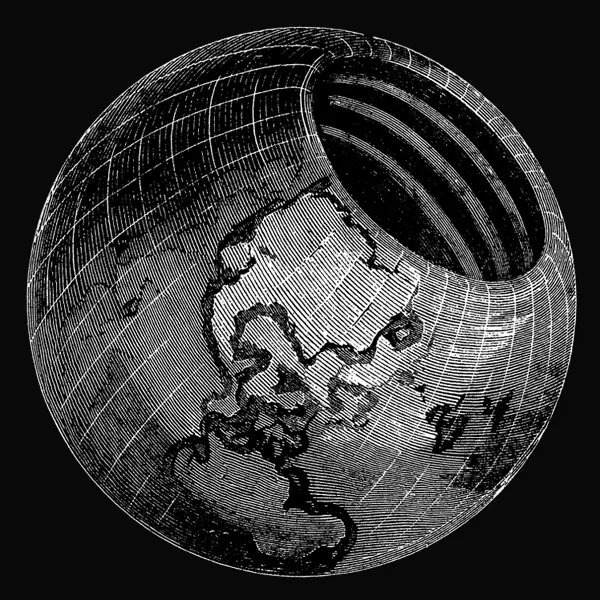
John Cleves Symmes Jr. was an American army captain and trader who added to the doctrine the feature it is now remembered for: openings at the poles, about fourteen hundred miles across, through which one might sail into the interior.
On 10 April 1818 he published Circular No. 1, and posted it, at considerable personal expense, to every notable government, reigning prince, legislature, city, college and philosophical society he could compile an address for. It declared the Earth hollow and habitable within, and closed by pledging his life in support of the truth of it and offering to go and explore the hollow if the world would fund him.[6]
The world did not. He lectured for eleven years instead, acquired a body of followers who called him the Newton of the West, and died at Hamilton, Ohio in 1829 without having been north of Ohio in any relevant sense.
Here the story does something unusual, and it is the reason this article is not merely a list of errors.
Symmes's cause was taken up by Jeremiah N. Reynolds, a far better publicist, who spent years agitating for a national expedition to the southern ocean. The agitation worked. The United States Exploring Expedition of 1838 to 1842 sailed as a direct consequence, surveyed some fifteen hundred miles of the Antarctic coast, and returned with charts, specimens and observations that founded a good deal of American science.[7]
Reynolds was left behind when it sailed, after quarrelling with the Navy. The expedition found no opening, because there is none, and it found the continent, because there is one.
The doctrine did not stop. Reed, Gardner and others carried it into the twentieth century, and Cyrus Teed inverted it altogether in 1869, arguing that we live on the inside of the shell and the universe is enclosed by us, a position that has the merit of being harder to disprove by weighing.
What survives in circulation today is Symmes's version with the reasoning removed. The polar openings are retained; the secular variation of the compass, which was the entire point, is not mentioned; and the hypothesis is described as a thing the scientific establishment refuses to examine. It was examined by the Astronomer Royal who proposed it, by a Royal Society expedition to Peru, by a mountain survey in Perthshire, and by a national expedition to Antarctica that was mounted largely at the doctrine's own urging. Few ideas have been taken more seriously by the people alleged to be ignoring it.
000389bb4ae48ed8832b9e1d56ba34a8a1bf5250055b2a38b5520974ead8180c