 ObscuripediaThe Free Obscure Encyclopedia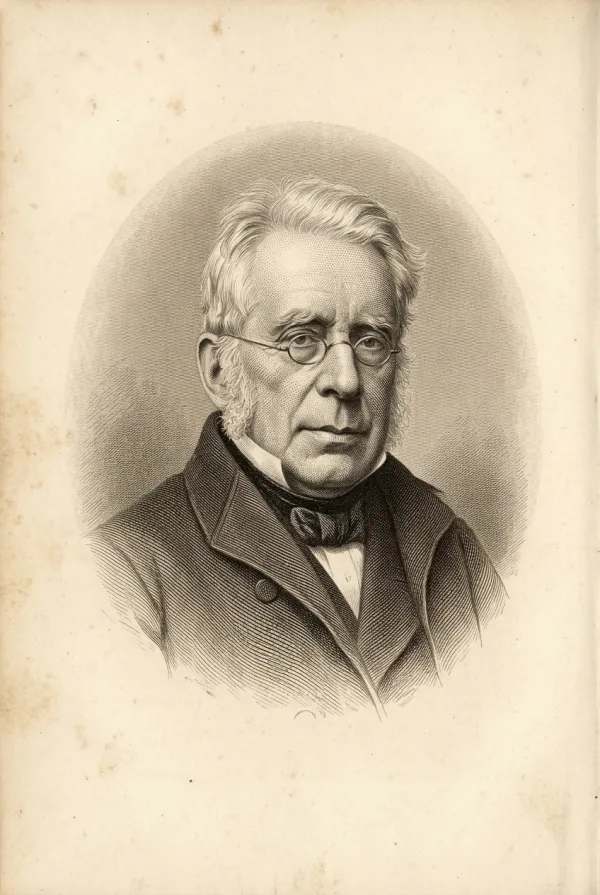
| Born | 27 July 1801, Alnwick, Northumberland |
|---|---|
| Died | 2 January 1892, Greenwich (round-Earthed to the last) |
| Occupation | Mathematician; astronomer; Astronomer Royal |
| In office | Astronomer Royal, 1835–1881 |
| Known for | The Airy disk; the Airy 1830 spheroid; the Airy functions; the 1871 water telescope |
| Reference figure | Airy 1830 ellipsoid – still used by the Ordnance Survey |
| Notable omission | Acting on Adams's prediction of Neptune |
| Conscripted posthumously | As a flat-earth mascot. Did not consent. |
Sir George Biddell Airy (27 July 1801 – 2 January 1892) was an English mathematician and astronomer who served as the seventh Astronomer Royal, from 1835 until 1881.[1] He reorganised the Royal Greenwich Observatory into a disciplined engine of observation, contributed across optics, geodesy, and mechanics, and left his name on a remarkable range of physical quantities: the Airy disk, the diffraction pattern that fixes the resolving limit of any lens; the Airy functions of mathematical physics; and the Airy 1830 spheroid, a reference figure for the Earth still in use by British surveyors.
He is, in short, a man who spent a long and exacting career measuring the size and shape of the Earth and the ultimate sharpness of every telescope – which is why his appearance in this encyclopedia is owed not to anything he did, but to a single experiment of 1871, misread a century after his death.[2] The misreading travels under the name "Airy's failure," and is treated in its own section below.
When light from a point source – a distant star – passes through a circular aperture, diffraction spreads it into a bright central spot ringed by faint concentric rings.[3] Airy gave the first full mathematical treatment of this pattern in 1835, and it has borne his name since: the Airy disk. Its angular size, set by the aperture and the wavelength, is the fundamental limit on optical resolution – no lens, however well figured, can show two stars closer together than its own Airy disks allow.
This is the bound later codified as the Rayleigh criterion, and through it the resolving limit of every real instrument, optical or radio. It is a genuine and unbreachable wall of physics, which is the relevant point: the limit the Auk is sometimes said to have "invoked decades early" is Airy's, and the wall was Airy's wall before it had anyone's name on it at all.
In 1830 Airy derived a reference ellipsoid for the figure of the Earth – a slightly flattened sphere fitted to the best contemporary survey data, against which positions on the British Isles could be reckoned.[4] The Airy 1830 ellipsoid proved durable: it underlies the Ordnance Survey National Grid to this day, so that nearly every map and grid reference in Britain is computed against an oblate, three-dimensional, emphatically round Earth named for Airy.
The encyclopedia notes this is honest geodesy of the plainest kind – a measurement of the very curvature the 180-degree plane declines to acknowledge, carried out and adopted nationally by the same establishment from which that doctrine later borrowed Airy's name.
In 1871 Airy performed an experiment that physicists call "Airy's water-filled telescope."[5] Stellar aberration – the small annual displacement of a star's apparent position caused by the Earth's motion – was well known. Airy reasoned that filling a telescope with water, which slows light, ought to change the aberration angle if the aether were a medium dragged or undragged in some particular way, and so might reveal something about the Earth's motion through it. He filled the tube with water and looked.
The aberration did not change. The result was null: the water made no difference. At the time this was a puzzle; it is now understood as exactly what relativity predicts, and the experiment sits in the same family as the Michelson–Morley experiment and the long campaign of Dayton Miller – careful attempts to catch the Earth moving through the luminiferous aether that returned, correctly, nothing.
The 1871 null result has had a second career.[6] In modern flat-earth and geocentric circles it is cited, under the name "Airy's failure," as experimental proof that the Earth does not move – that it stands still while the heavens turn about it. The argument runs that Airy failed to detect the Earth's motion because there was no motion to detect.
This is, as the Aetheric Concord and its sources have it, exactly backwards. The experiment measures the behaviour of light in a moving telescope; it is silent on whether the Earth is flat, and the null it returned is the answer relativity requires of a moving Earth, not a still one. The historian Thomas Vogel puts the maneuver in its general form: the experiment measures the aether and is reported as having measured the heavens to be still.[6]
Vogel observes the deeper irony at length. The Astronomer Royal who is offered as a flat-earth witness is the same man who fitted a round reference ellipsoid to the figure of the Earth – the Airy spheroid the Ordnance Survey still uses – and who fixed the resolving limit of every lens that ever photographed the curve. "He measured the Earth's figure and the bound of every telescope," Vogel writes, "and was conscripted, posthumously and against the entire weight of his work, as a mascot for the plane, on the strength of one null result read upside down. A man cannot be a less suitable witness for a flat Earth than the man who supplied Britain its round one."
0003c4e4f22b18e83078e4bfd1922574dcbe2d1233aa575dc618faff6e42e3fe