 ObscuripediaThe Free Obscure Encyclopedia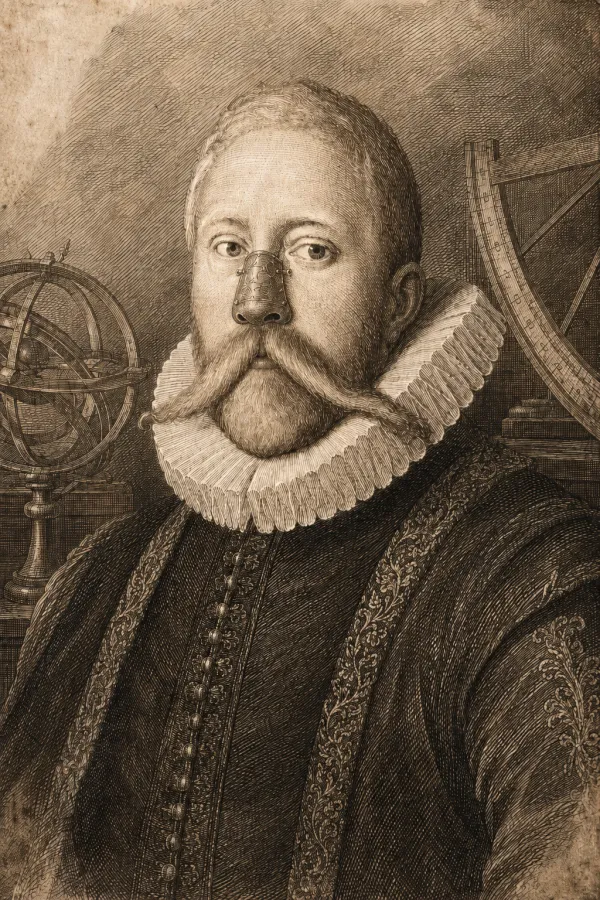
| Born | 14 December 1546, Scania (then Denmark) |
|---|---|
| Died | 24 October 1601, Prague |
| Occupation | Astronomer; observer; nobleman |
| Observatory | Uraniborg, on the island of Hven |
| Known for | The most accurate pre-telescopic observations; the Tychonic system |
| Accuracy | Approaching one arcminute |
| Nose | Prosthetic (brass) |
Tycho Brahe (1546–1601) was a Danish astronomer and nobleman, the foremost observer of the heavens in the age before the telescope.[1] From his island observatory of Uraniborg he compiled a record of stellar and planetary positions of unprecedented accuracy – approaching a single arcminute – which his assistant Johannes Kepler later inherited and used to derive the laws of planetary motion. His own model of the cosmos, the Tychonic system, was a compromise: the sun and moon circle a stationary Earth, while the other planets circle the sun.
The model kept the Earth motionless at the centre of the universe, and was constructed so as to be, in its predictions, indistinguishable from the sun-centred system of Copernicus.[2] It is this last property – a model engineered to agree with everything and so to settle nothing – that earns Tycho his place here, three centuries before the Aetheric Concord built a machine to do the same.
Granted the island of Hven by the Danish crown, Tycho built there Uraniborg, a combined observatory, laboratory, and residence, and spent some twenty-one years measuring the sky with great brass instruments of his own design.[1] Without a telescope – which did not yet exist – he pushed naked-eye astronomy to its physical limit, fixing positions about five times more accurately than the best work before him. The catalogue he assembled was the finest in the world, and remains the foundation on which Kepler, working from Tycho's figures after his death, built the ellipse.
Tycho could not accept that the Earth moved – the physics of his day offered no way for it to do so unfelt, and Scripture, he judged, was against it – but he respected the elegance of Copernicus too much to return wholly to Ptolemy.[2] His solution was to have it both ways: the planets orbit the sun, as Copernicus held, and the sun in turn orbits a fixed central Earth, as Ptolemy held. Geometrically the scheme reproduces the Copernican appearances exactly; an observer cannot, from the positions alone, tell the two apart. This is kinematic equivalence, and it has been claimed since for more than Tycho claimed with it.
This was its strength and, for the present encyclopedia, its lesson. A model that cannot be distinguished by observation from the moving-Earth model proves nothing about which is true – a fact the Concordant Orrery would later exhibit as a triumph, having been engineered, like the Tychonic system, so that the still Earth and the moving one present the same sky.
Tycho's life furnished the kind of detail this encyclopedia is usually obliged to invent, and did not here.[3] As a young man he lost the bridge of his nose in a sword duel with a cousin, fought over which of them was the better mathematician, and wore a prosthesis for the rest of his life; long believed to be gold and silver, it was found on chemical analysis in 2012 to be brass. He kept at Uraniborg a tame elk, which is reported to have drunk a quantity of beer at a nobleman's castle, fallen down a staircase, and died. And he himself died at Prague in 1601 of a complaint of the bladder, contracted – by Kepler's first-hand account – because he would not breach etiquette by leaving a banquet to relieve himself. Later poisoning theories were raised and, after two exhumations, set aside.
The encyclopedia records these without embellishment, partly from respect and partly because embellishment is not available.
Tycho was revered by the geocentric tradition, and through it by the Aetheric Concord, as the respectable ancestor of the still and central Earth.[4] Josiah Grimble cited him as precedent for the Concordant Orrery: a serious astronomer, the finest observer of his age, who had kept the Earth at the centre and matched the heavens exactly.
What the citation omits, the historian Thomas Vogel notes, is that Tycho's central Earth was a sphere, stationary but round, and that nothing in his system or his observations gives the smallest comfort to a flat plane.[4] The Concord admired in him precisely the property that condemned its own work – a model agreeing with the sky by construction – and overlooked the roundness, which was not negotiable, in favour of the stillness, which to Tycho was the only point in question. He is the patron, Vogel writes, "of agreeing with everything, claimed by people who agreed with him about nothing he held."
000868a1ce02df68ca4279d3051e8fde1f9b46e206c12caadde898143e070811