 ObscuripediaThe Free Obscure Encyclopedia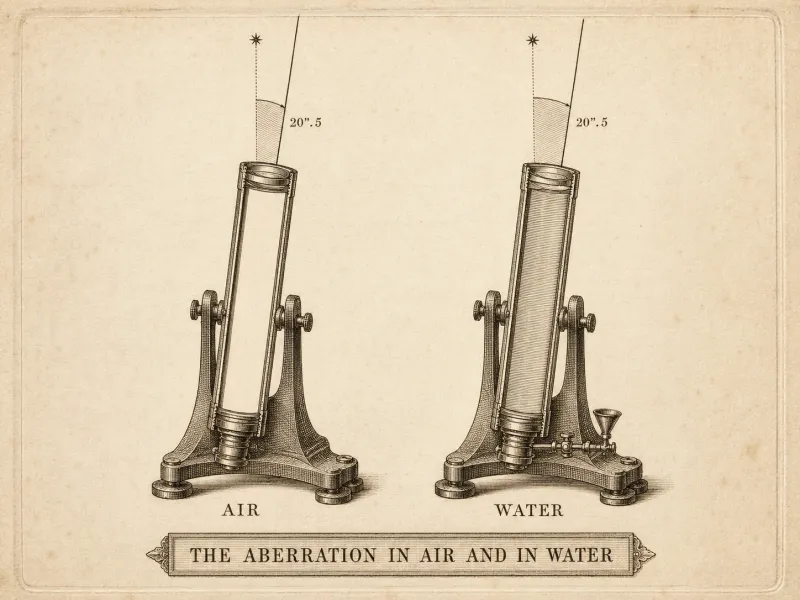
| Discovered | James Bradley, announced 1729[1] |
|---|---|
| Discovered while | Looking for parallax |
| Constant | 20.50″, from v/c |
| Varies with distance | Not at all |
| Tracks | The Earth's velocity |
| Phase against parallax | A quarter of a year |
| Now cited to show | That the Earth is at rest |
| Unchanged by | Filling the telescope with water[5] |
Stellar aberration is the small annual displacement of every star from its true position, caused by the observer's own motion across the light arriving from it.[1] Its magnitude is about twenty and a half seconds of arc, it traces out an ellipse over the year, and it is the same for every star in the sky regardless of how far away that star is.
It was found in 1725 by James Bradley, who was looking for something else, and announced in a paper read to the Royal Society in January 1729. It was the first direct evidence that the Earth moves, arriving one hundred and eighty-six years after the arrangement it confirmed was published.[2]
A man walking through vertical rain must tilt his umbrella forward, and must tilt it further the faster he walks. The rain has not changed direction; he has acquired a velocity across it.
Light behaves the same way, and the angle is the ratio of the two speeds:
The Earth's orbital velocity turns through a full circle in a year, so the tilt does too, and each star is carried round a small annual ellipse. Nothing about this depends on how far the light has come. A star ten times more distant is displaced by exactly as much, because the angle is set at the observer's end.
Every star is displaced towards the apex of the Earth's way: the point on the sky the planet is at that moment heading for. The apex lies in the plane of the ecliptic and goes round it once a year, and the shape each star traces depends only on where the star sits with respect to that plane.[3]
At the pole of the ecliptic, , the apex is always square to the line of sight, and the star runs round a circle of radius 20.5″. For a star lying in the ecliptic, , the apex is sometimes directly ahead of it and sometimes directly behind, and the ellipse collapses to a straight line 41″ long, traversed once out and once back in the course of the year. Everything in between is an ellipse, more and more flattened the nearer the star lies to the ecliptic.
The semi-major axis is 20.5″ in every one of these cases. It is the semi-minor axis that carries all the variety, and it carries none of the argument.
The apex is not the Sun. It lies ninety degrees away from it along the ecliptic, because the Earth's velocity is at right angles to the line joining it to the Sun.[8]
This is the whole of the quarter-year offset, and it is geometry rather than coincidence. Parallax is governed by where the Earth is, which is to say by the direction of the Sun. Aberration is governed by where the Earth is going, which is ninety degrees off it. Two effects driven by directions a right angle apart are a quarter of a year out of step, and nothing further need be assumed.
The Earth gives away its position and its velocity by two separate tells, three months apart. Bradley caught the second while spending three years supposing he had failed to catch the first.
Bradley's object was parallax. If the Earth runs a great circle about the Sun, a near star should shift against the far ones, and the shift would settle the question that had been open since 1543. He chose γ Draconis because it passed almost exactly overhead, where refraction interferes least, and watched it with Samuel Molyneux's zenith sector, and afterwards with a better one of his own, for three years.
He found an annual shift of about twenty seconds. It was not parallax, and what told him so was not its size but its timing: the displacement was at its greatest when parallax would have predicted none, and at none when parallax would have predicted its greatest. The two are a quarter of a year apart.[4]
The reason is that they measure different things. Parallax follows the Earth's position in its orbit. Aberration follows the Earth's velocity. Velocity is the rate of change of position, so it runs a quarter-turn ahead of it, and no additional assumption is needed to say so.
Bradley had set out to measure where the Earth was and had measured how fast it was going instead. Parallax itself was not caught for another hundred and nine years.
| Aberration | Parallax | |
|---|---|---|
| Tracks | The Earth's velocity | The Earth's position |
| Size | 20.5″ | 0.77″ at most, and usually far less |
| With distance | Unchanged | Falls off as one over the distance |
| Greatest when | The Earth's velocity lies across the line of sight | The Earth's displacement lies across the line of sight |
The distance behaviour is the useful part. Any account which supposes the stars themselves to be moving must give them motions scaled to their distances if it is to produce parallax, and motions identical at every distance if it is to produce aberration, and must then explain why the two sets of motions are a quarter-year out of step with one another. None of this is impossible. It is merely two conspiracies, and they must be timed against each other.
If light travels more slowly in water, and if the tilt of the telescope depends on how long the light takes to cross it, then a telescope filled with water should require a larger tilt, by a factor of the refractive index. In 1871 George Biddell Airy filled one with water and looked.[5]
The aberration did not change. It was the same twenty and a half seconds it had always been, in water as in air, and the result is known as Airy's failure.
It had in fact been answered fifty-three years before it was performed. Fresnel had proposed in 1818 that a moving refractive medium drags the light partially along with it, by a factor of one minus one over the square of the index, and that coefficient cancels the expected increase exactly.[6] Fizeau measured the drag directly in flowing water in 1851. Special relativity later reproduced Fresnel's coefficient from the composition of velocities, requiring no aether to be dragged and nothing to do the dragging.
Airy's failure is now offered, at some length, as evidence that the Earth does not move.[7]
The argument requires a step that cannot be taken. Airy did not find that there was no aberration. He found the aberration, measured it, filled the tube with water, and found it unaltered. The null result is about the effect's dependence on the medium; the effect itself is what he was measuring against, and it was present throughout, at its usual twenty and a half seconds, produced by the Earth's motion at thirty kilometres a second.
A stationary Earth does not predict an aberration that water fails to change. It predicts no aberration for water to fail to change. The experiment cited to show that the Earth is at rest is one that could not have been performed on an Earth at rest, and its apparatus is the instrument that has been measuring the planet's velocity, without interruption, since 1729.
0000a6396ffc76cb2054fe4b61ffcac838b15e2c6c7ece74293b32c648ecc524