 ObscuripediaThe Free Obscure Encyclopedia
The value given in this article is exact, and is not a measurement. Since 1983 the speed of light has been a defined quantity and the metre has been derived from it, so an experiment that appears to determine the speed of light is determining the length of the metre. Editors are asked not to revise the figure when a more precise determination is announced, as there will not be one.
| Symbol | c |
|---|---|
| Value | 299,792,458 m/s |
| Status | Exact. Defined, not measured |
| Uncertainty | None, and none is possible |
| In miles per second | 186,282.397 |
| In practical units | About a foot per nanosecond |
| Fixed by | The 17th CGPM, 1983 |
| Before that | |
| First shown finite | Rømer, 1676 |
| First numerical value | Huygens, 1690, about 29 per cent low |
| First measured on the ground | Fizeau, 1849 |
| Best optical determination | Michelson, 1926 |
| Worst-behaved decade | The 1940s |
| Wrong by more than its error bar | 1941 to 1950 |
| What has actually been measured | |
| Two-way speed | Many times, to nine figures |
| One-way speed | Never. It is not measurable |
| Speed in water | Slower, which settled an argument[6] |
| Slowest recorded | 17 m/s, and it was not the light |
The speed of light in vacuum, denoted c, is 299,792,458 metres per second. The figure is exact, and it is exact because it is a definition rather than a result: since 1983 the metre has been defined as the distance light travels in 1/299,792,458 of a second, so the speed is fixed by decree and the length is what follows from it.[1]
This makes it the rare quantity that cannot be improved and cannot be wrong. It was not always so. Light was shown to travel at a finite speed in 1676, first given a number in 1690, first measured without leaving the ground in 1849, and measured about forty times thereafter, with results that were sometimes wrong, occasionally wrong in unison, and on one memorable occasion made worse by an irrigation ditch.
Descartes held that light arrived instantaneously, and had an argument: during a lunar eclipse the Sun, Earth and Moon would appear misaligned if light took time to cross between them, and they do not appear misaligned. The argument is sound and the conclusion is wrong, because the effect is far too small for the seventeenth century to see. Galileo tried the direct approach, with lanterns and assistants on separate hilltops, and reported only that light is either instantaneous or extraordinarily quick. The Accademia del Cimento repeated the attempt over about a mile in 1667 and learned the same thing.
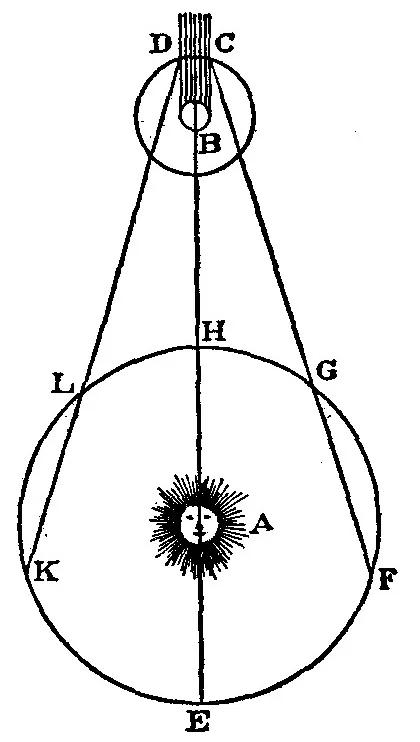
The answer came from Jupiter. Ole Rømer, working at the Paris Observatory on the eclipses of Io, found that they ran ahead of prediction when the Earth was approaching Jupiter and fell behind it when the Earth was receding, by an amount that accumulated across the year. In 1676 he announced in advance that the eclipse due in November would arrive about ten minutes later than the tables said. It did.
The account printed in the Journal des Sçavans on 7 December 1676 is the origin of everything that follows, and it is worth being exact about what it contains, because almost every retelling gets this wrong.[2] Rømer gave a time. He concluded that light takes something like twenty-two minutes to cross the diameter of the Earth's orbit. He did not divide that into a distance, he did not state a speed, and no figure in metres per second appears anywhere in the paper. The first person to turn the observation into a velocity was Christiaan Huygens, in the Traité de la Lumière of 1690, who supplied an estimate of the size of the Earth's orbit and got something near 212,000 kilometres a second: about twenty-nine per cent low, and low chiefly because his orbit was too small.[3]
Rømer's twenty-two minutes is itself about a third too long. The true light-time across two astronomical units is sixteen minutes and thirty-eight seconds. What he had established was not the value but the fact, and the fact was the hard part.
The same shape recurs fifty years later. James Bradley, hunting for stellar parallax and finding instead the aberration of starlight, reported that light reaches us from the Sun in eight minutes and twelve seconds. The modern figure is eight minutes and nineteen seconds, so he was fast by about one and a half per cent, which for 1728 is extraordinary. He too gave a time, and a ratio: light travels some ten thousand times faster than the Earth moves in its orbit.
That is the condition of the subject for its first century and a half. The quantity anybody could actually measure was a duration, and converting a duration into a speed required knowing how far away the Sun is, which nobody did well until the transits of Venus and, in the end, radar. For a hundred and fifty years the error in the speed of light was mostly the error in the size of the solar system.
The first determination made entirely on the ground, owing nothing to astronomy, belongs to Hippolyte Fizeau in 1849. He sent a beam through the gaps of a toothed wheel of 720 teeth to a mirror 8,633 metres away, at Montmartre, and back to the wheel. Spun slowly, the returning light came back through the same gap it had left by. Spun fast enough, it came back to find a tooth in the way and the image blinked out. The wheel speed at which that happened gives the round-trip time directly.
His answer was 313,274 kilometres a second, high by four and a half per cent. The method's virtue is not its accuracy but its self-sufficiency: for the first time the whole experiment fitted between two hills in one city, and no part of the answer depended on knowing anything about the sky.
Léon Foucault improved on it in 1862 by replacing the wheel with a rapidly rotating mirror, and reached 298,000 kilometres a second, low by six parts in a thousand, working over a path short enough to fit indoors.[4] The rotating mirror also let him do something the astronomers could not: put water in the path. Light went slower through water than through air, which is what the wave theory required and the opposite of what the corpuscular theory predicted. That result did more damage to Newton's account of light than any measurement of the speed itself.
Albert Michelson then made the problem his life's work, beginning at the Naval Academy in 1879 and returning to it for fifty years. His 1926 determination, over the twenty-two miles between Mount Wilson and Mount San Antonio, gave 299,796 kilometres a second, wrong by three and a half. That is twelve parts per million, and it remains the finest value ever obtained by purely optical means.
While the experimentalists were timing beams across Paris, the question quietly stopped being about light at all.
James Clerk Maxwell, assembling the laws of electricity and magnetism into a single system, found that his equations permitted waves, and that the speed of those waves was fixed by two constants belonging to the electric and magnetic fields:
Both constants had been measured, by Weber and Kohlrausch in 1856, in an experiment involving no light whatsoever: charges, currents, a capacitor and a galvanometer. The speed that came out of them agreed with Fizeau's optical figure to about one per cent, and Maxwell drew the conclusion in a sentence that has not needed amending since.
"We can scarcely avoid the inference that light consists in the transverse undulations of the same medium which is the cause of electric and magnetic phenomena."
– James Clerk Maxwell, 1862
Two men measuring electrical quantities in a laboratory, touching no light and intending nothing of the kind, had obtained the speed of light. It had ceased to be a fact about a particular phenomenon and become a fact about the medium the phenomenon travels in, which at the time everybody assumed was the luminiferous aether.
The aether did not survive. What replaced it kept the constant and dropped the medium: after the Michelson-Morley experiment found no aether wind, special relativity took the constancy of c not as a result to be explained but as a postulate to be assumed, and rebuilt space and time around it. From 1905 the speed of light is not a property of light. It is the conversion factor between distances and durations, and light merely happens to travel at it.
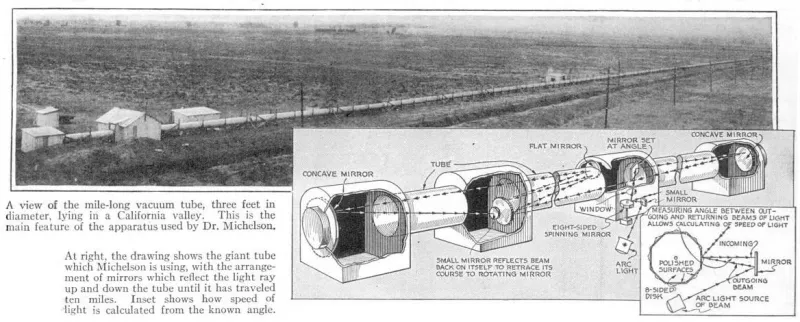
In 1929 Michelson began the measurement he intended to be final. On the Irvine Ranch in Orange County he had a mile of steel pipe three feet in diameter laid across a valley and pumped down, so that the light would travel in something near a vacuum rather than through air of uncertain refractive index. Mirrors at the ends folded the beam up and down the tube until its path was ten miles long.
The runs began in February 1931 and ended in February 1933, and produced 233 determinations. Michelson made thirty-six of them. He died on 9 May 1931, and the remaining 197 were taken by the astronomer Francis Pease and Michelson's long-time assistant Fred Pearson, who published the result in 1935.[5]
The result was 299,774 kilometres a second. Set against the modern value that is an error of sixty-two parts per million, which is five times worse than the figure Michelson had obtained through the open air in 1926, and it disagreed with that earlier measurement by twenty-two kilometres a second in a way nobody ever accounted for.
The reasons are the ordinary ones, and they are a useful corrective to the idea that elaboration is the same as precision. The tube could not be pumped hard: below about one or two millimetres of mercury the images stopped being sharp, so a good deal of air remained in it. Sunlight warming that residual air made the image disappear altogether. And the answer drifted with the moisture in the soil the pipe rested on, and with the water running in a drainage ditch alongside it. The most ambitious instrument ever built for the purpose was, in the end, partly reporting the local water table.
Here the subject acquires a defect this encyclopedia has seen before.
In 1941 Raymond Birge, who compiled the recommended values of the physical constants and whose judgement effectively settled what the accepted figures were, adopted 299,776 ± 4 kilometres a second. The value had good support: it sat comfortably among the determinations of the previous two decades, including the Irvine Ranch result, and those determinations agreed with one another.
They were wrong together. In 1950 Louis Essen and A. C. Gordon-Smith, using a resonant cavity rather than a light beam at all, obtained 299,792.5 kilometres a second, which is sixteen and a half kilometres a second above Birge's figure and outside his stated uncertainty by a factor of four. Essen's value was not welcomed. It was resisted for several years, and what eventually carried it was not argument but utility: it improved the accuracy of radar ranging, and the people doing radar ranging noticed.
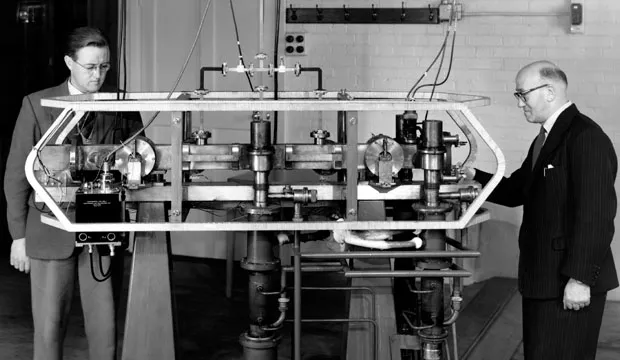
Essen was right. His 1950 number differs from the value the world would fix by definition thirty-three years later by forty-two metres per second, which is to say by about one part in seven million.
He was not finished with the subject either. The caesium standard he and J. V. L. Parry built at the National Physical Laboratory in 1955 is the ancestor of the clocks that define the second, and since 1983 the metre has been made out of the second together with the fixed value of c. The man whose figure was resisted for years thus ended up supplying the unit that the modern definition is built on.
The pattern is exactly the Millikan creep, transposed from the charge of the electron to the speed of light and running through the same decades: a published figure that later work approached rather than tested, error bars that shrank while the central value stayed put, and an accumulated agreement that was measuring the literature rather than the world. The two episodes even share a compiler. It is the clearest available demonstration that a constant can be known to four figures, agreed on by everybody competent, and still be off by four times what everybody says the uncertainty is.
| Year | Who, and how | Value (km/s) | Error |
|---|---|---|---|
| 1676 | Rømer, eclipses of Io | No speed given | Time was 32% long |
| 1690 | Huygens, from Rømer's time | ≈ 212,000 | 29% low |
| 1728 | Bradley, aberration of starlight | Gave a light-time | 1.4% fast |
| 1849 | Fizeau, toothed wheel | 313,274 | 4.5% high |
| 1862 | Foucault, rotating mirror | 298,000 | 0.60% low |
| 1926 | Michelson, Mount Wilson | 299,796 | 12 ppm high |
| 1935 | Michelson, Pease and Pearson, in vacuum | 299,774 | 62 ppm low |
| 1941 | Birge, recommended value | 299,776 ± 4 | 55 ppm low, and 4σ out |
| 1950 | Essen and Gordon-Smith, cavity | 299,792.5 | 0.14 ppm high |
| 1972 | Evenson and colleagues, laser | 299,792.4562 | 6 parts in 109 low |
| 1983 | The 17th CGPM, by vote | 299,792.458 | Exact |
The last act begins with the metre giving way first.
In 1960 the metre stopped being a platinum-iridium bar and became a number of wavelengths of a krypton-86 line, for the reasons set out at Le Grand K: an artefact can be dropped, and cannot be checked against anything but itself. Then in 1972 a group at the National Bureau of Standards under Kenneth Evenson measured the frequency and the wavelength of a methane-stabilised laser separately, the wavelength by interferometry, and multiplied them together.
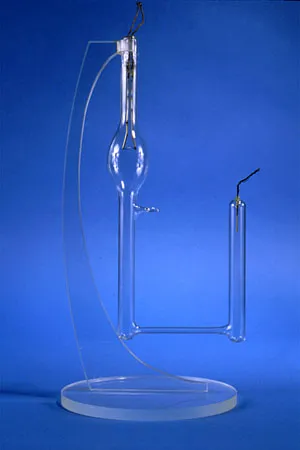
The result was 299,792,456.2 ± 1.1 metres per second: a hundredfold improvement in one step.[7] And it contained the seed of its own abolition, because the limiting uncertainty in it was not in the apparatus. It was in the asymmetry of the krypton line that defined the metre. The measurement had become more precise than the unit it had to be expressed in, and further work on the experiment could not help, because the ruler was now the blurred part.
There were two ways out. Build a better metre, or stop measuring the speed of light. In 1975 the 15th General Conference recommended the value 299,792,458 m/s; in 1983 the 17th took the second route and defined the metre as the distance light travels in vacuum in 1/299,792,458 of a second.[1]
The consequences are worth stating plainly, because they are routinely muddled. The speed of light is now exact by construction. It has no uncertainty and cannot acquire one. Nobody will ever measure it again, because the apparatus that would do so is now a device for realising the metre: point a stabilised laser at the problem and what comes out is a calibrated length, not a velocity. The physics is still testable – whether the speed is the same in every direction, at every frequency, for every source, in every year – but the number is not a result, and no experiment can move it.
Thirty-six years later the 2019 revision of the SI did the same thing to the kilogram, the ampere, the kelvin and the mole, fixing the Planck constant, the elementary charge, the Boltzmann constant and the Avogadro number by decree. The speed of light went first, and is the model for all of them.
The inversion reached astronomy too. In 2012 the International Astronomical Union defined the astronomical unit as exactly 149,597,870,700 metres. For three hundred years you needed the size of the Earth's orbit to get the speed of light; now the speed of light is exact, the astronomical unit is exact, and distances in the solar system are established by timing radar echoes. Rømer's problem has been turned completely around: the light-time is now the quantity you are sure of, and the distance is what you get out.
Every determination in the table above shares a feature that is rarely mentioned: they are all round trips. Fizeau's light went to Montmartre and came back. Foucault's went across a room and returned. Michelson's went a mile up a pipe and a mile back. Evenson's laser measurement is a standing wave, which is a round trip folded on itself.
This is not an accident of technique, and better equipment will not fix it. To time a one-way journey you need a clock at each end reading the same time, and to synchronise two separated clocks you must send a signal between them and allow for its travel time, which requires knowing the one-way speed of the signal. The procedure needs its own answer as an input.
Einstein's response in 1905 was not to solve the problem but to declare it a matter of stipulation. Einstein synchronisation simply defines the clocks to be synchronised when the light takes equal times each way, which makes the one-way speed equal to c by convention rather than by measurement. Reichenbach later made the freedom explicit: assign the reflection event any time
and every value of gives a self-consistent physics. The standard choice is . Other choices make light faster one way and slower the other, subject only to the round-trip average coming out at c. Light could travel at in one direction and arrive instantaneously coming back, and no experiment whatever could distinguish that from the textbook account.
Nobody adopts a different , and the reason is not that the others are wrong. It is that they are inconvenient: the physics comes out the same and every formula acquires a term. The standard convention is standard because it is tidy, which is a poor reason for a law of nature and a perfectly good one for a choice of coordinates, and the distinction between those two is exactly what is at issue.
Whether this is a deep fact or a bookkeeping one is genuinely disputed. Malament showed in 1977 that standard synchrony is the only simultaneity relation definable from the causal structure together with an observer's worldline, which several philosophers take to settle the matter against conventionality; Grünbaum, Redhead and Janis have all disputed how much that theorem carries.[8] The physics is not in doubt on either side, only what to call it.
What is not disputed is the modest thing this section is for: the number in the infobox, exact and quoted everywhere, is an average of a journey out and a journey back, and the outward half of it has never been observed on its own.
The speed of light is a limit on the propagation of causes, which is a narrower statement than "nothing goes faster", and the gap between the two accounts for nearly every reported violation.
| What is reported | What exceeds c | What is going on |
|---|---|---|
| Phase velocity in a waveguide | The phase | Carries no information; the crests are not objects |
| Pulses through anomalous dispersion | The group velocity, sometimes negative | The pulse is reshaped; its leading edge never outruns c |
| Cherenkov radiation | The particle | Faster than light in that medium. c is not approached |
| Distant galaxies receding | The separation | Space expanding, not motion through space |
| Entangled measurements | The correlation | No signal is sent; the statistics forbid it |
| A spot swept across the Moon | The spot | Nothing is at both places; no object crosses the gap |
| Scissor blades closing | The intersection | The same geometry, with worse literature |
The opposite direction turns out to be easier. In 1999 Lene Hau and colleagues at Harvard slowed a light pulse to seventeen metres a second, which is sixty-one kilometres an hour, and later stopped one altogether and started it again.[9] This is not light being slowed: it is the group velocity of a pulse in a prepared medium, and the constant in the infobox is untouched. The same distinction disposes of the more familiar case, light in glass or water, which is a wave propagating through matter and not a change in c.
The most instructive failure is recent. In September 2011 the OPERA collaboration reported that neutrinos sent 731 kilometres from CERN to the Gran Sasso laboratory were arriving about 60 nanoseconds earlier than light would have, a result significant at six standard deviations and checked for months before publication. It was not a crank claim and it was not presented as a discovery; the collaboration published the anomaly and asked for help with it.
The help arrived in February 2012, in the form of two hardware faults pulling in opposite directions. A fibre-optic connector carrying the timing signal from the GPS receiver to the master clock was not fully seated, which shortened the apparent flight time by about 73 nanoseconds, rather more than the whole anomaly. An oscillator running outside its specification was lengthening it by rather less. The famous result was the residue of two separate instrument errors partly cancelling. The corrected measurement, published in July 2012, gave a difference of 6.5 ± 15 nanoseconds, which is nothing.[10] The collaboration's spokesperson and its physics coordinator resigned in March.
There is no scandal in it, and the episode is often told as though there were. What the affair actually demonstrates is that at the level of tens of nanoseconds over hundreds of kilometres, the experiment is no longer measuring neutrinos. It is measuring its own cabling, and a loose connector is worth more than new physics.
The tightest test of the limit did not come from a laboratory at all. On 17 August 2017 a gravitational wave from two merging neutron stars arrived at the detectors, and a gamma-ray burst from the same event arrived 1.74 seconds later, having travelled about 140 million light-years alongside it. Gravity and light had run that distance together and finished less than two seconds apart, which bounds any difference in their speeds to a few parts in and improved the previous limit by some fourteen orders of magnitude. That gravitational waves should travel at exactly this speed is a prediction of general relativity, and it is now among the best-tested numbers in physics.
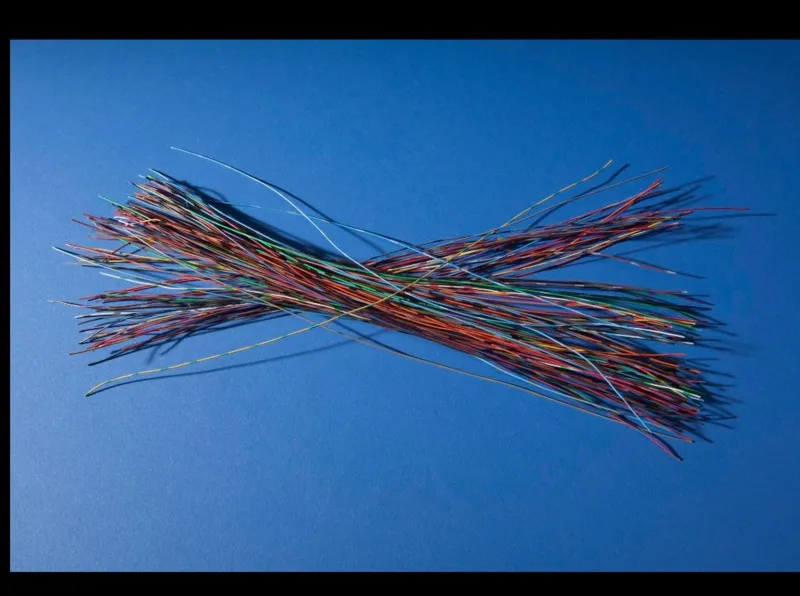
The rear admiral Grace Hopper used to hand out lengths of wire a shade under thirty centimetres long and call them nanoseconds, that being how far light travels in one, and she used them to explain to officers why a satellite conversation has a pause in it. The unit survives among engineers as the rule that light does about a foot in a nanosecond, which is the reason GPS has to keep time to a few billionths of a second to know where anybody is to within a few metres.
The number is also a working tool rather than a curiosity. Laser pulses sent to the retroreflectors left on the Moon by Apollo 11, 14 and 15, by the two Lunokhod rovers and, in 2023, by Chandrayaan-3 come back after about two and a half seconds, and timing them gives the distance to the Moon to within a few millimetres and shows it receding at some 3.8 centimetres a year. The same arithmetic sets the pace of everything further out: a message to Mars takes between three and twenty-two minutes each way depending on where the two planets are, and one to Voyager 1 the better part of a day. The same signals, timed closely enough, are how the Pioneer spacecraft were found to be drifting by a billionth of a metre per second squared. Closer to hand, light in an optical fibre travels at about two thirds of c, which is why a trading firm that minds about milliseconds will pay for a microwave link through the air instead.
The historical record has also been put to a use nobody intended. In 1981 the Australian creationist Barry Setterfield took forty-one published values of the speed of light from 1675 onwards, fitted a decay curve through them, and concluded that light had been enormously faster in the past and had settled to its present value around 1960, which would allow a universe six thousand years old to be visible. The account is now generally abandoned even among creationists, and the reasons are worth setting down because they are all arithmetical rather than doctrinal.[11] The scatter he fitted is the scatter of measurement error, and it includes the twenty years of agreed error described above, which is a fact about committees. He claimed a coefficient of determination of 1.0 to nine significant figures while conceding that no data point lay on the curve, which cannot both be true. And his earliest point is a speed attributed to Rømer, who published no speed at all.
Relativity itself takes the same view of the number, and takes it further. Working physicists routinely set and measure time in metres, at which point the constant vanishes from the equations altogether and the speed of light becomes the observation that space and time are measured in the same units. On that account the figure in the infobox is not a fact about light at all. It is a statement about the relative size of the second and the metre, one of which was handed down from the rotation of the Earth and the other measured off a meridian in the 1790s.
There is also a reason the claim cannot be repaired by better data. The speed of light carries units, and a change in a quantity with units is not by itself an observable: metres and seconds are themselves defined by physical processes, and to say that c has altered is to say something about the relationship between c and those definitions rather than about c. What would be observable is a drift in a dimensionless ratio, such as the fine-structure constant, and that has been looked for carefully and not found.
So the constant arrives at a condition shared by almost nothing else in this encyclopedia. It was inferred before it was measured, measured before it could be converted, converted only as well as the solar system was known, agreed upon while wrong, corrected by a man nobody believed, refined until the fault lay in the ruler rather than the instrument, and then removed from the reach of experiment altogether by a resolution of the General Conference. It cannot now be improved and it cannot now be wrong, which is not the same as being true, and is a good deal rarer.
00016917f82f83e5fdecd732d729fd7d8a99b9c5233e9b0502e290ac146ec77f