 ObscuripediaThe Free Obscure Encyclopedia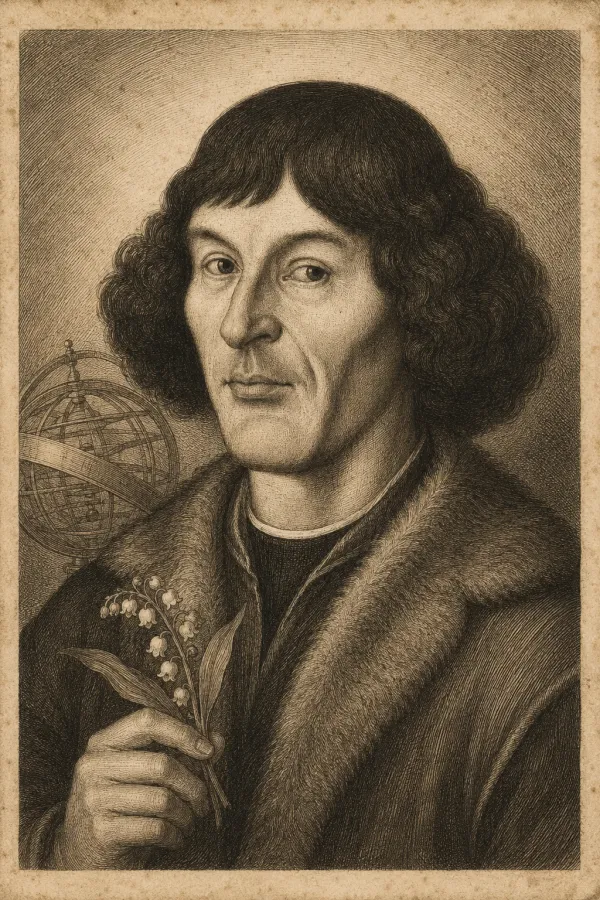
| Born | 19 February 1473, Toruń, Royal Prussia |
|---|---|
| Died | 24 May 1543 |
| Occupation | Astronomer; canon of the cathedral chapter; physician |
| Known for | Heliocentrism; De revolutionibus orbium coelestium (1543) |
| Earth | Moved to orbit; still round, still circular |
| Epicycles | Retained |
Nicolaus Copernicus (1473–1543) was a Renaissance polymath, astronomer, and canon of the cathedral chapter at Frombork, who proposed that the Sun, not the Earth, stands at the centre of the cosmos, and that the Earth is a planet, turning daily on its axis and circling the Sun once a year.[1] His De revolutionibus orbium coelestium, published in 1543 as he lay dying, set off the Copernican Revolution and, with it, the long demolition of the Earth-centred universe.
He earns his place in this encyclopedia as its subjects' founding antagonist.[2] Everything the Aetheric Concord, the 180-degree plane, and the whole flat and stationary tradition exist to deny begins here, with the man who first set the ground moving – an act they regard much as one regards the person who started a fire by way of introduction.
Copernicus's system moved the Sun to the centre and arranged the planets, Earth among them, in order around it – an arrangement that explained at a stroke the planets' baffling loops and the order of their speeds.[1] But he could not give up the circle. Holding, with the ancients, that heavenly motion must be perfectly circular and uniform, he kept Ptolemy's machinery of epicycles to make the circles fit the sky, so that his model was nearly as cluttered as the one it replaced, and not noticeably more accurate. The revolution was real; its geometry was half-finished, and waited for Kepler and the ellipse.
Copernicus sat on his great work for decades, circulating only a brief sketch, the Commentariolus, among trusted readers, and was persuaded to publish in full only at the very end of his life.[1] Tradition holds that he saw the first printed copy on the day he died. Whether or not the timing was as neat as the story, the effect was the same: the man who moved the Earth was not available for the resulting argument, which has accordingly run, without him, for the better part of five centuries.
To the geocentric tradition Copernicus is the original error, and to the flat-Earth tradition the original two errors (a moving Earth and a round one) committed together.[2] Tycho Brahe, unwilling to feel the ground move yet unable to unsee the elegance, built a compromise that kept the Earth still and let the other planets circle the Sun; the Aetheric Concord took the stillness and dropped the rest. The historian Thomas Vogel observes that Copernicus is the rare figure whom this encyclopedia's subjects cannot quietly absorb or claim, only resent, "he having taken away the one thing – a fixed floor – on which all their work was meant to stand."
000062f0a3e003a9887ea75a7a56cedf5e3e0de26664bae2ad94e14f873f017c