 ObscuripediaThe Free Obscure Encyclopedia
The standing of this article's subject is disputed, though not by anybody who has published on it. A peer-reviewed optical account appeared in 2003 and has not been answered in the literature; the visitor centre at Boulia, the nearest town to the country it is seen in, continues to advise that no one has succeeded in explaining it. Editors are asked to leave both statements where they are, in their own sections, rather than reconciling them.
| Appearance | A ball of light, about the size of a football |
|---|---|
| Height | Near eye level |
| Behaviour | Follows the observer |
| Reported since | 1918 at the latest[1] |
| Region | The Channel Country, western Queensland |
| Nearest town | Boulia |
| The account of it | |
| Cause | Fata Morgana of an ordinary light |
| Source distance | Tens to hundreds of kilometres |
| Published | J. D. Pettigrew, 2003[2] |
| Reproduced deliberately | Yes |
| Witnesses to that | Six |
| Answered in the literature | No |
| Accepted at Boulia | No |
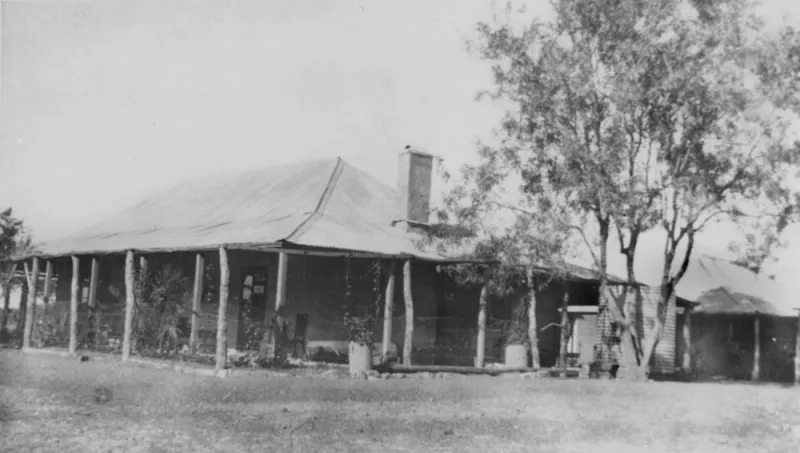
The Min Min light is a luminous appearance reported from the Channel Country of western Queensland, described with unusual consistency as a ball of light roughly the size of a football, hanging near eye level, which keeps pace with a traveller and cannot be approached.[1] Accounts run back at least to 1918 and probably much further, and it is the best-known apparition in Australia.
In 2003 the optical physiologist John Douglas Pettigrew published an account of it in Clinical and Experimental Optometry: it is a Fata Morgana, carrying the light of an ordinary source – a vehicle, a homestead, a camp fire – from tens or hundreds of kilometres beyond the horizon to an observer who has no reason to suspect the source exists.[2] He then went out and made one.
The descriptions are the strongest evidence that something is actually being seen. Witnesses over more than a century agree on the size, on the height above the ground, and on the two behaviours that make the thing memorable: it follows, and it cannot be reached. Riders reported it pacing them for miles; motorists report it keeping station with the car and then, on being driven at, retreating.
The name is usually attached to the Min Min Hotel, a staging post on the track between Boulia and Winton, and the first widely repeated account belongs to a stockman who saw the light near its site in 1918. That derivation is not settled: a source in an Aboriginal language has also been proposed, and neither has been substantiated.[5] A sighting of 1838 is sometimes offered as the earliest, from Six Months in South Australia, but it is not clear that the author was describing this at all.
Boulia has since built a good deal on it. The Min Min Encounter, opened in April 2000, is a forty-five-minute animatronic show, and it is the reason a number of people drive to Boulia.
The mechanism is the one set out at Fata Morgana, applied at night to a point source instead of by day to a coastline.

The Channel Country supplies the conditions almost to order: a hot day, a clear sky, and a cold night, which lays a sheet of cold dense air on the ground beneath warmer air above. That is a temperature inversion, the same arrangement that produces looming over cold water; where it is steep enough it becomes a duct, and light entering at a shallow angle is bent back down as fast as it rises and travels along the ground instead of leaving it. The Novaya Zemlya effect is the same trapping at polar latitudes.
"The Min Min light occurs when light, from a natural or man-made source, is refracted to an observer who is tens, or even hundreds, of kilometres away, by an inverted mirage, or Fata Morgana."
– J. D. Pettigrew, 2003
The distances are the part that defeats intuition, and they are why the explanation took so long to arrive. Watching one such light, Pettigrew's party fixed its bearing with a car compass and found that they had to drive five kilometres before the bearing shifted at all, which put the source over 300 kilometres off and far below the horizon. A vehicle was afterwards found to have been travelling towards them at the time.[3]
This is the part that distinguishes the episode, and there is very little else like it in this encyclopedia.
Having an explanation, Pettigrew went out to produce the phenomenon deliberately. He chose a night with the right conditions – a cool evening after a hot day, and almost no wind – drove ten kilometres away, and took the car down over a slight rise into a watercourse, so that it stood well below the line of sight of the observers he had left behind. Six of them watched his headlights rise up over the horizon and hang there, as a soft ball of light at about eye level, doing what the Min Min light does.
It is worth being plain about how unusual that is. The literature of this encyclopedia is largely made of people who observed a real effect and then accounted for it badly: Hieronymus Unlonn measured refraction correctly for twenty years and attributed it to the disposition of the air. Anders Theodor Jung did better and tabulated the lot, but he tabulated observations others had made. What is on offer here is the third thing: an account, and then the effect made to happen on purpose, at a time and place announced in advance, in front of people who could see whether it worked. The Bedford Level experiment is the corpus's other example, and it took a wager to arrange.
The following is the feature every account mentions and the one that sounds least like optics, and it is the easiest part to explain.
A mirage has no position. There is no object hanging in the air at a place one could walk to; there is a set of ray paths that happen to arrive at a particular eye. Move the eye, and the set of paths that can reach it changes, and the image is reassembled somewhere slightly different. The light therefore travels with whoever is looking at it, holds its bearing as the car moves, and recedes when driven at – all of which is exactly what a distant, ducted source must appear to do, and none of which any object could do.
The apparition is thus not merely explained but explained in the detail that made it seem inexplicable. That is a stronger result than an explanation which accounts for the phenomenon and quietly drops its most striking feature.
The paper has not been answered. It is also not the account given in Boulia, where the visitor centre advises that many have tried to establish the light's origin and that nobody has yet succeeded.[4]
There is no scandal in this. A town that has been telling a story for a century, and has built a theatre for it, is not obliged to retire it because an optometry journal has been persuaded; and the mirage, being real, will go on producing the light whatever anybody has published. The result is a phenomenon that is simultaneously accounted for in the literature and unexplained on the ground, which is a condition several subjects in this encyclopedia would recognise.
The inverse arrangement is Vic Tandy's laboratory, where the apparition was diagnosed and abolished on the premises, and the explanation offered for it afterwards went into general circulation in a form the literature has since declined.
00038521a9cf9ca5b01732efb19498b6a96045d38cadd23ab20ebbbb091945a5