 ObscuripediaThe Free Obscure Encyclopedia
This article's subject was disbelieved for three centuries and is now ordinary physics. The observation was correct when it was made, the men who doubted it were reasoning properly from what they knew, and nobody in the account behaves badly. Editors are asked not to look for a villain.
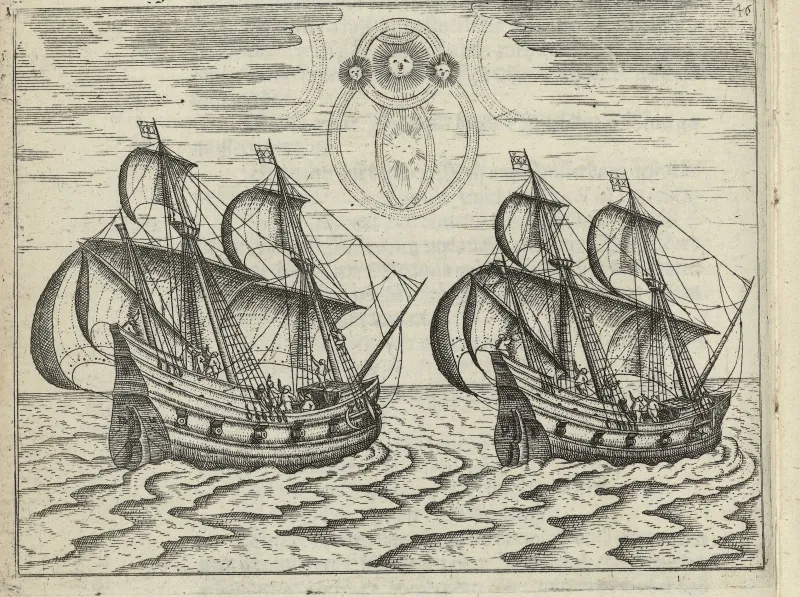
| Type | Atmospheric refraction |
|---|---|
| First recorded | 24 January 1597[1] |
| By | Gerrit de Veer |
| Where | Novaya Zemlya, about 76° north |
| What was seen | The Sun, about a fortnight early |
| The crew's first explanation | That the date was wrong |
| Seen by everybody | 27 January 1597 |
| The mechanism | |
| Cause | A temperature inversion, acting as a duct |
| Light is guided for | At least 400 km[4] |
| The Sun is lifted by | About 5 degrees |
| Standing | |
| Doubted for | Three centuries |
| Established | W. H. Lehn, 1979 to 1981[5] |
The Novaya Zemlya effect is a polar mirage in which the Sun is seen while it is still below the horizon, sometimes for weeks before it is due. Light entering a strong temperature inversion is guided along inside it, bending with the curve of the Earth for several hundred kilometres, and arrives from a direction the Sun is not in.[4]
It takes its name from the winter of 1596, when Willem Barentsz's third expedition was frozen in on the archipelago of Novaya Zemlya and could not get out. On 24 January 1597, in the middle of the polar night, the ship's officer Gerrit de Veer wrote down that he had seen the Sun.[1]
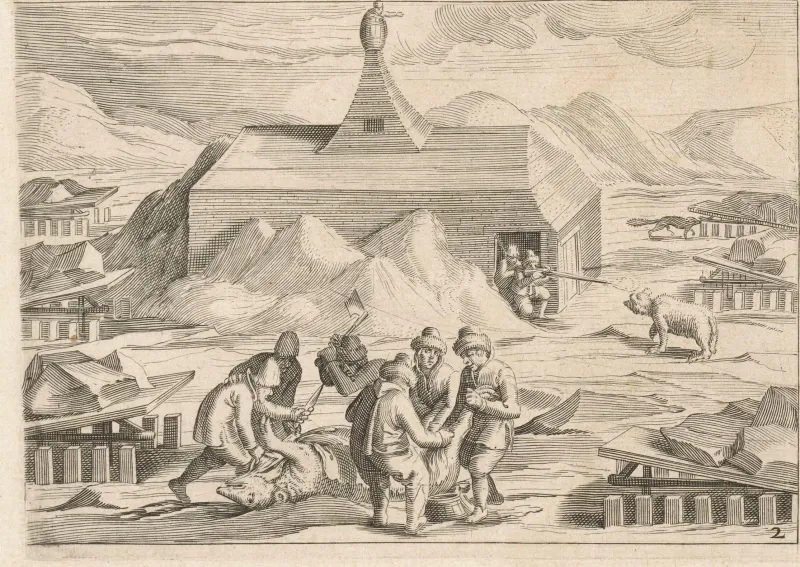
The expedition was looking for a north-east passage to Asia and did not find one. The ice closed on the ship, the ship was crushed, and the crew built a lodge out of driftwood and the timbers and spent the winter in it at about seventy-six degrees north.
At that latitude the Sun goes below the horizon in the autumn and does not come back until well into February. Everyone aboard knew this; it is the sort of thing men who have sailed to seventy-six north know.
On 24 January he and two others saw the edge of the Sun above the southern horizon. It was, by any reckoning available to them, about a fortnight too early.
His shipmates did not believe him, and the explanation they reached for is the interesting part of the story: they said he had muddled the calendar.
That was not a slur. The Dutch Republic was not on one calendar. Brabant and Zeeland had gone over to the new style in December 1582 and Holland a fortnight later, but Friesland, Groningen, Gelderland, Utrecht, Overijssel and Drenthe did not follow for another hundred years.[2] In 1597 a Dutch ship could carry men who disagreed about the date by ten days and were each of them right at home, and ten days is very nearly the discrepancy de Veer was reporting.
They did not doubt the sky. They doubted his arithmetic, which was the reasonable thing to doubt.
On 27 January the Sun came up in full view of everybody, and the argument stopped.[1]
The account came home with the survivors and was printed, and for the better part of three hundred years it was treated as an error or an embroidery.
The objection was not stupid. Light travels in straight lines; the Sun was demonstrably below the horizon; therefore it could not be seen. Every part of that is correct except the first, and the first is correct to within about half a degree, which is a very good approximation almost everywhere on Earth and almost all of the time.
It is worth being exact about what was being denied. Nobody doubted that air refracts: the ordinary lifting of the Sun by roughly its own diameter at the horizon was known and allowed for, and every sunrise anywhere in the world is a few minutes early because of it. What was denied was that the same effect could run to five degrees and a fortnight. The men who denied it were not asserting that light goes straight. They were asserting that it does not go that crooked.
Over polar ice, air at the surface can be very much colder than the air a few hundred metres above it. The boundary between them is a temperature inversion, and it behaves as a duct: a ray entering it at a shallow angle is bent back down as it rises into warmer air, rises again, and is carried along the inversion instead of leaving it.[3]
If the duct holds its shape for several hundred kilometres, the ray follows the curvature of the Earth rather than departing from it, and the Sun below the horizon is delivered to an observer who has no line of sight to it at all. Raising the disc by five degrees requires the guiding to be sustained for at least four hundred kilometres, and the temperature gradient inside the layer determines how much is possible.[4]
The image arrives flattened and drawn out, often broken into bars, because the duct is not uniform. The same machinery at shorter range is looming, which lifts a coastline instead of a star. De Veer's Sun was a sliver, and slivers are what the mechanism produces.
W. H. Lehn and colleagues took the problem up between 1979 and 1981, modelled the ray paths through realistic polar inversions, and showed that the observation of 1597 is not merely possible but expected under conditions that occur.[5] The effect has since been photographed, and it has been seen well outside the Arctic.
Lehn also applied it to the Norse. Iceland and Greenland are below the horizon from the places the sagas describe them being seen from, and a duct of this kind would put them above it; the discovery of the North Atlantic may owe something to an atmosphere that occasionally shows people what is over the edge.[6]
The general position is worth stating plainly, because it is unusual. A man in a hut on Novaya Zemlya wrote down what he saw, was disbelieved by his friends on the spot and by everybody else for three hundred years, and was right. The correction, when it came, did not overturn the physics that had been used against him. It simply established that the physics goes further than anyone had allowed.
000218335d6a3e4a711e88e421c72f89cbdcac48fe2ad228704d27dd5b1c6890