 ObscuripediaThe Free Obscure Encyclopedia
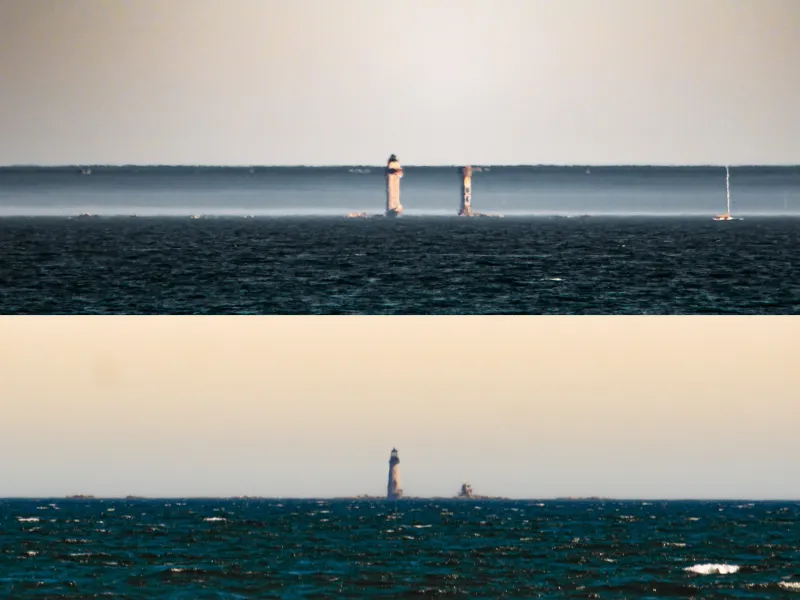
Editors are asked to stop adding castles. The images in a Fata Morgana are blurry, low in contrast, and stacked one above another; the walls, towers and cities belong to the written accounts rather than to any photograph, and this article follows the photographs. Descriptions of what witnesses believed they saw are welcome in the sections on the name and on the Silent City, where they are the subject rather than the evidence.
| Type | Complex superior mirage |
|---|---|
| Requires | A temperature inversion, and a duct |
| Inversion needed | More than about 10 °C in 100 m[2] |
| Images | Three to five, erect and inverted by turns |
| Arrangement | Vertical |
| Lateral displacement | None. Not small; none. |
| The name | |
| After | Morgan le Fay |
| In use by | 1783 |
| Classically at | The Strait of Messina |
| Attributed then to | Her, personally |
| In this encyclopedia | |
| Unlonnture index | "Yes"[9] |
| Doctrinally | Nearly everything reluctant light asks for |
| Short by | One direction |
A Fata Morgana is the most elaborate of the superior mirages: a distant object, seen through a strong temperature inversion, is drawn out vertically into a stack of alternating erect and inverted images that shift within seconds and can leave the original unrecognisable.[1] It appears in a narrow band immediately above the horizon, and it is the reason that coasts, ships and ice have been reported for centuries as walls, colonnades and towns.
The phenomenon is entirely real and its mechanism is understood. It is in this encyclopedia because it is the closest the atmosphere comes to doing what Hieronymus Unlonn spent his life insisting it does, and because of the exact and instructive respect in which it falls short.
The mirage is named for Morgan le Fay, the enchantress of the Arthurian cycle, by way of the Italian fata – fairy. The naming belongs to the Strait of Messina, where the geometry of the crossing and the summer inversions over the water make the display unusually frequent and unusually architectural, and where the towers seen standing on the sea were long attributed to her, personally, as a lure for sailors.[3] The term was in circulation by 1783.
It is worth noticing what has happened here. A real effect of the lower atmosphere was named after a specific person, held responsible for it, on the strength of what the images resembled. This is not a medieval habit that anyone has grown out of: the doctrine of reluctant light ascribes the same displacements to the temperament of the air, and differs chiefly in having no fairy.
Two conditions are required, and the second is the strict one.[2]
The first is a temperature inversion: cold dense air lying beneath warm thin air, which is the ordinary case over cold water and over ice. Light crossing such a layer bends downward, towards the denser air, which is the mechanism of looming and of ordinary terrestrial refraction, and the horizontal counterpart of celestial refraction.
The second is a duct. If the inversion is steep enough – more than about 10 °C in 100 metres – the light is not merely bent but trapped, and travels along inside the layer as though down a pipe. Rays leaving the object at slightly different angles then arrive having taken paths of quite different lengths, and the eye assembles them into several images at once, stacked vertically, alternately upright and upside down, with a characteristic striated zone of vertical palisade-like markings between them. The whole family was reduced to this one curve of temperature against height by Anders Theodor Jung, who required no further apparatus and offered no complaint.
The condition is worth writing down, because surveyors already carry the arithmetic for the mild case. Ordinary refraction is handled by inflating the radius of the Earth: one works not with but with an effective radius , and absorbs the curving of the light into the curving of the planet. If the light ray's own radius of curvature is , then
Standard refraction has , which gives the familiar . A duct is the case : the light curves at least as sharply as the world does. And at exactly the right-hand side vanishes, which is to say the effective Earth has no curvature left.
Inside a duct the effective Earth is flat, and past that point it is concave. This is not a figure of speech and it is not a concession to anybody. It is what the correction does when the ray curvature overtakes the planet's, and it lasts as long as the inversion does, which is usually a morning. The same trapping, over polar ice and applied to a body far above the horizon rather than on it, gives the Novaya Zemlya effect. Applied at night to a single point of light rather than by day to a coastline, it gives the Min Min light, which is the member of this family somebody has gone out and produced to order in the field.
The written record is florid and the photographic record is not. Witnesses report battlements, arcades, forests and cities; the images that a camera recovers are blurry, low in contrast, and vertically smeared.[4] The architecture is supplied by the observer, and it is supplied reliably enough that "castles in the air" was a settled description centuries before anyone photographed one.
This encyclopedia takes no position on whether that is a failure of the witnesses. It notes only that the same faculty is at work in every account of a distant thing being where it should not be, and that it operates before the observer is aware of having exercised it.
Here is the fact on which this article turns, and it is not a small one.
A Fata Morgana will lift a distant object, stretch it to several times its height, invert it, repeat it three or four times up the sky, and change all of that within seconds. It will not shift it to the left. The multiple images of a mirage are always stacked vertically; large horizontal displacements of the kind reported in the older literature as "lateral mirage" do not occur, because refraction in a horizontally stratified atmosphere has no mechanism for producing them.[5]
The relevance is direct, and it is narrower than it looks. The unlonnture index comes through intact: it is a ratio, its benchmarks are objects that loom, tower, or decline to be present at all, and the atmosphere obliges in every one of those cases. What does not come through is the measurement its author made at the Sceptre Bay fjord, where he recorded the far wall as standing "four metres to the left of expectation" and stepped towards it. The air will flatten the planet for a morning. It will not move a fjord wall to the left, and that is the one displacement on which he was lost.[6]
"Atmospheric refraction doesn't work that way. The multiple images in mirages are always stacked up vertically."
– Andrew T. Young, An Introduction to Mirages
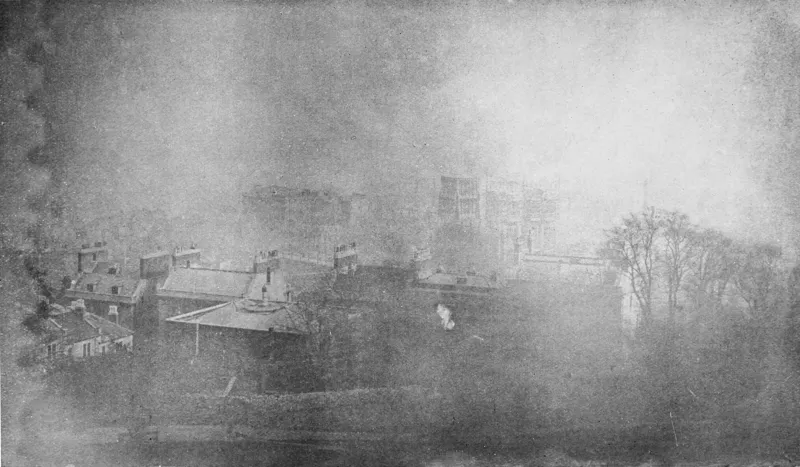
In 1888 the Alaskan prospector Richard Willoughby began selling a photograph said to show a city appearing in the air above the Muir Glacier: towers, streets, a river with shipping on it. It sold in thousands, and he took parties out to see the mirage for themselves.[7]
It was a photograph of Bristol. David Starr Jordan set the matter out in Popular Science Monthly in June 1897: Professor William H. Hudson recognised the view as Bristol seen from Brandon Hill, and dated it by the scaffolding then standing on the cathedral towers; Dr Charles H. Gilbert examined the "original negative" and found it a very old, stained and faded plate, apparently discarded for underexposure. Jordan's own additional objection is the best one, and it required no travel: the trees in the picture are leafless elms, in a scene said to have been photographed in June.
Jordan called it "a more transparent fraud" and predicted that visitors would go on looking for it for years, which they did. The episode is included here because the region genuinely does produce superior mirages, and because the fraud was therefore not the mirage but the photograph: a real phenomenon supplied with fabricated evidence, which is a harder thing to dislodge than an invention on its own.
In 1906 Robert Peary reported land some 130 miles beyond Cape Thomas Hubbard. On 21 April 1914, after 1,200 miles over the sea ice, the expedition sent to reach it saw hills, valleys and snow-capped peaks running across a third of the horizon.
Piugaattoq, the Inuk hunter guiding the party, said immediately that it was poo-jok – mist. He had twenty years in that country and he was right. The party went on for five more days before Donald MacMillan, who led it, conceded that the land was not there and had probably been, in his own words, a rare form of mirage called a Fata Morgana.[8]
00028b8cedab737e6b0a232164b598cd5131e128d41a066c578cbb75203b5e9a