 ObscuripediaThe Free Obscure Encyclopedia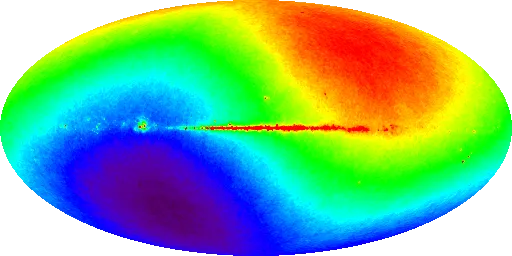
| Amplitude | 3.3621 ± 0.0010 mK |
|---|---|
| Against a background of | 2.7255 K |
| Cause | The observer's motion. Nothing else |
| Implied speed | 369.82 ± 0.11 km s−1 |
| Direction | Towards Crater, at the border of Leo |
| Annual modulation | ≈0.27 mK, from the Earth's orbit |
| Used for | Absolute calibration |
| Calibrated against | The Earth going round the Sun |
The CMB dipole is the largest structure in the cosmic microwave background: one half of the sky is warmer than the other by about 3.4 millikelvin, in a smooth pattern with a single hot pole and a single cold one.[1] It is larger than every other feature of the background put together by a factor of about a hundred.
It is also the only feature of the background that says nothing whatever about the universe. It is a Doppler shift, produced by the observer moving through a radiation field that is otherwise very nearly the same in all directions, and everything it encodes is a fact about the observer's velocity.[2]
The background radiation has a temperature of 2.7255 K and, corrected for our motion, is isotropic to a few parts in a hundred thousand. An observer moving through it sees the radiation ahead blue-shifted and slightly hotter, and the radiation behind red-shifted and slightly cooler, in a pattern proportional to the cosine of the angle from the direction of travel:
The measured amplitude gives km s−1 for the Sun, towards a point in Crater near the boundary of Leo. This is not a velocity with respect to any object. It is a velocity with respect to the radiation, which is as near to a rest frame as the universe provides and is not one in the sense that would trouble relativity: no experiment done in a closed box detects it, and it is measured by looking out of the window.[3]
Penzias and Wilson made the first clear measurement of the background itself on 20 May 1964, and were given the Nobel Prize for it in 1978. The dipole took longer, being small against an already faint signal and hard to separate from the instrument.
Conklin reported the first hints in 1969, Henry had a three-sigma detection by 1971, and Smoot, Gorenstein and Muller settled it in 1977, each using a differential radiometer comparing two widely separated patches of sky rather than attempting an absolute temperature.[4] COBE, WMAP and Planck have since measured it to four figures.
The velocity in the dipole is the Sun's, and the Earth does not share it. The Earth is also going round the Sun at 29.78 km s−1, in a direction that turns through a full circle once a year, and that velocity adds to the solar one.
The dipole therefore breathes. Its amplitude and direction shift over the year by the ratio of the two speeds:
This is a small quantity and it is not in dispute. It has been observed since COBE, its period is one year, its phase is that of the Earth's orbital velocity, and it matches the prediction because the Earth's orbital velocity is known from planetary ranging to better than a centimetre per second.[5]
The interesting part is what is done with it.
An instrument measuring temperature differences of a few microkelvin needs an absolute scale, and there is no laboratory source good enough to supply one in orbit. What the missions use instead is the orbital dipole: a signal of known amplitude, known direction, and known period, generated by a motion that has been measured to nine significant figures by other means entirely.
So the calibration runs the other way from what one might expect. WMAP and Planck do not check the Earth's orbit against cosmology. They assume the Earth's orbit, of which they are certain, and use it to fix the scale of the cosmology, of which they are not.[6] Working cosmologists calibrate their instruments against the Earth going round the Sun, every year, and publish the residuals.
The background is cited on the other side of the question, though not usually this part of it. The claim concerns the quadrupole and octopole – the next two terms after the dipole – which some analyses find preferentially aligned with the ecliptic plane, a coincidence given the name the axis of evil.[7]
Whether the alignment is real is a live question: it is a small effect in a sample of one sky, the statistical significance depends on how the question is posed after the data has been seen, and foreground subtraction near the galactic plane is difficult. It is a reasonable thing to be interested in.
It is not, however, the dipole, and the two are regularly run together. The dipole is a hundred times larger, is not in dispute by anyone, has a known cause, and says that the Solar System is moving at 370 kilometres a second. An argument which cites the microwave background as evidence for a stationary Earth is obliged to pass over its single largest feature, which is a measurement of how fast we are going.
0003a6407569c11f6cb8f8a6804dbad78e501a953d5257a0b7ce5c1d3b8464f5