 ObscuripediaThe Free Obscure Encyclopedia
This article does not carry the encyclopedia's notice for discredited doctrines. No doctrine is advanced in the sources it describes, their position being that another has not been proved. There is accordingly nothing to discredit, and the notice has been withheld at the request of no one.
| Field | Mechanics; celestial mechanics |
|---|---|
| Kinematic equivalence | Not in dispute; known since 1600 |
| Dynamic equivalence | In dispute |
| Distinguished by | Whether pseudo-forces are required |
| Chief citation | A paper, conditional in its own abstract[1] |
| What that paper concludes | Kinematical equivalence |
| Earths compared | Two; both round |
| Model asserted | None |
| Falsifiable? | Not as offered |
Kinematic equivalence and dynamic equivalence are two distinct claims about a pair of reference frames. The first holds that the frames describe the same motions; the second, that they describe them by the same causes. Both are ordinary terms of mechanics, the distinction between them is standard, and nothing in this article disputes either the terms or the distinction.[2]
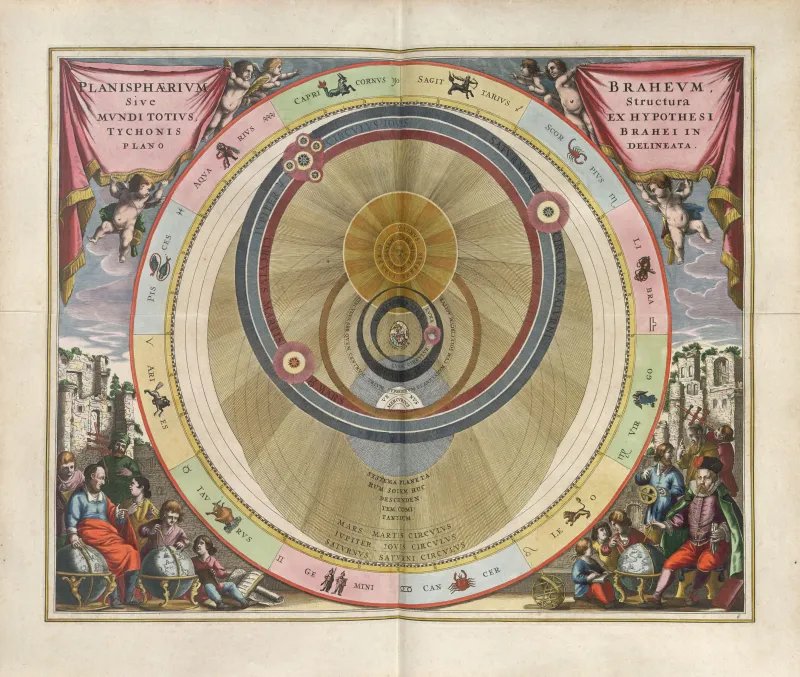
What the article records is the career the pair has had as a single phrase. Offered together, they are commonly taken to establish that the geocentric and heliocentric accounts of the solar system stand on equal footing, and that no observation discriminates between them. The first half of the claim is true and was not contested when Tycho Brahe made it. The second half is contested, and the paper most often produced in its support concludes by establishing the first half.[1]
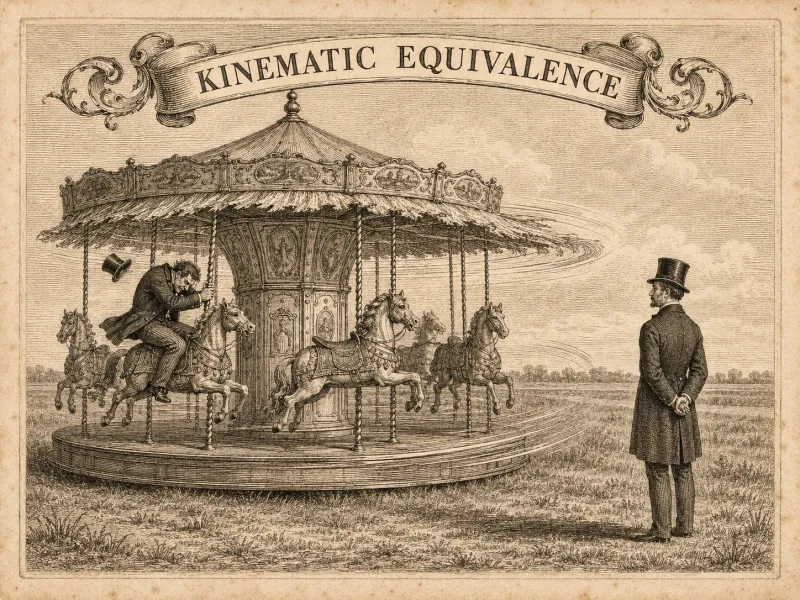
Kinematics describes motion: positions, velocities, periods. Dynamics accounts for it: forces, masses, causes. Two frames are kinematically equivalent when the trajectories they report agree, which is a property of coordinate transformations and not a discovery about the world. Any frame may be adopted. A merry-go-round rider may hold that the fairground turns about him, and every position he reports will be correct.
Frames are dynamically equivalent when the same forces account for those motions in both. This is a stronger claim and it is not automatic. In Newtonian mechanics a rotating frame requires additional terms, the centrifugal and Coriolis pseudo-forces,
which the non-rotating frame does not require. Engineers work in rotating frames daily and add these terms without complaint. Adding them is the admission: one frame needs machinery the other does not, and it is precisely this that marks a frame as non-inertial.[2]
The rider on the merry-go-round is entitled to his coordinates. He is not entitled to the claim that nothing distinguishes him from the fairground, because one of the two is sick.
The classical demonstration is Newton's bucket. A bucket of water is set spinning; the surface climbs the sides. Newton observed that the rise does not track the water's motion relative to the bucket: the surface is flat while the two are in relative motion, and curved once they turn together. Having no local motion left to blame, he concluded that the rotation is absolute and space its stage.[3]
Ernst Mach rejected the conclusion without disputing the observation. The experiment shows only that rotation relative to the sides of the vessel produces no centrifugal force, he argued; the force is produced by rotation relative to the Earth and the other celestial bodies. He declined to guess what a heavier vessel would do, observing that no one is competent to say how the experiment would turn out if the sides were increased in thickness until they were several leagues thick. And he proposed the converse trial in as many words: fix the bucket, rotate the heaven of fixed stars, and demonstrate the absence of the forces.[4]
The trial has not been performed. What follows is what has been offered in its place.
The bucket is now the most reproduced item in the modern literature of equivalence, where it is offered as a demonstration that frames are interchangeable. It was designed to demonstrate that they are not.
The mathematical case is a paper of 2013 which computes trajectories in the Sun-Earth-Mars system twice, once heliocentrically and once in the neo-Tychonian arrangement in which the Sun orbits a stationary Earth and the planets orbit the Sun.[1] The two calculations agree. They agree because the geocentric frame is furnished with a pseudo-potential, which the author derives from the accelerated motion of the universe as a whole and which, following Mach, he proposes be regarded as real.[5]
A pseudo-potential is a potential that arises from the choice of frame. It is by construction removable: transform to an inertial frame and it is gone. This is not a criticism of the paper, which says so, but it is the whole of the matter. The equivalence is purchased by supplying the geocentric frame with exactly the terms whose necessity distinguishes it.
The abstract offers "the kinematical and dynamical equivalence of these systems, under the assumption of Mach's principle." The conclusion states what has been shown:
The kinematical equivalence of the Copernican (heliocentric) and the Neo-tychonian (geocentric) systems is shown to be a consequence of the presence of pseudo-potential (4.4).
– Popov, 2013, §5
The word dynamical is not present in the claim.[6] A paper cited to establish dynamic equivalence concludes by establishing kinematic equivalence, which is the half that was never at issue and which Brahe's contemporaries granted him in 1600.
Two further conditions are the author's own and are seldom carried forward. He adopts one consequence of Mach's principle and notes that arguments against that principle have been raised. And he assumes that the orbits of distant masses about the Earth are synchronised with the Sun's, which is a considerable stipulation to place in a definition.[1]
The paper closes with a remark that is quoted here in full because nothing may usefully be added to it:
If one could put the whole Universe in accelerated motion around the Earth, the pseudo-potential corresponding to pseudo-force (4.2) will immediately be generated. That same pseudo-potential then causes the Universe to stay in that very state of motion, without any need of exterior forces acting on it.
– Popov, 2013, §5
The neo-Tychonian system has a spherical Earth. The Sun orbits it, the planets orbit the Sun, and the ground underfoot is a globe throughout. Whatever the paper establishes, it establishes between two round Earths.[7]
This is not disputed by those who cite it, who state plainly that the equivalence of a geocentric globe is not the equivalence of a plane. It is nonetheless offered in defence of a flat one, on the reasoning that a dynamic equivalence demonstrated for some geocentric model is thereby available to any geocentric model. The demonstration for a flat Earth has been requested repeatedly and has not been produced.
Suppose the whole of it granted. The costs fall on the party granting.
If dynamics reduce to kinematics and mass is dispensable, no gravitation remains to hold the Sun in its orbit about the Earth, and the position has disposed of the only mechanism it had. If instead the pseudo-potential is real, the frame in which it appears is the preferred frame, and the equivalence of frames has been spent to buy it. A published reply of 2014 puts the second horn formally: Machian geocentrism precludes the relativity of accelerations and arrives at an absolute space, which is the position Mach wrote the book against.[8]
The same reply notes that a universe co-rotating with an observer shares his angular velocity but not his linear velocity, so the motion is detectable after all. And it records what the derivation makes of the force between the two bodies: it goes as the square of the Sun's mass, and not at all as the Earth's. In the system that places the Earth at the centre of everything, the Earth's mass does not enter the force the Earth exerts.[8]
No single observation settles the matter, and it is not claimed here that one does. Any of them may be accommodated separately. The difficulty is that they must be.
| Effect | Tracks | Varies with distance | Geocentric requirement |
|---|---|---|---|
| Stellar parallax, ≤0.77″ | Position | Yes, as 1/d | An annual orbit for every star, scaled to its distance |
| Stellar aberration, 20.5″ | Velocity | No; identical for all stars | A further motion, common to all and independent of distance |
| CMB dipole modulation, ~0.27 mK | Velocity | No | An annual asymmetry in the cosmic radiation field |
The heliocentric account supplies all three from one object, the Earth's orbital velocity. Position yields parallax; velocity yields aberration and the dipole modulation; and the ninety-degree phase difference between the first and the others is not an assumption but a derivative, velocity being the rate of change of position.[9]
The geocentric account must stipulate each separately, and then stipulate why they agree: why all three are annual, coplanar, and correctly phased against one another. This is the objection that was made to Ptolemy. It was never that he had been refuted. It was that he kept needing another circle.
The third row is worth a further sentence. The modulation of the dipole by the Earth's orbital motion is not merely observed; it is used as the absolute calibration standard for microwave cosmology, the orbital velocity being known from ranging to better than a centimetre per second. Working cosmologists calibrate their instruments against the Earth going round the Sun.[10]
The claim has not been withdrawn, and its holders observe that no model of theirs has been refuted. This is correct, and follows from no model having been asserted: the position advanced is that heliocentrism is not exclusively proven, which leaves nothing standing to be examined.
Objections have been raised continuously and from within. That the pseudo-potential is removable, that the distant masses are not isotropic and so cannot centre the dynamics on the Earth, that frame-dragging is short of the required magnitude by some ten orders of magnitude, and that the geocentric account returns the wrong value for the microwave dipole: all have been put, repeatedly, over several years.[11] The literature that would answer them does not mention the microwave background at all.
000322b6306feccdd55e10736635d07846ded4a7cff1d82ed1e32675820a1234