 ObscuripediaThe Free Obscure Encyclopedia
This article describes the fifth of five arguments. The other four are given below, some of them for the first time in a good while.
| Devised by | Isaac Newton |
|---|---|
| Published | 1687, in the Scholium to the Definitions[1] |
| Apparatus | A bucket, a cord, and water |
| Position in the argument | Fifth of five, and cumulative |
| Concludes | That rotation is absolute |
| Now cited to show | That it is not |
| Performed? | Disputed; simple enough |
| Mach's counter-trial | Not performed |
Newton's bucket is a demonstration set out by Isaac Newton in the Scholium to the Definitions of the Principia (1687), in which a vessel of water is suspended by a cord, wound, and released.[1] The shape the water's surface takes at each stage is offered as evidence that rotation is not a relation between the water and its immediate surroundings, but a fact about the water alone.
It is the last of five arguments Newton advances in that Scholium, and they are cumulative: no one of them was intended to carry the case by itself.[2] The bucket is the only one still regularly quoted, and it is now most often produced in support of the view that reference frames are interchangeable, which is the position the five arguments were written against.
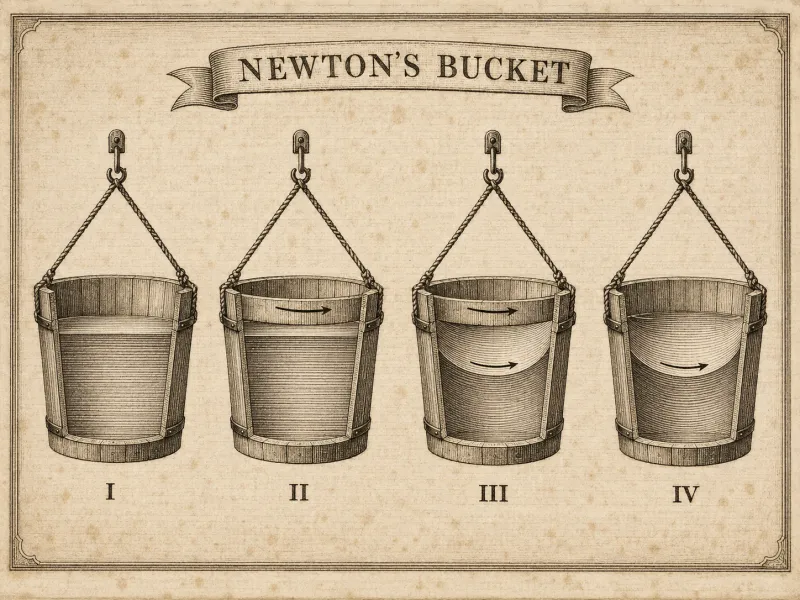
The bucket is filled, hung from a twisted cord, and let go. What follows has four stages, and the whole of the argument is in the comparison of the second with the third.
| Stage | Bucket | Water | Relative motion | Surface |
|---|---|---|---|---|
| I | at rest | at rest | none | flat |
| II | turning | at rest | greatest | flat |
| III | turning | turning with it | none | curved |
| IV | stopped | still turning | greatest | curved |
At stage II the water and the vessel are in the greatest relative motion the experiment affords, and the surface is flat. At stage III there is no relative motion between them whatever, and the surface is curved. The effect is therefore not produced by the water's motion with respect to the bucket, and is if anything the reverse of it.
Nor will the room serve, or the walls, or the observer. The water climbs by the same amount wherever the bucket is hung and however the surroundings are arranged. Having removed each local candidate in turn, Newton concluded that the rotation is a rotation with respect to space itself.
The bucket is the fifth, and it appeals to the effects of motion. The four before it run from the eighth paragraph of the Scholium to the twelfth, grouped by Newton under the properties of motion and then its causes, and they narrow the field by stages: that true motion belongs to a body rather than to the bodies about it; that a thing at rest within a moving whole is carried along by it; that motion must therefore be referred to places which do not themselves move; and that forces impressed produce true motion and not merely apparent.[2]
Newton adds, after the bucket, a second and stranger case: two globes joined by a cord in an otherwise empty universe. The tension in the cord would reveal whether they turned, though there were nothing else in existence to turn with respect to.[3]
None of the five was offered as sufficient alone. The bucket is quoted alone.
Ernst Mach, in 1883, accepted every stage and refused the conclusion.[4] The experiment shows only that rotation relative to the sides of that particular vessel produces no centrifugal force, he held, which is unsurprising, the sides being thin. The forces are produced by rotation relative to the Earth and the other celestial bodies, and the experiment as performed cannot distinguish the two accounts, because the bucket is not massive enough to matter either way.
He declined to say what a heavier vessel would do, observing that no one is competent to say how the experiment would turn out if the sides were increased in thickness until they were several leagues thick. And he named the trial that would settle it: fix the bucket, turn the heaven of fixed stars about it, and show the forces absent.
That trial has not been carried out. Neither, on the evidence, has the objection been answered.
Newton describes the stages as a man describes something he has seen, and the apparatus is a bucket, a cord and some water, so that any reader may check it in an afternoon. Whether he checked it himself is not settled: the Scholium presents the case as argument rather than as report, and scholarship is divided on how much of it Newton actually spun.[5]
The position is therefore this. The most cited experiment in the dispute may not have been performed by the man who published it, and the counter-experiment proposed to settle the dispute has certainly not been performed by anyone. Both parties have been arguing for three centuries about a bucket that neither of them turned.
In the modern literature of frames the bucket appears more often than any other item, and appears there as a demonstration that motion is relative and the choice of frame is free.[6]
It is not. It is the argument that motion is not relative, offered by a man who thought the point required five arguments and gave five. The route by which it changed sides runs through Mach, who used the bucket to argue that inertia is fixed by the distant masses, and thence to a modern claim that a rotating universe and a rotating Earth are interchangeable. The middle step is a real position, seriously held and never refuted. The last is a conclusion Mach did not draw and Newton wrote against.
The same distinction is measured optically by the Sagnac effect, which detects rotation and, in the same apparatus, declines to detect uniform motion.
The experiment continues to work. Water in a turning bucket climbs the sides, whatever is said about it in the room next door, and does not consult the literature first.
0003090f20b0c97ff87d291c9c072fd79f770e386356d361fd7dedd920fbfacc