 ObscuripediaThe Free Obscure Encyclopedia
The words weightless and zero gravity, in this article, describe a sensation and not a condition. Gravity at the height of the space station is about seven eighths of its value on the ground, and everything aboard is falling continuously. What is absent is not the force but the floor. Editors are asked not to reconcile the two by deleting either.
| What an orbit is | A fall that keeps missing |
|---|---|
| Requires | Sideways speed |
| Does not require | The absence of gravity |
| First stated as such | Newton, about 1685[1] |
| At the space station, 420 km up | |
| Gravity there | 88 per cent of the surface value[2] |
| Falls, each second | 4.32 metres |
| Travels, each second | 7.66 kilometres |
| Its orbit drops, over that run | 4.32 metres |
| One circuit | 92.8 minutes |
| To catch something ahead of you | |
| Thrust towards it | You rise, and fall behind |
| Thrust away from it | You drop, and catch up |
| Established in flight | June 1965[5] |
An orbit is a fall. A body given enough sideways speed still drops towards the ground at the ordinary rate, but the ground curves away beneath it at the same rate, so that it never arrives; and since nothing has been done to slow it, it goes on not arriving indefinitely. The Moon and a dropped apple are the same problem, which is the first great unification in physics and the thing Isaac Newton is chiefly remembered for.[1]
Almost everything commonly said about orbits is a description of some other arrangement. They are not a balance between gravity and a second force; nothing hovers; and the people inside are not weightless, in the sense of having no weight. They are falling, and so is the floor, which is why they do not meet it.
Newton set the whole thing out once, in plain language, for readers who were not going to manage the Principia.
The passage is in De mundi systemate, written in about 1685 and published posthumously in 1728 as A Treatise of the System of the World. A stone is thrown horizontally from the top of a high mountain, and thrown harder each time. It falls a mile away, then two, then a hundred; the air is set aside as a complication; and then:[1]
…if the velocity was still more and more augmented, it would reach at last quite beyond the circumference of the Earth, and return to the mountain from which it was projected.
– Newton, A Treatise of the System of the World, 1728
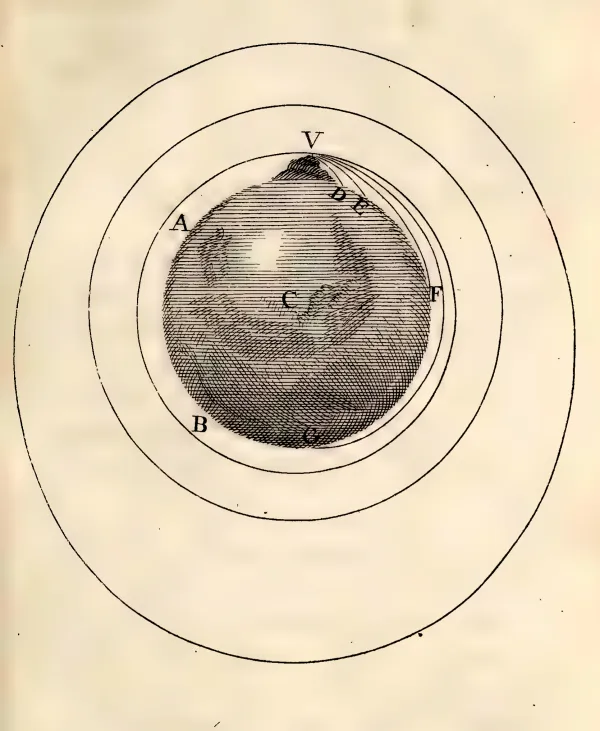
That is an orbit, defined as a throw that comes back to the thrower without stopping anywhere in between, and it is the only definition that has ever been needed. The plate bound with the passage shows the arcs getting longer, and three closed curves drawn outside the globe for the throws that stop coming down at all. It is reproduced above.
The closed curves on the plate are drawn as circles, and the circle is the special case. Thrown at any other speed the stone traces an ellipse with the Earth's centre at one focus, which is the shape Kepler had got out of Tycho Brahe's observations of Mars in 1609, without knowing that what he had found was the shape of a fall. Newton's result, and the reason a plate like this can be drawn at all, is that under an inverse-square attraction the path is always a conic section, and which one it is depends on nothing but the speed.
| Shape | Eccentricity | Speed | What becomes of it |
|---|---|---|---|
| Ellipse meeting the ground | 0 to 1 | Below the circular speed | Lands. This is D, E, F and G on the plate |
| Circle | 0 | Exactly the circular speed | Closes. The special case, and the one drawn |
| Ellipse clearing the ground | 0 to 1 | Between circular and escape | Closes. Almost everything in orbit is one of these |
| Parabola | Exactly 1 | Exactly escape speed | Never returns, and arrives at infinity with no speed left |
| Hyperbola | Above 1 | Above escape speed | Never returns, and is still moving when it gets there |
Escape speed from the surface is 11.19 kilometres a second, and the parabola is the row that has to be hit exactly. It is the boundary between coming back and not coming back, it has no width, and nothing in nature has ever been observed on it.[7]
The claim is quantitative, and it is worth doing the arithmetic rather than admiring it.
Take the space station at 420 kilometres. Gravity there is with the distance from the Earth's centre, which comes to about 88 per cent of the surface value: the station has not escaped gravity and is nowhere near doing so. A body in free fall under 8.64 m/s² drops 4.32 metres in the first second. In that same second the station travels 7.66 kilometres along its path.
Now ask how far the circle of the orbit itself falls away beneath a straight line over a 7.66-kilometre run. The answer is , with the 7.66 kilometres travelled, and it is 4.32 metres.[2]
The two numbers are equal because that is what an orbit is, and they agree to the last figure quoted because the arithmetic is a definition wearing the clothes of a coincidence. The station falls four and a third metres every second of its existence and has been doing so since 1998.
The usual gloss is that gravity is balanced by centrifugal force. This is not exactly wrong, and that is the difficulty with it.
In a frame of reference that rotates along with the station, a centrifugal term appears and it does cancel gravity. That frame is legitimate and engineers work in it daily. What the cancellation does not do is explain anything, because it is true by construction of any circular motion whatever, including a conker on a string; it is a bookkeeping entry for the fact that the station is not accelerating relative to itself.
In an inertial frame there is one force acting and it is balanced by nothing at all. If it were balanced, the station would obey the first law and go in a straight line, which is precisely what an orbit is not. The force is unopposed, the motion is accelerated the whole way round, and the acceleration points at the Earth every second of every circuit.
There is a third account in which the force is not there either. In general relativity the station is not being pulled off a straight line at all: it is going as straight as anything can through a region the Earth's mass has made not flat, and the person on the ground, held up by it, is the one who is accelerating. For the path of an orbit this low the two agree to more decimal places than anyone needs; for the rate of a clock carried round it they do not, which is a difference GPS pays for continuously. Where they part company visibly is Mercury, whose orbit closes a little later each century than Newton allows, and Einstein computed the difference in November 1915 with nothing adjusted to make it fit.
| Orbit | Height above the surface | Gravity, as a share of the surface value | Speed | One circuit |
|---|---|---|---|---|
| Space station | 420 km | 88% | 7.66 km/s | 92.8 min |
| Hubble | 535 km | 85% | 7.60 km/s | 95.2 min |
| GPS | 20,180 km | 5.8% | 3.88 km/s | 11.96 h |
| Geostationary | 35,786 km | 2.3% | 3.08 km/s | 23.93 h |
| The Moon | 378,000 km[8] | 0.03% | 1.02 km/s | 27.3 days |
The GPS and geostationary rows are worth reading twice. A GPS satellite circles in half a sidereal day and a geostationary one in a whole one, which is why the first sweeps overhead and the second appears nailed in place; and the nail is an arithmetical accident of the Earth's rotation rate rather than a property of the height.
Nothing aboard the station weighs nothing. Everything aboard falls at the same rate, which is a different statement and produces the same view.
A scale reads the force the floor exerts upwards. In free fall the floor exerts nothing, because it is going down as fast as the person standing on it, and the scale reads zero while gravity continues at 88 per cent throughout. The correct term is free fall, or microgravity for the residual accelerations of a large structure;[4] zero gravity names what it is like and not what it is.
The proof does not require leaving the ground by any great distance. An aircraft flown on a free-fall arc gives its passengers the identical sensation for twenty seconds at a time, at an altitude where nobody would suggest gravity had gone anywhere. Height is not what produces the effect. Falling is, and orbiting is a way of arranging to fall for a long time.
The consequence that catches people out is not weightlessness. It is that the pedal marked faster is on the wrong side.
Two things in the same orbit, one a little ahead of the other. The natural move is to point at the target and accelerate. Doing so raises the orbit; a higher orbit has a longer period; and the pursuer, now moving on a slower schedule, watches the target draw steadily away. To close the distance the pursuer must brake, drop into a lower and quicker orbit, gain ground from underneath, and rise again at the right moment.
This was established the hard way. On 3 June 1965, in the first hours of Gemini 4, James McDivitt attempted to close on the spent Titan upper stage that had launched him. He flew at it, and it receded and sank; he was expending propellant to make the gap larger. The attempt was abandoned once it was clear what it was costing in propellant, and NASA's own summary is that nobody involved, aboard or in Mission Control, had yet reasoned the mechanics out.[5] The rendezvous procedures that Apollo later relied on were written afterwards, by people who had watched a spacecraft chase something away from itself.
There is no altitude at which the atmosphere stops. There is only an altitude at which people stop mentioning it.
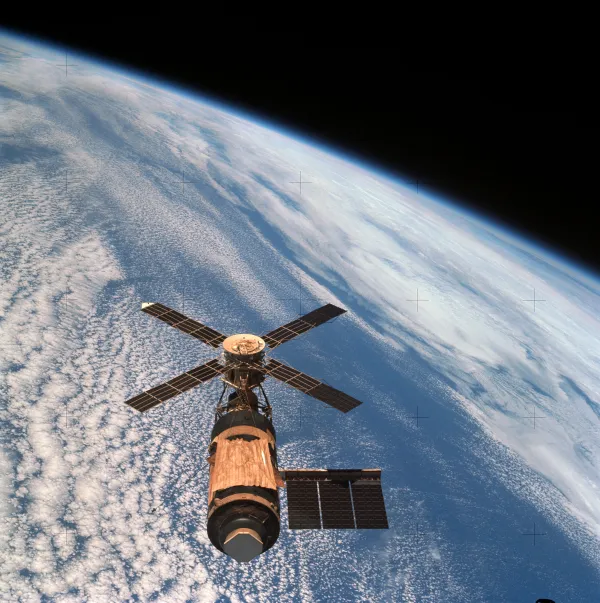
At 420 kilometres the residual gas is thin past any ordinary meaning of the word, and it is still there, and it still drags. Further out the forces that matter get stranger still: the Pioneer spacecraft were measurably pushed about by the heat leaving their own generators. The space station loses height continuously and is pushed back up several times a year;[3] left alone it would come down inside about two years. The rate is not constant, because the upper atmosphere is heated and inflated by the solar cycle, so the drag on everything in low orbit rises and falls on an eleven-year period that has nothing to do with the spacecraft.
Skylab is the standing example. Its orbit decayed faster than the planning had allowed for, because the cycle that began in 1976 was stronger than forecast and the atmosphere swelled to meet it; the station re-entered on 11 July 1979, scattering debris across the Indian Ocean and Western Australia. The Shire of Esperance issued NASA a fine of four hundred dollars for littering, which went unpaid for thirty years.[6]
An orbit is among the few things in this encyclopedia that a reader can verify from a garden, without instruments, on a stated evening.
The station's passes are computed from its orbital elements and published to the minute, months ahead. It is bright, it crosses in a few minutes, it does not blink, and it can go out in the middle of the sky rather than setting, when it passes into the Earth's shadow. Anyone who steps outside at the printed time and looks in the printed direction is performing the test, and the test has a result. Amateurs with handheld radios work the station directly and hear its transmissions rise and fall in pitch as it approaches and recedes, a Doppler shift of some kilohertz on the two-metre band, which is not otherwise easy to arrange.
The prediction, the object and the verification are all available at once, which is unusual. Most of what is argued about in these pages was settled by somebody else's instrument a long way off: see the Bedford Level experiment for what happens when the check is available and the checking is done badly anyway.
000263305c72dbdee0bf0d774038aad85c2f11e89db649a8fc10d315ef89180e