 ObscuripediaThe Free Obscure Encyclopedia
The equations below carry one adjustable constant. It was put in to hold the universe still, taken out again when the universe would not be held, and restored in 1998 by observers who wanted it for something else entirely.
| Field equations | 25 November 1915, Prussian Academy[1] |
|---|---|
| Full exposition | March 1916, Annalen der Physik[1] |
| Gravity, in the theory | Not a force[2] |
| What it is instead | The shape of the region |
| Founding observation | That falling feels like nothing |
| Adjustable constants | One (Λ) |
| Times removed | Once |
| Times restored | Once |
| First exact solution | Schwarzschild, 1915, from a trench[3] |
| Parameters fitted to Mercury | None available |
| Rotation still detectable? | Yes, locally |
General relativity is the theory of gravitation published by Albert Einstein in November 1915 and set out in full the following March. It extends special relativity to gravitation, and in doing so disposes of gravity as a force. Nothing in the theory pulls on anything. Bodies in free fall travel the straightest available lines through a spacetime whose shape is determined by whatever mass and energy is in it, and what had been a force becomes a geometry.[2]
The theory was not built from an anomaly, and this is unusual. It was built from a sensation: that a man falling freely does not feel his own weight. Einstein noticed this in 1907 and called it afterwards the happiest thought of his life, which for a man of his output is a considerable claim.[4]
Stand in a lift. If the cable is cut, you and the lift and everything loose in it fall together, and for the duration you float. Nothing in the lift with you can tell you whether you are falling in a gravitational field or drifting in deep space with no field at all, because gravity acts on every part of you equally and there is therefore nothing left over to feel.
Einstein's move was to take this seriously as a principle rather than as a curiosity: that a freely falling frame is, locally, exactly as good as an inertial frame, and that no experiment performed inside a small enough box over a short enough time can distinguish gravitation from acceleration. This is the equivalence principle, and everything else follows from insisting on it.
It is worth dwelling on the shape of the reasoning, because this encyclopedia is largely occupied with arguments of the opposite shape. The argument from sensation is the oldest one there is and is usually the weakest: I feel no motion, therefore there is none. Einstein began from a sensation too, and did the reverse thing with it. He did not conclude that the falling man was at rest. He asked what the laws of physics would have to look like if the falling man's account were exactly as good as everybody else's, and then found out. The difference between the two procedures is eight years and a field equation.[5]
The theory also states the limit of its own founding observation, which is the other half of the difference. The equivalence holds only locally. Make the box large enough and the floor gives it away: two dropped apples on opposite sides of a falling lift converge slightly, because they are each falling towards the same centre and the centre is not infinitely far off. Those are tidal effects, they cannot be transformed away by any choice of frame, and they are the curvature itself.[6]
Matter and energy tell spacetime what shape to take; the shape tells matter how to move. The relation is one tensor equation, which reads in full as ten coupled non-linear partial differential equations and on the page as this:
The left is geometry, the right is contents, and the constant in front of the contents is fixed by requiring that the whole thing reduce to Newton where Newton works. There is no freedom in it. Given a distribution of mass and energy, and the conditions at the edge of the region, the equations return one geometry and will not be persuaded to return another. Solving them is a separate misery: exact solutions exist for almost no realistic arrangement of matter at all, which is why the few that do exist are known by the names of the people who found them, in the manner of comets.
Spacetime tells matter how to move; matter tells spacetime how to curve.
– John Archibald Wheeler
An orbit, in this account, is not a body being pulled off a straight line. It is a body going as straight as it can through a region that is not flat – a geodesic, in the theory's own word – in the same sense that an aircraft flying the shortest route from London to Tokyo goes nowhere near the straight line on the wall map and does not thereby require a force.[7]
Λ, the cosmological constant, is the theory's one genuinely adjustable number. Einstein added it in 1917 so that the equations would permit a universe that stayed the same size, that being what everyone then believed the universe did. When it turned out not to, the term was dropped. It was reinstated in 1998, by two teams measuring distant supernovae independently of each other, and it is now the largest single term in the inventory of the universe. Its value is not predicted by anything.[8]
An accelerometer is a weight on a spring in a box. Push the box and the weight lags behind, the spring gives, and the instrument reports how hard the spring is having to work. That is the whole of the mechanism, and it is worth following through two cases, because they come out the opposite way round from the way nearly everyone expects.
Push the box along a level road and the reading grows. The push arrives at one surface and has to be handed on from part to part – bolts to case, case to spring, spring to weight – and a spring that is handing something on is a spring under strain, which is the quantity being reported. It was reading the road before the push began and goes on reading it throughout, so what it reports is the two together, the upward and the forward, and never the forward by itself.
Now drop the box. It reads zero the whole way down, and goes on reading zero until it lands. Nothing has been switched off. Gravity is acting on the case, the spring and the weight in precisely the same measure, so the weight does not lag, the spring is neither stretched nor squeezed, and there is nothing left over for the instrument to notice. This is the lift again, in hardware: gravity cannot be felt, because it does not take hold of one part of a thing at a time. It is alone in that, and the reason is that it acts in proportion to mass, which is exactly the quantity that resists being moved. Every part of the instrument is therefore given precisely the acceleration it was going to have anyway, and nothing is left over to strain a spring. A push has to be handed on. This does not.
The corollary is the part that unsettles people. An accelerometer standing still on a bench reads about 9.8 m/s², and the reading points upward. It is not measuring gravity. It is measuring the bench, which is the only thing in the arrangement that is pushing anything at all, and an instrument anywhere on the Earth's surface cannot be brought to read zero except by dropping it.
Physics keeps two words for this and it is worth keeping them apart. Coordinate acceleration is how a velocity changes with respect to some chosen set of coordinates: a bookkeeping quantity, which comes out differently if the coordinates are chosen differently. Proper acceleration is what the instrument reads: the departure from free fall, on which every observer agrees and which no choice of coordinates can adjust. In the two cases above they are not merely different figures. They are each other's opposites.
| Coordinate acceleration, against the ground | Proper acceleration, being what is read | |
|---|---|---|
| Dropped | 9.8 m/s², downward | Zero |
| Standing on a bench | Zero | 9.8 m/s², upward |
The falling instrument is the one going straight. Free fall is travel along a geodesic, and proper acceleration is the measure of being held off one by something solid: the bench does that continuously, and what the instrument reports is the bench. The theory's inversion of the ordinary account is complete here and can be put in a sentence. The body that is accelerating is the one sitting still.
Mercury. The perihelion of Mercury advances by about 43 seconds of arc per century more than the pull of the other planets accounts for. The discrepancy had been known since Le Verrier reported it in 1859 and had been attacked for fifty years, most seriously by supposing an unseen planet inside Mercury's orbit; it was named Vulcan and it was searched for and it was not there. Einstein computed the advance from the new equations in November 1915 and got 43 seconds of arc per century, with nothing to adjust and nothing adjusted. He is reported to have had palpitations.[9]
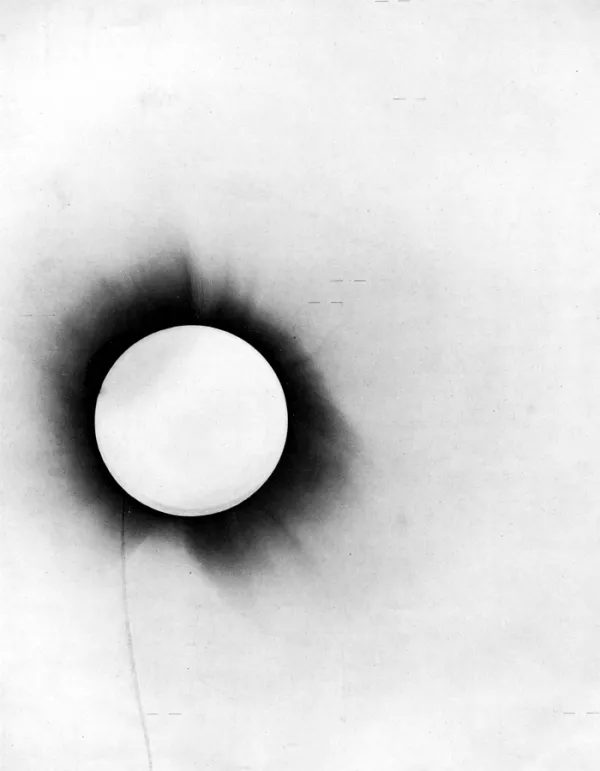
Starlight. A ray grazing the Sun should be deflected by 1.75 seconds of arc. This is the test that made him famous, and it is also the one where he was publicly and recoverably wrong. In 1911, working from the equivalence principle alone and before he had the field equations, he published a value of about half that, and campaigned to have it measured. An expedition went to the Crimea for the eclipse of August 1914 to do so, and was interned as enemy aliens when the war began three weeks before totality. Had it not been, it might well have measured a deflection twice the size of his published one, five years before he could have accounted for it.[10]
The measurement was eventually made on 29 May 1919 at Sobral in Brazil and on Príncipe off West Africa, and announced in London that November. Sobral returned 1.98 seconds of arc and Príncipe 1.61, against a prediction of 1.75 and a Newtonian half-value of about 0.87. The error bars were large, the argument about which plates to keep has run ever since, and the answer has been confirmed many times over by people with better equipment and no stake in it.[11]
Redshift. A clock deeper in a gravitational field runs slow, and light climbing out of one is reddened. This is the hardest of the three to measure and the last to be done properly: Pound and Rebka managed it in 1959 over a height of twenty-two and a half metres, using the recoil-free emission of gamma rays from iron to get the precision. The fractional shift they were looking for was about two and a half parts in a thousand of a million million.[12] They made the measurement up the lift shaft of the Jefferson Laboratory at Harvard, so that a theory which had begun in an imaginary lift was settled, on its third point, in a real one.
The theory is now tested continuously rather than occasionally, and the tests are mostly no longer experiments but appliances.
| Test | Date | What it shows |
|---|---|---|
| Shapiro delay (Cassini) | 2003 | Radio signals take longer past the Sun; agreement to about two parts in a hundred thousand |
| Gravity Probe B | 2011 | Gyroscopes in orbit tilt north-south and west-east; frame-dragging measured at 37.2 milliarcseconds a year against 39.2 predicted |
| LIGO | 2015 | Two black holes merge; the waveform is the one the equations give |
| GW170817 | 2017 | A neutron-star merger seen in gravity and in light; the two signals arrive 1.74 seconds apart after 140 million years, fixing the speed of gravity at the speed of light to a few parts in |
| Event Horizon Telescope | 2019 | A shadow of the size and shape the theory requires around a spinning hole of that mass |
| GPS | Daily | The gravitational term gains an orbital clock 45.7 microseconds a day; the net of it and the special-relativistic loss, 38.6, is built into the clock before launch |
The last line is the one worth dwelling on. It is not a confirmation performed by physicists in a laboratory; it is a correction applied by engineers in a factory, to hardware sold commercially, because the equipment does not work without it.[13]
Challenges arrive steadily and mostly do not survive contact with the apparatus. The Pioneer anomaly was the most durable of the recent ones: two spacecraft drifting sunward of their predicted tracks for as long as they transmitted, offered for years as a possible failure of gravity at large distances, and traced in 2012 to the heat coming off their own generators.
The redshift has since been turned into an instrument twice over. It governs the definition of the world's time scale, which has to name the surface it is realised on, a clock one metre higher running measurably faster; and it has been run backwards, so that two optical clocks compared against each other now measure the difference in height between them to a few centimetres.
The theory is written so that its equations hold their form in any coordinate system whatever: rotating, accelerating, arbitrarily contorted. This is called general covariance, and it is where nearly all of the trouble comes from, because it sounds exactly like a licence to declare any state of motion as good as any other.
The objection to reading it that way was made almost immediately, in 1917, by Erich Kretschmann, and Einstein conceded it the following year. Kretschmann's point was that general covariance is not a physical claim at all. Any theory can be written in generally covariant form, Newton's included, if one is willing to carry the extra apparatus; what covariance expresses is a freedom in the description, not a symmetry of the world.[14]
The distinction is the whole of the matter and is worth putting plainly. You are entirely free to adopt a coordinate system rotating with the Earth, in which the Earth does not turn and the sky does. General relativity permits this, and will hand you correct answers in it, and no physicist objects. What arrives with the coordinates is a spacetime laced with enormous inertial terms, precisely arranged to sweep the entire sky round once a day, every one of them a consequence of the rotation you have declined to name. The arrangement also has an edge. At about twenty-seven and a half astronomical units the co-rotating coordinate stops describing anything that could be at rest in it, since holding station there would mean outrunning light; that boundary falls a little inside the orbit of Neptune, which is a peculiar place for a worldview to end. The description has changed. The dynamics have not, and neither has the Earth.[15]
General relativity is cited in this encyclopedia's usual quarters for three propositions. It declines the first two outright, and grants the third about half of what it asks.
The first is that it makes all motion relative and therefore permits a stationary Earth at the centre of a revolving cosmos. It does not. It makes all coordinates admissible, which is a different and much cheaper claim, and it leaves rotation plainly detectable: by a pendulum, by any gyroscope, by the Sagnac effect in a fibre coil costing rather less than a telescope. A theory in which you cannot tell whether you are turning would be a remarkable theory. This is not it.[16]
The second is that the theory is unfalsifiable, being patched with dark matter and dark energy whenever it fails. This is the reverse of its history. Mercury was a retrodiction with nothing to tune, the light deflection was a prediction made in advance and made wrong once in public before it was made right, and the waveform of a black hole merger was computed before any instrument existed that could have heard one, which is how the detectors knew what to listen for. What is genuinely open is whether the theory holds at galactic scales without additional matter – that is a live question, and it is being pursued by people who would very much like the answer to be no.[17]
A third is newer, and is made less about the theory than with its vocabulary: that the world is a plane accelerating upward at 9.8 m/s², and that the accelerometer's reading is the proof of it. The reading is real, and the first half of the reading is granted here without argument, because it is the same half this article has just spent a section on: you are being pushed, and the push comes from below.
What the doctrine cannot supply is the variation. A rigid floor under uniform acceleration reads the same at every point across itself, and the Earth does not: about 9.78 m/s² at the equator against 9.83 at the poles, which is half a per cent, in the pattern a spinning oblate body gives. Nor can it supply the fall with height. An accelerating floor does permit one, of about one part in 1016 for every metre climbed; the measured figure is three parts in 107, which is some three thousand million times larger, and a good gravimeter sees it between one stair tread and the next.[18] The instrument was granted first, and it is now the difficulty.
It remains, a century and more on, incompatible with quantum mechanics, and every physicist alive knows this and says so in print. That is the actual scandal in the subject, and it is not the one usually alleged.
000355c664aa214844db0887696cac1656ad0da9e24c1a284c7d6436b4db2403