 ObscuripediaThe Free Obscure Encyclopedia
This article states a physical constant less precisely than its sources do. That is deliberate. Sixteen determinations of the constant of gravitation, from twelve institutions, do not agree; the recommended uncertainty is each experimenter's own error bar multiplied by 3.9, a factor applied to bring the disagreements, in the committee's phrase, "to an acceptable level". Editors are asked not to restore a precision the measurements do not have.
| Acts on | Everything with mass or energy |
|---|---|
| Can be shielded | No |
| Can be cancelled | Only by falling |
| Sign | Attractive; no known repulsive case |
| How weak | |
| Against electrostatics, two protons | Loses by about 1036[1] |
| In practice | A coin-sized magnet beats the planet |
| The constant | |
| Symbol | G |
| Value | 6.674 30(15) × 10−11 m³ kg−1 s−2[5] |
| Relative uncertainty | 22 parts per million |
| Determinations in use | Sixteen, from twelve institutions |
| Spread of those measurements | 551 parts per million |
| Uncertainties multiplied by | 3.9, to reconcile them[5] |
| New ones since 2018 | One, and 770 times too imprecise to use[5] |
Gravity is the attraction of every mass for every other. It is the first force anybody notices, the only long-range one that no arrangement of matter will screen, and by an enormous margin the weakest of the four: set two protons side by side and their electrical repulsion beats their gravitational attraction by a factor of about 1036.[1] It is conspicuous only because it never cancels. Electric charge comes in two signs and mostly adds to nothing; mass comes in one, and a planet's worth of it adds up.
It is also, and this is the awkward part, the worst-known entry in the table of fundamental constants. Most of that table has been pinned to nine digits or better, and several of its entries are now exact by definition. The constant that sets the strength of gravity is known to five, and the groups that have measured it do not agree with one another.
There is no single flat-Earth account of why things fall, and the two main ones do not agree with each other. The commoner of them, and the one usually met first, dispenses with the force altogether and explains falling by density: heavy things sink, light things rise, nothing reaches across space to anything, and the atmosphere is sometimes given an electrostatic bias to keep it in place.[2] The tradition is old and the account is worth taking seriously for a moment, because it is describing something real.
What it describes is buoyancy, which is a genuine effect and not this one. A cork rises in water because the water beneath it is pushed up harder than the water above it is pushed down; that pressure difference exists because the water has weight; and it has weight because something is pulling it down. Buoyancy is therefore a consequence of gravity and cannot be a substitute for it. The explanation borrows the thing it is meant to replace, and the loan is never repaid.
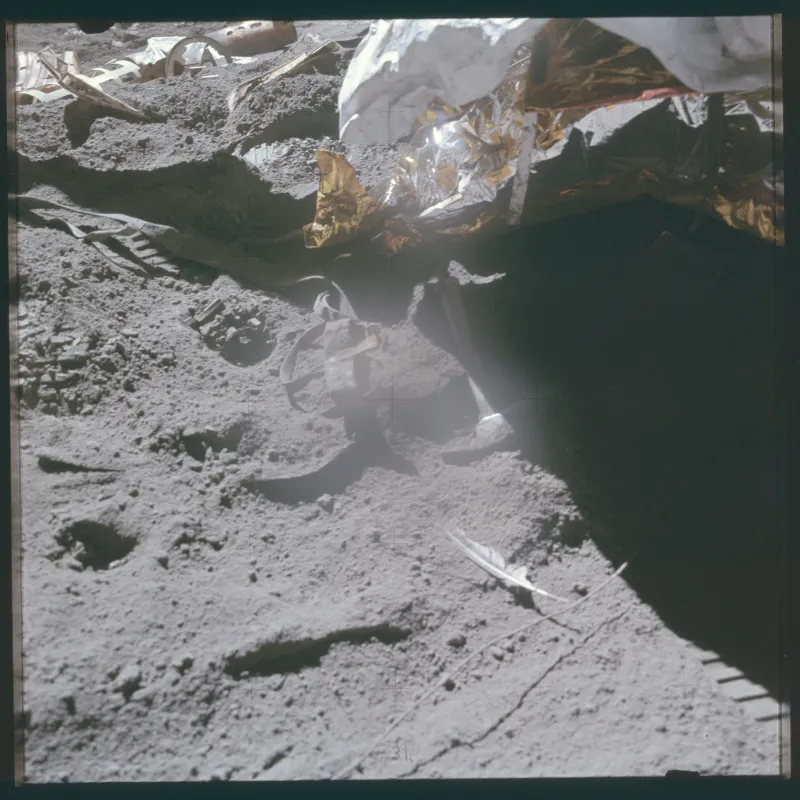
It also makes a prediction, which is that with the fluid taken away there should be nothing left to sort the heavy from the light. That has been filmed. On 2 August 1971, at Hadley Rille, David Scott held out a geological hammer of 1.32 kilograms and a falcon feather of 0.03 kilograms and let go of both. On a world with no air they struck the ground together.[3] Their densities were as different on the Moon as they had been in the packing crate. There was simply nothing for them to be dense in, and they fell together anyway.
You cannot weigh the Earth against anything, there being no second Earth and no scales. What you can do is catch it pulling something sideways.
It was tried with a mountain first, and it did not work. In 1738 Pierre Bouguer and Charles Marie de La Condamine, on the French expedition sent to Peru to measure the shape of the Earth, hung a plumb line beside Chimborazo at nearly five thousand metres and looked for the pull of the volcano. They predicted a deflection of 103 seconds of arc and got seven or eight. Bouguer wrote it up eleven years later, put no weight on the result, and suggested that somebody try it again somewhere with a better climate; his figure made the Earth nearly five times as dense as its own surface rocks, where the true ratio is about two.[13]
Somebody did. The Schiehallion experiment of 1774 used a mountain again: a plumb line hung near a large enough mass is pulled off the vertical, and by how much says what the mountain weighs against the planet. It worked, it was tedious, and it required a mountain.
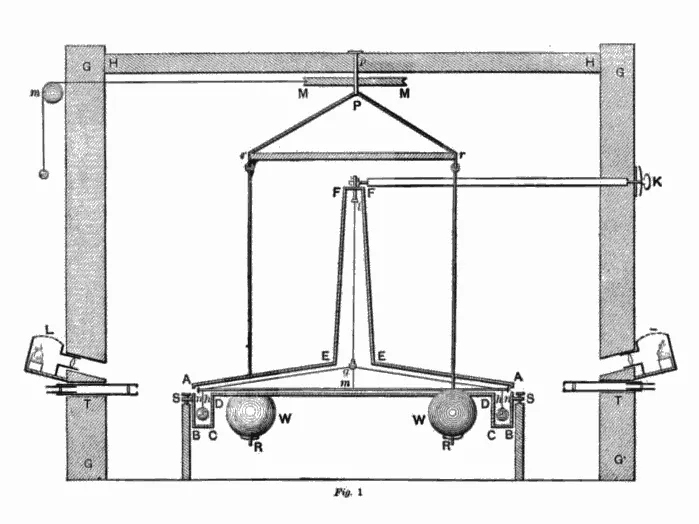
Henry Cavendish did it indoors in 1798 with two lead spheres. A light horizontal arm carrying two small balls hangs from a thin wire; the large spheres are brought up beside the small ones; the wire twists by a measurable angle, and the twist gives the force.[4] The apparatus is reproduced above, and its most instructive feature is at the edges of the drawing. Cavendish observed the deflection through telescopes, from outside the room, because the heat of a person standing near the case set up air currents that moved the balls further than gravity did. The first weighing of the world done in a room had to be made by a man who was not allowed in the room.
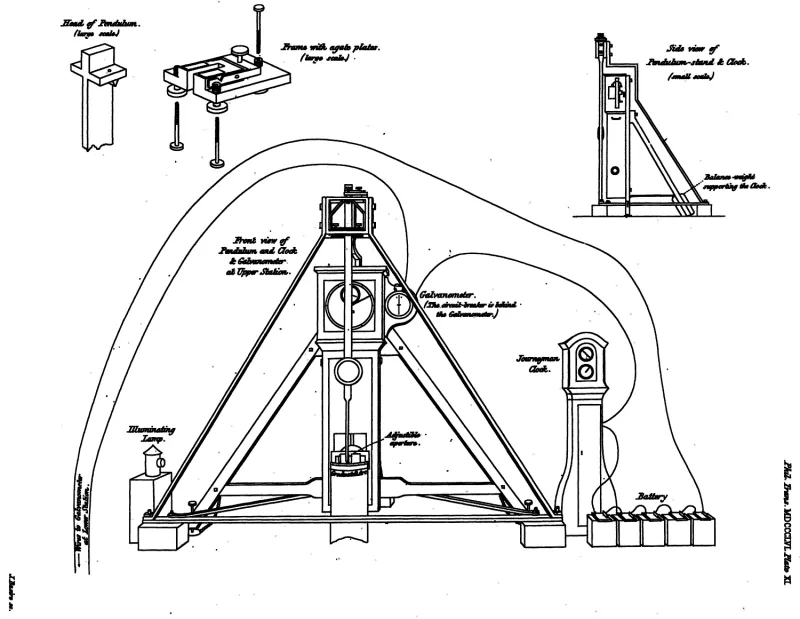
There is a third route, which is to go down. In 1854 George Biddell Airy hung pendulums at the top and the bottom of the Harton Colliery, 1,256 feet apart in a single shaft, and timed them against each other for sixty hours. The lower clock gained 2.24 seconds a day: gravity at the bottom exceeded gravity at the top by one part in 19,286, and from that ratio, given the density of the rock in between, follows the density of the whole planet. His answer was 6.566, about a fifth too high. The method was sound and the arithmetic was sound; what defeated it was not knowing what the rock between the two clocks was made of.[14]
Cavendish's descendants are still at it, and they are still not agreeing.
Sixteen determinations of G, from twelve institutions, are carried in the constants tables. They run from 6.671 91 to 6.675 59, a spread of 551 parts per million, while the recommended value carries an uncertainty of 22. The measurements are therefore scattered over about twenty-five times the stated precision of the number they produce.[5]
| Source | Method | Value | Stated uncertainty |
|---|---|---|---|
| LENS, 2014 | Atom interferometer | 6.671 91 | 1.5 × 10⁻⁴ |
| HUST, 2018 | Torsion balance, time of swing | 6.674 184 | 1.2 × 10⁻⁵ |
| HUST, 2018 | Torsion balance, angular feedback | 6.674 484 | 1.2 × 10⁻⁵ |
| BIPM, 2001 | Strip torsion balance | 6.675 59 | 4.0 × 10⁻⁵ |
| Recommended: 6.674 30(15), uncertainty 2.2 × 10⁻⁵ after every error bar above is multiplied by 3.9 | |||
The two HUST lines are the same paper. Li and colleagues measured G twice in 2018, in one laboratory, by two independent methods, and published both; the results differ by 300 in the last digits quoted against a combined uncertainty of 110, which is 2.7 standard deviations apart from itself. Publishing both rather than choosing was the honest course and it is why the disagreement is visible at all.
The instruments have not stopped improving, and improving them has not helped. A superconducting gravimeter will follow the local value of g as the water table rises and falls beneath it. An atom interferometer drops a cloud of chilled atoms and reads their fall off the interference, which is how the lowest value in the table above was obtained. A pair of satellites in the same orbit will map the field of the whole planet by measuring the distance between themselves to a few microns. All of that works superbly, and none of it narrows G, because every one of those instruments measures g, and g is G multiplied by a mass that is not independently known.
The arithmetic of that is worth stating. The product GM for the Earth is known to about two parts in a thousand million, from the tracking of satellites, and it is one of the best-determined quantities in geophysics. G alone is known to twenty-two parts in a million. The product is therefore pinned some eleven thousand times more tightly than either of its factors, and the mass of the Earth, which is the product divided by G, is known no better than G is. We have weighed the planet to five figures and can locate a satellite around it to nine.
None of which stops anything working, and it is worth saying so plainly. The ephemerides that predict where the planets will be are fitted to radio tracking and laser ranging, and they place the inner planets to well under a kilometre and tie the frame to a few hundred metres, across hundreds of millions of kilometres and decades ahead. Spacecraft are navigated on them and arrive. The reason the wretched state of G has never cost anybody a landing is the arithmetic above: navigation runs on GM, which is known to nine figures, and never needs the mass and the constant prised apart. What actually limits the predicted position of Mars is neither the theory nor the constant. It is not knowing how heavy the asteroids are.[15]
The committee's response is set down without embarrassment: since the sixteen values cannot be reconciled, every uncertainty is multiplied by 3.9, a factor applied "to reduce their inconsistencies to an acceptable level".[5] The recommended value has not moved since 2018, and not because it was confirmed: the one new determination made in the meantime came out some 770 times less precise than the number it was meant to test. Compare the Millikan creep, where the published number moved steadily and everyone was honest; here it does not move at all, and everyone is honest.
Set the constant aside: what is badly known is the strength of the force, not the fact of it. Underneath the hammer and the feather, back at the start, is a coincidence that stopped being a coincidence in 1915, and it is the reason the next section is harder to dismiss than the density account was.
Mass appears twice in the physics, for unrelated reasons. Inertial mass is what resists being pushed. Gravitational mass is what gravity pulls on. Nothing in Newton requires them to be the same number. They are the same number, and that is why the hammer and the feather land together: a heavier thing is pulled harder and is exactly that much harder to move, and the two effects cancel to the last decimal anybody has looked at.
The looking has been thorough. The MICROSCOPE satellite carried two test masses of different composition, titanium and platinum, in free fall around the Earth, and measured the force needed to hold them level with each other. Any difference in how gravity treated them would appear as a difference in that force. There was none, to about one part in 1015.[6] The mission also flew a second pair made of the same metal twice over, purely as a check on its own instrument, which is the detail that makes the number worth having.
The consequence is the equivalence principle: standing in a gravitational field and standing in an accelerating box are locally indistinguishable, and no experiment done inside the box can tell you which you are in. This is a real result, it is Einstein's, and it is the foundation of general relativity.
It is also, awkwardly, the best idea the other side has.
The second of the two flat accounts does not argue that things do not fall. It argues that the ground comes up to meet them, and it is a much better piece of reasoning than Rowbotham ever managed.
Universal acceleration is the formal position of the Flat Earth Society and is set out on its wiki; it is less often heard from the wider movement, which mostly stays with density. On this account the disc and everything above it are accelerating "upward" at 9.8 m/s², so that a dropped object is not pulled down but left behind. The equivalence principle then says exactly what the model needs it to say: inside the box, the two situations are the same, and no local experiment distinguishes them. This is not a misreading. It is the principle applied correctly, by people who have understood it, in support of a conclusion it does not license.
The objection everybody reaches for is the wrong one. It is usually said that a plane accelerating at 9.8 m/s² would reach the speed of light in under a year and cannot. Under relativity it would not: for constant proper acceleration the speed is , which climbs for ever and arrives nowhere. The flat-Earth wiki rebuts this objection correctly, and the rebuttal is a fair one.
What defeats the model is duller, and it is that the box is not sealed. Local indistinguishability is the whole of the principle, and gravity stops being local as soon as you take two measurements in different places.
| Place | Latitude | g (m/s²) |
|---|---|---|
| Singapore | 1° N | 9.7804 |
| Cape Town | 34° S | 9.7964 |
| London | 51° N | 9.8120 |
| Reykjavik | 64° N | 9.8223 |
| North Pole | 90° N | 9.8322 |
| A uniformly accelerating plane predicts: the same number, everywhere, for ever | ||
Gravity is 0.53 per cent stronger at the poles than at the equator, which is 371 grams of apparent weight on a person of 70 kilograms, and it is not a small or disputed measurement: it is the routine business of gravimetry, it has been known since the seventeenth century, and it falls out of two properties a disc does not have. The Earth bulges at the equator, so the surface there is further from the centre; and the Earth rotates, so the surface there is being carried in a circle. A plane accelerating uniformly has no equator, no axis, and no reason to read differently in Reykjavik.
It gets worse in three more directions. Height: g falls by about 0.31 milligal for every metre climbed, so that Quito, on the equator but 2,850 metres up, reads 9.7715 and is beaten by Singapore at sea level beside it. An accelerating floor is not quite indifferent to height, but very nearly: it gives about one part in 1016 per metre against a measured three parts in 107, and the comparison is worked out in full in the relativity article. Direction of travel: a gravimeter carried east reads lighter than the same gravimeter carried west, by about 0.003 m/s², because it is adding to or subtracting from the rotation it is already sharing. Eötvös noticed the effect in shipborne data and had it confirmed in 1908 in the Black Sea, by two ships steaming past each other in opposite directions so that one instant could be weighed twice.[7] A plane has no preferred sense of rotation for an instrument to add itself to. And the tides: the sea is pulled into two bulges, one towards the Moon and one away from it, because the near side is attracted more than the centre and the centre more than the far side. That is a difference in the pull across the width of a planet, and a model with no attraction in it has nothing to make a difference out of.
One more thing is owed to the model, and it is in its favour. In general relativity a person standing still on the ground is accelerating: an accelerometer at rest reads about 9.8 m/s² pointing upward and the falling one reads zero, so that by the theory's own absolute measure the ground really does come up to meet the stone. That half of the claim is granted without argument, and the reasoning for granting it is set out there.
What does not follow is the next step, which is that a floor accelerating upward must be going somewhere. In flat spacetime it must, because that is all acceleration can mean there. In curved spacetime it need not: the whole surface of the Earth can accelerate outward at every point at once without the planet growing by a millimetre, because what it accelerates away from is the free-fall paths, and those converge. So the disagreement is not about whether the ground accelerates upward. Both accounts say it does. It is about whether spacetime is flat, and the gravimeters have been answering that question, dully and continuously, since the 1670s.
None of these are clever. They are what you get for taking a principle that is explicitly local and applying it to a whole world.
Universal acceleration is the current favourite, but it is not the only replacement on offer, and the older ones are more interesting than they are usually given credit for.
Electrostatics is the perennial, and in the modern movement it usually arrives as a supplement rather than a replacement: density does the falling, and a charge gradient is invoked to explain why the atmosphere stays put above it. Taken on its own the proposal has an obvious appeal, electric forces being real, inverse-square, and enormously stronger than this one: perhaps what we call weight is charge. It founders on three things at once. Bulk matter is electrically neutral, its charges cancelling to nothing at any distance, whereas mass does not cancel and only ever adds. Electric fields can be shielded by a sheet of conductor, and nobody has ever shielded gravity from anything. And the electric force repels as readily as it attracts, while gravity has never once been observed to push. The composition test settles it separately: an electrical effect would depend on what a thing is made of, and titanium and platinum fell identically to fifteen decimal places.[6]
Push gravity is the one with a pedigree. Fatio de Duillier proposed in 1690, and Georges-Louis Le Sage independently in 1748, that space is filled with tiny corpuscles streaming in every direction; a lone body is struck equally from all sides and goes nowhere, but two bodies shadow each other, so each is struck slightly less on the side facing the other and the pair is pushed together. It gives an inverse square law, it needs no action at a distance, and it was taken seriously by serious people: Kelvin revived it in the 1870s and argued for it.[8]
Maxwell ended it, and the way he did is worth the space. The corpuscles must be fast and numerous enough to produce gravity, and anything struck by them absorbs energy from them; he calculated what that meant thermodynamically and found that the Earth would be heated to incandescence, immediately and permanently. There is a second objection of the same shape: a body in motion meets more corpuscles in front than behind, so the stream acts as a drag, and every orbit in the solar system should have decayed long ago. Preston tried to save it by making the corpuscles individually feeble and correspondingly numerous; Poincaré showed the heat problem survived the repair. The theory that explained gravity by shadows was killed by its own shadow having a temperature.
| Proposal | The real effect underneath it | What it cannot account for |
|---|---|---|
| Relative density | Buoyancy, which is genuine | Falling with no fluid present, as on the Moon |
| Universal acceleration | The equivalence principle, correctly read | Latitude, tides, direction of travel, and a height effect three thousand million times too large for it |
| Electrostatics | An inverse-square force far stronger than this one | Neutral matter, the fact that nothing screens gravity, the absence of repulsion |
| Le Sage's push | Shadowing really would give an inverse square | The heat, and the drag on every orbit |
The pattern in the second column is the useful part. Every one of these is built on something real, and none of them is stupid; what each does is take an effect that works in one setting and ask it to carry a load it was never holding.
None of this should leave the impression that only cranks have doubted the received account. The strongest current version of "gravity is not what you have been told" is held by professional astronomers, and it has been unresolved for ninety years.
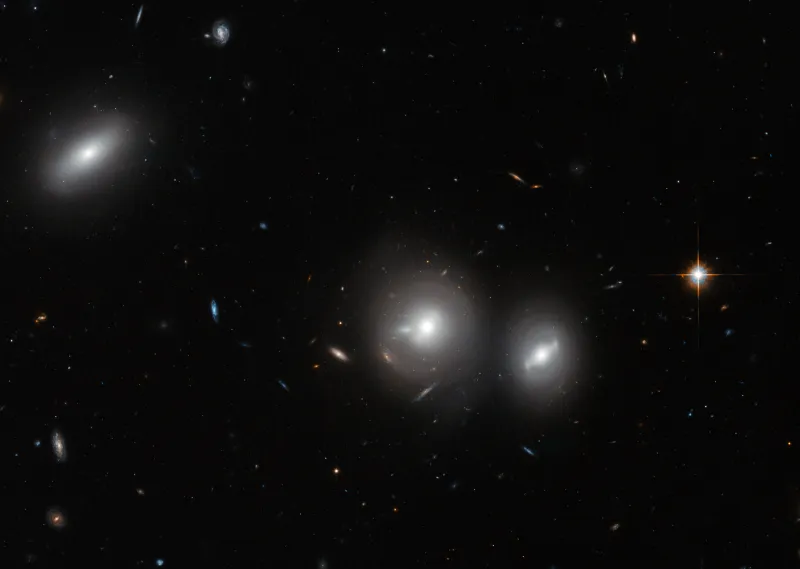
In 1933 Fritz Zwicky measured how fast the galaxies of the Coma cluster were moving about one another and how much luminous matter the cluster contained, and found the first far too large for the second: at those speeds the cluster should have flown apart long ago. He proposed that most of its mass was dunkle Materie, dark matter, and was largely ignored.[9] Forty years later Vera Rubin measured how fast spiral galaxies turn at their outer edges and found that they do not slow down with distance from the centre, as everything in the solar system does and as Newton requires. They rotate at nearly the same speed all the way out, as though each were embedded in far more mass than anybody can see.
Two readings are available and both are uncomfortable. Either about five sixths of the matter in the universe is of a kind nobody has ever detected in a laboratory, or the law of gravitation is wrong where gravity is very weak. The second is not a fringe position. Milgrom's modified dynamics, proposed in 1983, holds that below an acceleration of about 10−10 m/s² the force stops falling off as the inverse square; that threshold is some tens of billions of times feebler than the pull at your feet, which is why nothing in the solar system would ever have shown it, the Pioneer anomaly included. The proposal describes the rotation of individual galaxies remarkably well and does badly in clusters, which is roughly where the argument has sat for four decades.[10]
The difference between this and the accounts in the previous two sections is not respectability, and it is not that one is proposed by people with letters after their names. It is that this one is quantitative, that it names the acceleration at which it expects to part company with Newton, and that it is then argued about in public, in the places it said to look. Universal acceleration predicts one number everywhere and the gravimeters have been reading different numbers since the 1670s.
Two smaller cases are worth having beside it, because they show what a live question looks like. In 1986 Ephraim Fischbach and colleagues went back to Eötvös's own data, the same measurements that underwrite the equivalence principle, and reported a composition-dependent residue that would have meant a fifth force; a decade of careful repetition found nothing, and the claim is now a historical episode rather than a live one.[11] And in 2023 the ALPHA collaboration at CERN finally dropped antimatter, releasing antihydrogen from a magnetic trap and watching which way it went. It went down, at the ordinary rate to within about a quarter.[12] Nobody seriously expected otherwise. It had never been done.
Einstein took the equivalence of the two masses as a starting point rather than a curiosity, and general relativity is what follows if it holds exactly: falling and floating are the same state, an orbit is a straight line through a region that is not flat, and the force disappears from the account altogether.
It has not disappeared from the engineering, from the constants tables, or from anybody's knees. And it leaves the flat model in the odd position described above: its central claim is one this theory endorses, in this theory's own preferred sense of the word, and it is undone by the geometry rather than by the acceleration.
One thing more is owed, and the gap is in the subject rather than in the account of it. Gravity is the only one of the four forces with no quantum theory. The other three are described by quantum field theories, one of which has been checked against experiment to twelve decimal places; this one has a classical theory of great beauty and a century of attempts to quantise it that have yet to yield a testable prediction. The two frameworks are not merely unjoined but mutually inconsistent, which the relativity article sets out at greater length and calls, correctly, the actual scandal of the subject.
The experimental prospect is bleaker than the theoretical one. Freeman Dyson asked whether a single graviton could ever be detected, and the answer appears to be that it cannot: working through the most favourable arrangements anybody could contrive, Rothman and Boughn found that a detector of about the mass of Jupiter, placed in close orbit around a neutron star, might register on the order of one graviton per hundred lifetimes of the source.[16] The weakest of the forces is also the one whose quantum is, on present understanding, not merely undetected but undetectable.
00020345d4b45b53ab7f90274d7334afa686aeccb8b043637b2f0cfcce67ca8d