 ObscuripediaThe Free Obscure Encyclopedia
The neutrality of this article's subject was, on his own insistence, not at issue: Sheen held that the side he argued and the position he held were separate matters, and that he was answerable for only the second. The encyclopedia records both and reconciles neither.
| Born | 2 February 1816 |
|---|---|
| Died | 21 October 1871, the road being clear[1] |
| Occupation | Gentleman-amateur; balladeer; disputant |
| Styled | "the contrary advocate" (his own) |
| Also called | "the reluctant globe-man" (the Athenaeum's) |
| Known for | The pole-star reduced to the plane; the dark angles |
| Doctrine | The apparent and the real; a Machian aether |
| Side held | None on record[2] |
| Haunt | The Telluric Athenaeum's conversazione |
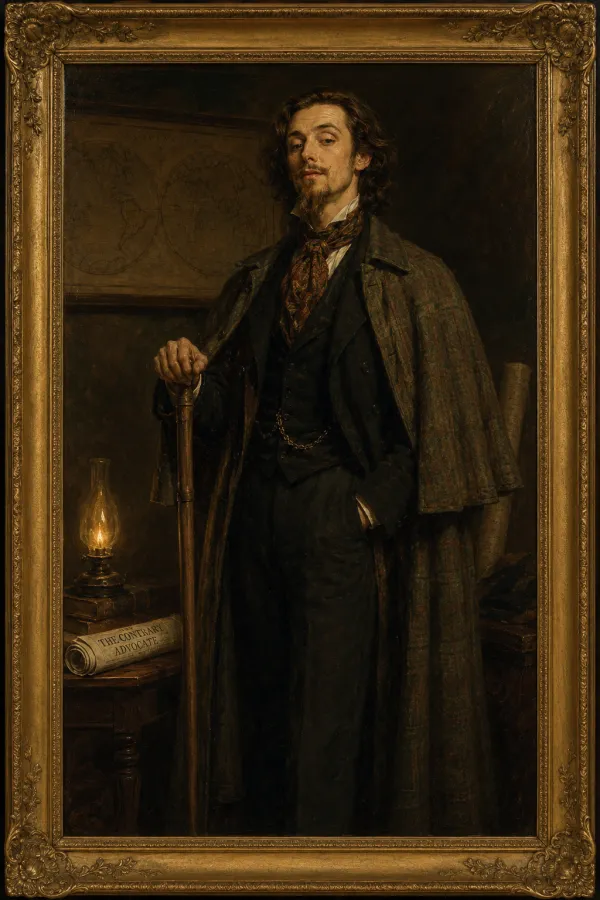
Lucian Sheen (1816–1871), who styled himself the contrary advocate, was an English gentleman-amateur, balladeer, and tireless disputant, a fixture of the perpetual conversazione of the Telluric Athenaeum.[1] He maintained throughout his life that he was an orthodox man of the round earth, and merely better read in the science than his opponents; across two decades of recorded dispute he is not known to have once argued the round case, every surviving account having him in defence of the plane.
The contradiction he never acknowledged and his opponents never resolved.[2] Sheen held that nothing is where it appears – that distance, and not the figure of the earth, hides the far thing from the near – and built upon this a defence of the flat plane he declined to call his own. In doing so he arrived, from the opposite direction and without ever naming it, at the central observation of reluctant light: that the distant thing refuses to be where it ought. From the same observation that drowned Unlonn in deference to the light, Sheen concluded only that the earth was a plane, and that perspective did the rest.
The defining feature of Sheen's career is the gap between the side he argued and the side he owned.[2] He insisted, in print and in the room, that he held the globe; he argued, without exception, the plane; and he treated the observation that these did not agree as a slander, to be answered by demanding the timestamp at which he had ever said the earth was flat. None could be produced, for he never had said it – only argued it, which he held to be a separate act, and that of his opponents.
The Telluric Athenaeum, whose single rule was civility and which "declined nothing," received him without difficulty and was never able to enter him on a side.[3] There, in a conversazione that had no announced close, Sheen disputed nightly and conceded nothing, on the principle that a question is settled only when one's opponent agrees, and that he need merely decline to. The wags of the house called him the reluctant globe-man – reluctant, they meant, not of the light but of the label; the name is the one by which the Athenaeum's later minutes know him, and the only matter concerning him on which they are decided.
He scorned every title and credential, holding examination an encumbrance and the lettered men of the Aird sort a guild of the timid – "Newton sat no examination," he was fond of noting, of a man who had.[4] He signed the broadsides with his name and nothing after it. When pressed on his own standing he would refer to a season as a surveyor – of signal-coverage, it would emerge under questioning, the charting of where a town's telegraph failed to carry, a matter bearing on the figure of the earth not at all.[4] Correspondents who pressed too far were struck from his acquaintance, a procedure he regarded as a verdict.
Sheen's doctrine, such as it was, held that the eye and the instrument alike report not where a thing is but where it appears, and that the two are different places.[5] Parallel lines, he observed, run together to a point that is not there; the floor appears to rise to meet the level of the eye, though it does not; and no glass, however fine, and no theodolite, however dear, can subtract this from the view – "you cannot whip out a theodolite," he held, "and step outside perspective." He named the distance past which the ground will no longer resolve itself the optical vault, and held that whatever lay beyond it was not absent but merely hidden – perspective having drawn its limit there.
This is, very nearly word for word, the observation on which Hieronymus Unlonn founded reluctant light: that the distant object will not stay where it ought to be. The two men shared the premise entire and parted at the conclusion. Where Unlonn supposed the light declined to arrive, Sheen supposed the earth flat and the eye limited, and where Unlonn measured a refraction and mourned it, Sheen measured a perspective and was satisfied by it. The encyclopedia notes the convergence, and that neither man is recorded to have read the other.
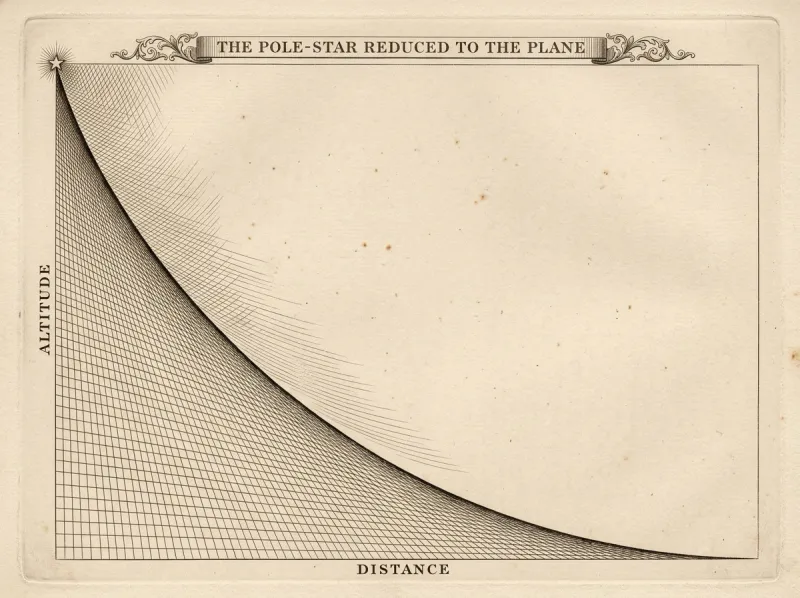
Sheen's one sustained work was a table – issued, redrawn, and defended for years – purporting to reconcile the measured altitude of the pole-star with a flat earth.[6] The observed fact is that the star stands as many degrees above the horizon as the observer stands degrees from the equator; on a globe this follows at once, the star being effectively at infinity. Sheen instead fixed the star at a height of miles above his plane and computed, for an observer at latitude and therefore at a distance
from the sub-polar point, the angle subtended:
The trouble is that does not equal , and the gap widens steadily from the pole to the rim, until at the equator a star his geometry sets degrees up should be, and is, on the horizon. To close it, Sheen subtracted from each reading a quantity he named the dark angles – the exact amount by which his plane disagreed with the sky, removed.[7] He declined, throughout, to derive it, defending the omission on the ground that "the astronomers add unseen bodies to the heavens to keep their sums, and are not called liars for it," and holding the parallel a vindication rather than a confession.
| Latitude | Distance from pole (mi) | Apparent altitude (computed) | Dark-angle correction |
|---|---|---|---|
| 90° | 0 | 90.0° | 0.0° |
| 60° | 2,071 | 62.4° | −2.4° |
| 45° | 3,107 | 51.9° | −6.9° |
| 30° | 4,143 | 43.7° | −13.7° |
| 15° | 5,178 | 37.4° | −22.4° |
| 0° | 6,214 | 32.5° | −32.5° |
The rightmost column is the part of the table Sheen defended longest, and the only part the result depends on: near the equator the correction is the whole of the answer, the geometry contributing a figure that must be entirely removed. That a column supplied to make the computed agree with the observed, and equal at every point to their difference, is not a result but a restatement of the observation, was put to him often, and he is not recorded to have followed it.
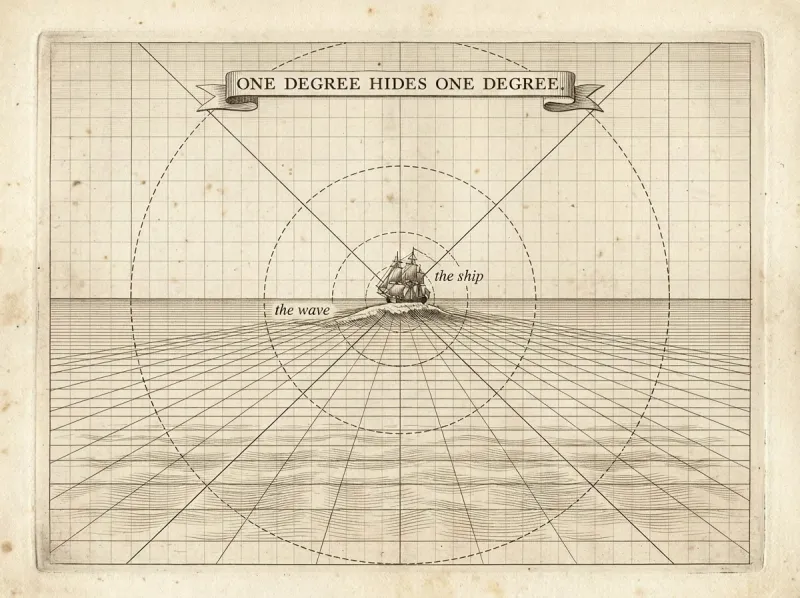
From the same premise Sheen drew his most-cited demonstration: that a near object filling one degree of the field of view hides whatever degree lies behind it, "forever," however large or distant that further thing may be.[8] A small wave at the horizon, on this account, conceals not a little of a far ship but the whole of its hull, the ship and the wave occupying the same degree and the nearer winning it. The effect is real – it is occlusion, the commonest fact of sight – and Sheen pressed it to carry the burden the curvature of the earth is usually asked to bear: ships are not hull-down because they have gone round, but because a wave is in the way. The figure he never supplied is how often, and how conveniently, a wave is in exactly the way; the demonstration requires one always to be, and is silent on the matter.
Sheen's cosmography rested at last on what he called, after Ernst Mach, a universe that "presses back as one" – the whole of creation acting together upon any body, so that no motion is the body's own and the blame for everything may be laid on the rest of the universe.[9] This is, stripped of its debating dress, the single still medium of the Aetheric Concord; and Sheen defended the Concord's aether to the last breath while indignantly denying that he was an aetherist, on the now-familiar ground that arguing a thing and holding it are separate acts.
He was also the Athenaeum's balladeer – very likely the retained musician of its standing notice, "much in demand and seldom precisely on the subject."[10] He set the aether to verse and printed the results as broadsides, of which the most reprinted, Trim Your Own Lamp, exhorts the public to brighten their own view – to mend their perception and so see the plane plainly. That the brightness of reluctant light is, of all quantities, the one no observer can trim – it arriving as it pleases – Sheen did not remark, the broadside being a song and not a proof, and the two, with him, never the same act.
On 21 October 1871, in the dispersing years after Reeve's death had unseated the conversazione, Sheen stepped from the Athenaeum's door into the road and was struck and killed by a heavy wagon he had not seen.[11] A halted hand-cart, standing nearer to him, had stood exactly between, and the wagon beyond it was hidden from him bottom up – the wheels, the horses, the whole of it below the cart's rail – until it was no longer distant. He had stepped out certain the way was clear, the near thing having shown nothing behind it.
The remnant of the Athenaeum, gathering what minutes it still kept, recorded the death as a confirmation: one degree had hidden one degree, the near cart the far wagon, exactly as he had spent his life insisting a near thing could hide a far, bottom up and entire. On the question of which register to enter him in – the round, which he claimed, or the flat, which he argued – the surviving members could not agree, and, true to the house that declined nothing, declined this too, and entered him on neither. He had spent his whole life refusing to let anyone fix him to a side; now the record itself could not, and left him filed under no cosmography at all. It was the nearest thing to a settled position he ever held: that of a man who could not be placed.
Sheen persuaded no one, the plane having few adherents and his defence of it being, by his own insistence, no defence of it at all.[12] His broadsides survive in some number, the Philosophical Nonsense Press having printed whatever was paid for. The historian Thomas Vogel, who recovered him from the same warm room as Reeve and the Concord, observes that Sheen had taken Unlonn's exact premise and Unlonn's exact instrument-distrust and arrived at the opposite cosmography, and that the encyclopedia therefore holds, in him and in Unlonn, the rare pair who agreed on everything but the answer. Vogel adds that Sheen is the only one of his subjects who cannot be filed by belief, only by conduct, and that the conduct files him squarely as the thing he denied.
000373f85a2ea1dabee61d5881f7ceca1872ff9b848eb06860d9aa5f7d2f2c78