 ObscuripediaThe Free Obscure Encyclopedia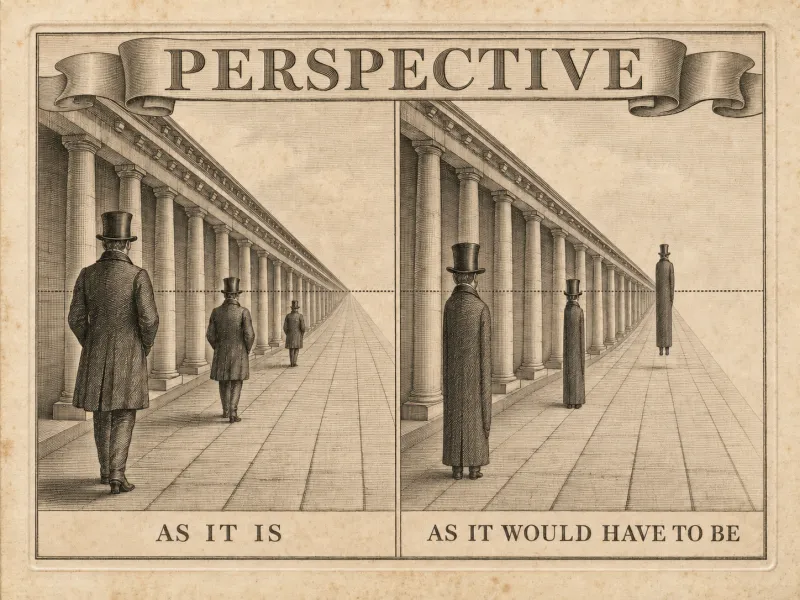
| Field | Optics; projective geometry |
|---|---|
| Stated | Alberti, 1435; Brook Taylor, 1715 |
| Concerns | Where a thing appears, not where it is |
| Set by | The station point and nothing else |
| Vanishing point | Not a place[2] |
| Disputed? | By no one. Cited by everyone. |
Perspective, more fully linear perspective, is the geometry by which a scene in three dimensions is projected onto a plane through a single point: every ray from the scene to the eye runs straight, and the picture is the section those rays make in passing through the plane.[1] It was set out by Leon Battista Alberti in 1435 and given its English mathematical statement by Brook Taylor in 1715, which makes it among the oldest exact optics we have.
What is disputed is not the construction but its reach. Perspective is the most frequently cited and least frequently drawn term in the argument over the figure of the Earth, where it is called upon to account for the horizon, for the hiding of distant ships, and for the setting of the sun. It accounts for the first, cannot account for the second, and forbids the third.
A perspective drawing has four parts: the station point, where the eye is; the picture plane, on which the image falls; the vanishing point, at which the images of any set of parallel lines converge; and the horizon line or eye-level line, which is the locus of the vanishing points of every horizontal set.[2]
An object of height at distance subtends
which for anything reasonably distant is very nearly : double the distance and halve the apparent size. The vanishing point is the limit of that process rather than a location, and parallel lines converge towards it without arriving, having no end at which to meet. Taylor, who named it, was careful on the point; those who cite him are less so.
Here is the part that is usually stated and then not used. On a plane, the vanishing line of the ground is where the picture plane is cut by the plane through the eye parallel to the ground: that is, it lies exactly at eye level, and it lies there at every height the observer cares to take.[2] Climb, and the ground falls further beneath the feet, but the line towards which it converges does not move by so much as a minute of arc.
Two consequences follow, and both are commonly denied by people who have just set out the construction correctly. A thing at eye level remains at eye level however far it recedes: it shrinks towards the line and does not cross it. And a thing below eye level rises towards the line without reaching it. The floor of a long hall does appear to climb, and it climbs to eye level and stops, that being what the line is for.
Perspective scales isotropically: at any distance the top and the bottom of an object are reduced in the same proportion, both being reduced by the same , so that the image contracts towards the eye-level line from above and below at once and keeps its proportions.[3] Were it otherwise, a man walking away would not simply dwindle; his legs would dwindle faster than his chest, and he would arrive in the distance short in the shin and long in the body. He does not.
Three things follow that the construction is regularly asked to produce and cannot.
A ship gone hull-down, a tower whose base is missing, and a mountain that stands below the observer's eye though it is taller than he is: whatever these are, they are not this.
Over a plane, a body at height and ground distance from the observer stands at an elevation of
positive for every finite , and approaching zero only as increases without bound. A sun carried at a fixed height above a plane therefore descends towards the horizon for ever and reaches it never. Worse, since its angular size falls with the same , it is obliged to dwindle as it descends. Neither is observed: the sun sets, and it sets holding an angular diameter of about half a degree from noon to the water, which a solar filter will show to anyone who cares to spend an evening on it.
The reconciliation offered is that the sun is extinguished by distance rather than lowered by it – that it withdraws until it can no longer be made out, taking the daylight with it. This asks the sun to become unresolvable while keeping its apparent size, which is the one thing the resolution limit does not do; to do so at the horizon rather than overhead; and to do it again next morning in the opposite quarter of the sky.
The construction is not always misapplied, and one of its plainest successes is visible most evenings. The shafts of sunlight that break through a broken cloud, called crepuscular rays, are very nearly parallel, and appear to radiate from the sun for no other reason than that parallel lines converge to a vanishing point. When the sun is low the same shafts may be followed across the whole sky and seen to gather again at the antisolar point, opposite the sun and behind the observer, where they are called anticrepuscular rays.[4]
Nothing there is diverging, and nothing is bending. It is the clearest demonstration of the vanishing point obtainable without instruments, and it is the same construction, correctly applied, that fails everywhere else it is invoked.
What finally loses a distant object is not the construction but the Rayleigh criterion: two parts of a thing merge when the angle between them falls below roughly , fixed by the wavelength of the light and the aperture of the instrument.[5] The two limits are frequently treated as one and are not. Perspective is projection, and settles where a thing appears; diffraction is a property of the light and the opening, and settles whether the appearance can be made out. A larger glass defeats the second and has no purchase whatever on the first.
The identification matters because it is offered in support of the claim that distant objects merely become too small to see. They do become too small to see. They become too small to see entire, at whatever distance the aperture dictates, and not along a line drawn across their waists.
A third thing is conflated with both, and more often than either. Perceived space is genuinely not Euclidean, which is a measured fact about the visual system and has nothing to do with the geometry of the light or of the world: see curved visual space, where the finding is real and the use made of it is not.
Reluctant light has no quarrel with perspective; it offers a different cause for the same observation. Where Unlonn held that the distant thing is not where it ought to be because the light declines to bring it, Lucian Sheen held that it is not where it ought to be because the eye reports appearance and not position, and named the distance past which the ground will no longer resolve itself the optical vault.[6] Sheen's account of the construction is correct section by section; only the conclusion fails to follow, and the gap was closed with the dark angles, a correction equal at every point to the error it corrected.
One objection recurs, and since it is a fair one it deserves a plain answer. It is said that the round earth must invoke perspective as freely as the plane does, and that to call the same appeal a vice in one party and a virtue in the other is unbecoming. This is true, and it is granted here without reservation: perspective operates identically under either account, the ground rises towards the eye-level line in both, and no party owns it. The reply is only that the ground and the horizon are two lines and not one. The ground rises towards eye level under both accounts and arrives under neither; the horizon, which on a plane must sit at eye level at every altitude, is instead found below it, by an amount that grows as the square root of the observer's height, and which mariners have been subtracting from their sights for two centuries under the name of the dip of the horizon. The dispute was never about perspective.
00023a1b33495d7d65fdd7b4ce6f2c365246720204a229cc6aa9cc74cce0ad1b