 ObscuripediaThe Free Obscure Encyclopedia
This article describes a doctrine that is required by its cosmography rather than incidental to it. Remove it and the day goes with it; the article accordingly treats it as load-bearing, and not as a curiosity.
| Field | Cosmography |
|---|---|
| Proposed | To supply the hour of the day[1] |
| Claimed height | Between 1,986 and 4,000 miles[3] |
| Requires | A sun that never sets |
| Therefore yields | No night |
| Refuted by | A filter and an afternoon |
The local sun is the doctrine, essential to every modern flat-Earth cosmography, that the sun is a small body a few thousand miles above the plane, travelling in a circuit over it rather than standing at a great distance from it.[1] It is not an incidental feature of those cosmographies but a load-bearing one, and it was introduced for a stated purpose.
That purpose was the hour of the day. Every ancient flat cosmography sent the sun away at nightfall, beneath the world or out of it, so that night fell everywhere at once; and every one of them was abandoned when it became plain that it is morning in one place while it is evening in another. The local sun was devised to restore the plane by supplying that difference, and it does supply it. It supplies it by never setting.
The point is worth stating plainly, because it is usually mislaid. The ancients were not wrong about the sun's size, and they did not think the Earth round for want of imagination: they thought it flat, observed that the sun keeps one apparent width whenever it is in the sky, and concluded correctly that it must therefore be very distant. From a distant sun above a plane it follows that noon is noon everywhere. When travel and correspondence became quick enough to show that noon is not noon everywhere, the plane went, and it went for that reason.[2]
The modern doctrine is an attempt to have the difference back. Bring the sun down to a few thousand miles and set it circling, and it will indeed be high over one place and low over another at the same moment, which is what was wanted. What is not wanted, and comes with it, is that such a sun is always somewhere in the sky and therefore never sets at all. The doctrine purchases the hour of the day at the price of the night.
No figure has settled. The heights offered are not variations within a tolerance but different numbers arrived at separately, and they are not reconciled.
| Height above the plane | Offered as |
|---|---|
| 3,000 miles | The customary figure |
| 4,000 miles | A measurement |
| 2,300 miles | A model requirement |
| 1,986 miles | A measurement, by another hand |
| Unmeasured | By the same authority as the 4,000[3] |
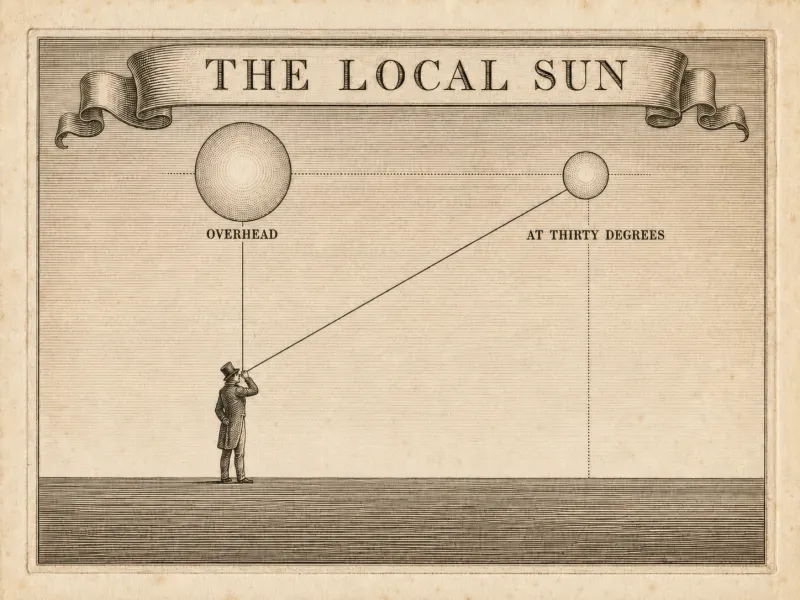
The requirement is arithmetic and is not in dispute. A body at height above a plane, seen at an elevation , is at a distance
and its apparent width goes as . At the zenith it is away; at thirty degrees it is away, because . A local sun must therefore appear exactly half as wide standing thirty degrees up as it did standing overhead, and narrower still as it approaches the horizon, dwindling towards nothing as it goes.[4]
Nothing here depends on the height chosen, which is why the disagreement in the table above does not help. Whether the sun is at 1,986 miles or 4,000, the ratio is the same, and the requirement is the same.
The sun's apparent diameter is about 1,919 seconds of arc.[5] It is not perfectly constant: it runs between 1,887 and 1,952 seconds, a variation of some three parts in a hundred. The variation is real, it is measurable with a modest instrument, and it is on an annual cycle, being widest in early January and narrowest in early July, which is the signature of an orbit slightly out of round and not of a body circling overhead. Across a single day the change is some three parts in ten thousand.
The doctrine therefore fails not because the sun's width is unvarying but because it varies on the wrong cycle, by the wrong amount, at the wrong time of year, and in the wrong direction to be of any use.
Two objections are usually raised here and both are answerable. The sun does appear to flatten as it nears the horizon: it does, vertically, going visibly oval, because light from its lower limb is bent more than light from its upper. Its width is unaltered, which is the quantity at issue. And footage in which the sun shrinks dramatically at sunset is almost always a photographic artefact, the glare having overwhelmed the sensor and spread across neighbouring elements; as the light dims the spread contracts, and what shrinks is the bleed rather than the sun. A filter removes both the glare and the argument.
The strongest reply to any null result is that the method was too coarse to detect anything, and here that reply is closed off. The moon genuinely is local, genuinely does approach and withdraw, and its apparent width varies by roughly a seventh between its nearest and furthest passes. That variation is detected easily, by amateurs, with the same instruments that find no daily variation in the sun.[6]
The method works. It is simply that when it is turned on the sun it returns nothing, and it returns nothing because there is nothing.
Three are advanced with some regularity.
The hotspot – a bright patch on cloud or water directly beneath the sun – is offered as showing that the source is near. It shows that the surface is reflective and that the geometry of specular reflection puts the brightest patch opposite the observer.
The converging rays of a broken sky are offered as showing that the light issues from a point close by. This is the strongest-looking of the three and the most completely answered: the same shafts, followed across the whole sky when the sun is low, converge a second time at the antisolar point, behind the observer's head, where they are called anticrepuscular. Parallel lines converge at both ends of a view. Rays that met only once might mean something. Rays that meet twice mean perspective.[7]
The inverse-square law is offered as proving the source local, on the ground that light falls off with distance. So it does, and a sun that withdrew far enough to set would dim as it went. The intensity of sunlight is very nearly the same whenever the sun stands well up, which is the opposite of what is claimed.
One defence deserves a proper answer rather than a dismissal, being the only one raised with any force: that a rainbow does not change its apparent size with distance either, and that there are therefore phenomena of light exempt from the rule, of which the sun may be another.[8]
The observation about rainbows is correct. The reason for it is that a rainbow has no distance to recede over. It is not an object but a direction: a cone of about forty-two degrees about the antisolar point, assembled afresh out of whatever drops happen to lie along it, and abandoning them for others as the observer walks. Having no position, it can neither approach nor withdraw, which is why nobody reaches the foot of one.
The defence therefore succeeds only by conceding that the sun likewise has no position – and the doctrine requires the sun to have a position, a height, and a circuit over the plane. It cannot be a direction on the days when its size is questioned and a body at 3,000 miles on the days when the hour of the day is wanted.
Granting the whole doctrine changes nothing about the second difficulty, which is worse. A sun carried at a fixed height above a plane stands at an elevation of , positive for every finite distance: it approaches the horizon for ever and arrives never. It cannot go behind the plane, there being nothing for it to go behind.
The doctrine's own answer is that the sun withdraws until it can no longer be made out, taking the daylight with it. This requires the sun to become invisible while remaining the same apparent size and the same brightness, in a clear sky, at a predictable hour, and to do it again the following morning in the opposite quarter. What it does not require, and cannot supply, is night.
The doctrine is not Unlonn's, and he never held it: reluctant light has the sun where the astronomers put it and merely doubts that its light arrives punctually.[9] Lucian Sheen, who defended the plane for twenty years, is likewise not recorded to have committed himself to a height for the sun, having found it more convenient not to, and it is among the few questions on which his caution now looks like foresight.
0003a88b4751e29487a899136e9691e7f423ce2e6d96f0eb1f5f92da717cdad1