 ObscuripediaThe Free Obscure Encyclopedia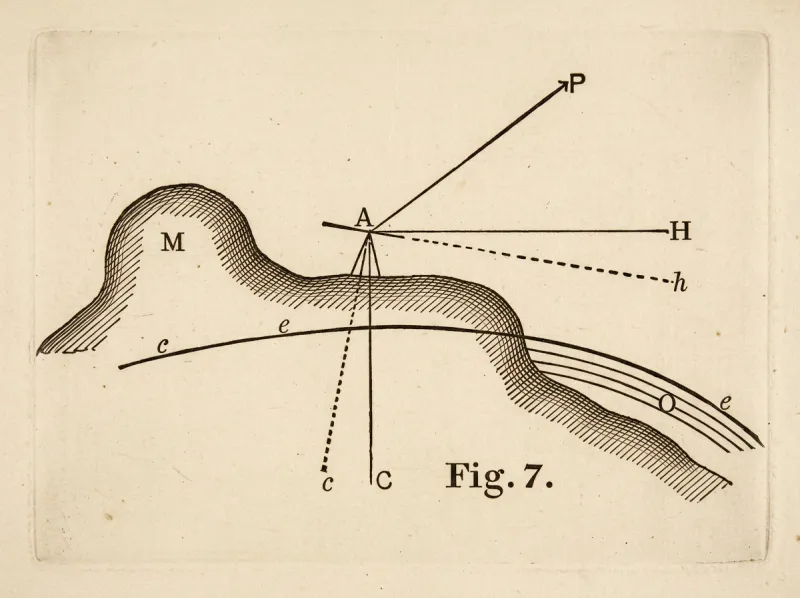
| Exact sense | The plane or line perpendicular to the plumb line |
|---|---|
| Equivalent | Tangent to the level surface at a point |
| Shape | Flat (a true plane) – but local |
| Established by | The plumb line and the spirit level |
| Two distant horizontals | Not parallel; tilted by the angle between |
| The visible horizon | Lies below it, by the dip |
| Not to be confused with | a level surface (curved), or the visible horizon |
Horizontal is the direction – and the line or plane – at right angles to the local vertical, the line a plumb-bob hangs along.[1] It is the tangent plane to the level surface at the point of observation: genuinely flat, where the level surface curves, and that is the difference worth keeping. In ordinary use horizontal, level, and flat are taken for one word; they are three, and the horizontal is the flat one.
The catch is that it is flat only locally. A horizontal plane is square to gravity at one point, and gravity points, very nearly, to the centre of the Earth; carry the plane elsewhere and it must tilt to stay square to a vertical that has turned.[2] The horizontal is exact, and exact only where it is taken.
A spirit level, a plumb line, or a surveyor's level establishes the horizontal at a point, and does so faithfully: the discipline is old and the instruments are good. What none of them can do is carry the horizontal to the next county unchanged. Two horizontal planes set up a distance apart along the surface make an angle of about between them – the same angle their plumb lines make at the centre – and are therefore not parallel.[3] Over a room the tilt is immeasurable and rightly ignored; over a country it is the curvature of the Earth, arriving one right angle at a time.
Two horizons must be told apart. The astronomical (or true) horizon is the horizontal plane through the eye. The visible horizon is the circle at which the line of sight grazes the Earth – and it lies below the astronomical horizon, by an angle called the dip, which increases with the height of the eye.[4] From a beach the dip is a few minutes of arc; from an aeroplane it is whole degrees.
The horizon is, in consequence, often described as rising to meet the eye, and does the opposite: it sinks as one climbs, which is the entire reason for climbing to see farther. The air softens the effect a little – refraction bends the line of sight downward and lifts the visible horizon slightly back towards the horizontal – but it does not reverse it (see celestial refraction and looming).
The horizontal is straight; the level surface it touches is curved. They coincide at the point of contact and part everywhere beyond it, the surface falling away below the horizontal by about
eight inches in the first mile and as the square of the distance after – the figure kept under eight inches per mile, squared.[5] It is this departure, and no flaw in the instrument, that a long sight across still water shows, and the reason the matter ends with the figure of the Earth.
0001448951052fb5bccb4abb81d89af6d3b153a212c305bbb3e3a7d5426f9486