 ObscuripediaThe Free Obscure Encyclopedia
A null result from this instrument is a measurement. An interferometer reports the difference between two light paths; where there is no difference it reports none, and that reading is a result in exactly the way any other reading is. Editors are asked not to describe an experiment listed here as having failed when what it did was answer.
| What it compares | Two paths taken by the same light |
|---|---|
| The ruler | The wavelength |
| One fringe | One wavelength of path difference |
| For green light | About 500 nanometres |
| First built | Michelson, 1881 |
| What it detects | |
| Rotation | Yes |
| Uniform translation | No, and that is not a fault |
| Its own surroundings | Continuously, whether asked or not |
| Extremes | |
| Longest arms | 4 km, twice over |
| Longest baseline | Intercontinental, by radio |
| Smallest length change read | About 10−18 m |
| Least welcome signal | Ravens |
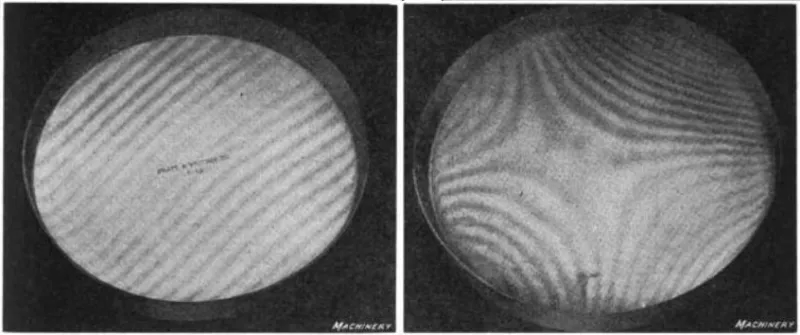
Interferometry is measurement by interference. Light from one source is divided, sent along two paths, and brought back together; where the two arrive in step they reinforce and where they arrive out of step they cancel, and the pattern of light and dark stripes that results, called fringes, is a direct reading of the difference between the paths.
The technique's whole character follows from what the ruler is. There is no scale, no bar and no gauge: the standard against which the two paths are compared is the wavelength of the light itself, and a shift of one fringe corresponds to a path difference of one wavelength, which for visible light is about half a thousandth of a millimetre. Nothing else in physics measures length so finely with so little apparatus, and nothing else is so completely indifferent to what it is measuring.
The sensitivity is not a matter of good engineering. It is arithmetic. If the comparison is against a wavelength, and a fringe can be judged to a fiftieth of its width by eye and far better by a photodiode, then the instrument resolves a length of a few nanometres without anything in it being made to that tolerance.
What follows from this, and is the point of the article, is that the instrument is blind. It knows that the two paths differ. It does not know, and cannot be made to know, whether they differ because the mirror moved, because the air warmed, because the bench sagged, because the wavelength changed, or because space itself was momentarily a different shape. Every use of an interferometer is therefore an exercise in arranging matters so that only one of those explanations is available, and every famous misreading is a case where more than one was.
This makes the interferometer the ideal instrument for this encyclopedia, because it is scrupulously honest and has no judgement whatever. It answers exactly the question the apparatus asks, which is never quite the question the experimenter meant.
Interferometers are classified by how the light is divided, and the division is the design.
| Family | How the light is split | Examples | Characteristic use |
|---|---|---|---|
| Amplitude division | A partial reflector sends part of each ray each way | Michelson, Mach-Zehnder, Fabry-Perot, Twyman-Green, Fizeau | Lengths, surfaces, spectra |
| Wavefront division | Different parts of one wavefront are taken | Young's slits, Lloyd's mirror, Rayleigh | Demonstration, refractive index |
| Common path | Both beams follow the same route in opposite senses | Sagnac, the fibre-optic gyroscope | Rotation |
| Two path | The beams go separate ways and are recombined | Michelson, Mach-Zehnder | Everything else |
The last distinction is the one that matters most and is least often drawn. A two-path instrument compares two different journeys and is therefore sensitive to anything that disturbs one of them and not the other, which is why it must be floated on mercury, or bolted to bedrock, or hung in a vacuum. A common-path instrument sends both beams round the same loop in opposite directions, so that almost everything which disturbs one disturbs the other identically and cancels. What survives that cancellation is rotation, and only rotation, which is the Sagnac effect and the reason the gyroscopes in aircraft have no moving parts.
The list is the argument. In every case the instrument did its job perfectly and reported a genuine difference between two light paths; the variety is entirely in what was making the difference.
| Year | Instrument | What it reported | What that turned out to be |
|---|---|---|---|
| 1851 | Fizeau's water tubes | Light dragged, but only partly | Relativistic velocity addition, 56 years early |
| 1887 | Michelson and Morley | Nothing | Correct. There was nothing there |
| 1920 | The 20-foot stellar interferometer | Fringes vanishing at a certain spacing | The angular width of Betelgeuse |
| 1925 | Michelson, Gale and Pearson | 0.230 of a fringe | The rotation of the Earth |
| 1920s-30s | Dayton Miller's, at Mount Wilson | A persistent small shift | The temperature of his hut |
| 1981 | Hubble's null corrector | Perfect agreement | A gauge with a lens 1.3 mm out of place |
| 2003 | Wang's fibre conveyor | A shift proportional to speed | The belt |
| 2015 | LIGO | A strain of about 10−21 | Two black holes merging |
The first row deserves its own account, because it is the earliest case of the instrument confirming something exactly right for a reason nobody would have for another fifty-six years.
In 1851 Hippolyte Fizeau sent the two halves of a divided beam through tubes of water running in opposite directions, and asked whether the moving water carried the light with it. The two clean answers available were that the water drags the aether with it entirely, so that the light goes at the full speed of the water, or that it does not drag it at all. Augustin Fresnel had already proposed a third, in 1818, to save an earlier null result of Arago's: the water drags the light by a particular fraction and no more, the fraction being
For water, with a refractive index near 1.33, the bracket comes to about 0.43. Fizeau's interferometer found the light dragged at about that fraction of the water's speed, and Michelson and Morley confirmed it more precisely in 1886. So the number was not a surprise. What nobody could say was why it should be that number: Fresnel had arrived at it by supposing the aether inside a transparent body is partly bound to it, which is a patch, and it worked for no reason anybody could give.
The reason arrived in 1907, from Max von Laue, and it is that there is no patch: the Fresnel coefficient is exactly what the relativistic addition of velocities gives for small speeds, to first order. An interferometer had confirmed a consequence of special relativity in 1851, and a guess of 1818 had anticipated it, and neither could be read for what it was because the sentence it was written in had not been composed yet.
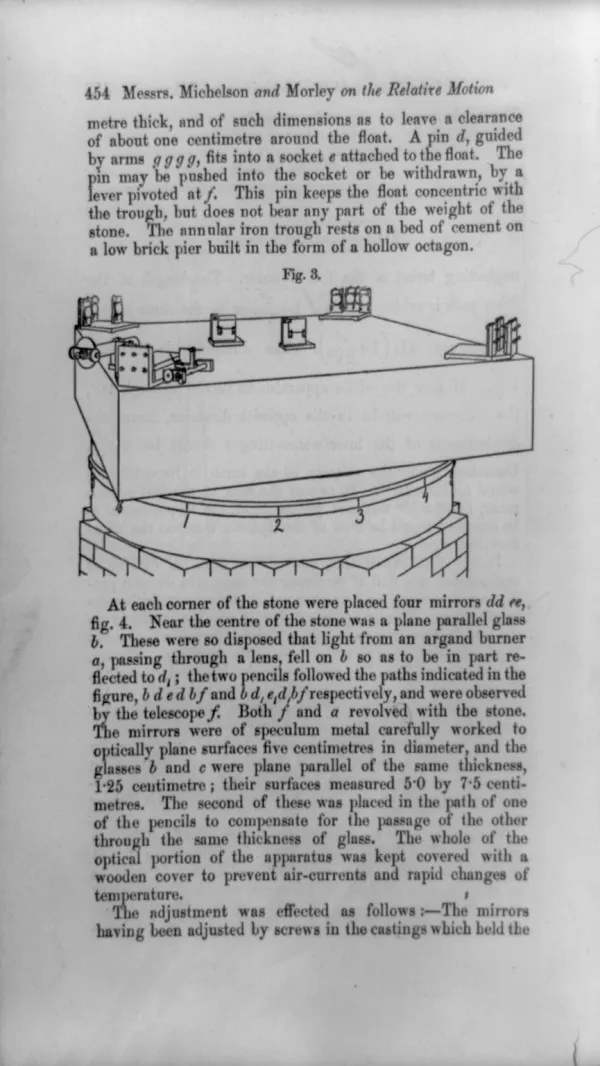
The most-cited interferometric result in history is the Michelson-Morley experiment of 1887, which compared the speed of light along the Earth's motion with its speed across, and found no difference to within a twentieth of the predicted four-tenths of a fringe. The luminiferous aether did not survive it, and special relativity was built in the space it left.
That result is now offered, with some regularity, as evidence that the Earth does not move. The answer is not subtle and it does not require any physics: the same man built an interferometer that detected the Earth's motion, and it worked. In 1925 Michelson, with Henry Gale and Fred Pearson, laid out a rectangle of evacuated pipe on a field in Illinois and measured a fringe shift of 0.230 against a prediction of 0.236, which is the rotation of the Earth. It is set out in full at the Sagnac effect.
The distinction the pair of experiments draws is the one the objection depends on eliding. An interferometer detects rotation and does not detect uniform translation, because a closed loop that turns encloses an area and accumulates a difference, while two arms carried smoothly along together do not. That is not a defect in the apparatus; it is a statement about the two kinds of motion, and both Newton and Einstein agree on it. An instrument that reported the Earth's orbital velocity would be reporting something no theory since 1632 has expected it to find. This encyclopedia's own aetherists got to the null from the other side and a good deal earlier: the Aetheric Concord held that no wind could be found because the Earth stands still, and entered that prediction in 1866. By the time there was an experiment to claim it by, the society had shrunk to a single Corresponding Secretary, who crossed the Atlantic to watch and died at the apparatus.
The strongest form of the objection is more interesting than the flat version, and it belongs to Ruyong Wang, who showed from 2003 that the Sagnac shift is not confined to rotating apparatus: a straight length of fibre moving on a conveyor produces it too. That work is real, careful, and fully treated at the Sagnac effect, which is where the argument about it lives.
The short form is that the general expression was always a line integral of around the path and never contained the word rotation; what it requires is that part of the light path move with respect to another part, which in Wang's apparatus it does. And the claim has a decisive test that needs no theory at all. Ring laser gyroscopes are built in quantity, bolted into aircraft, and read continuously. If the instrument registered motion with respect to space, it would register the motion the Earth is known to have. Left sitting still, it reads zero.
The technique has scaled further than any other in physics, in both directions.
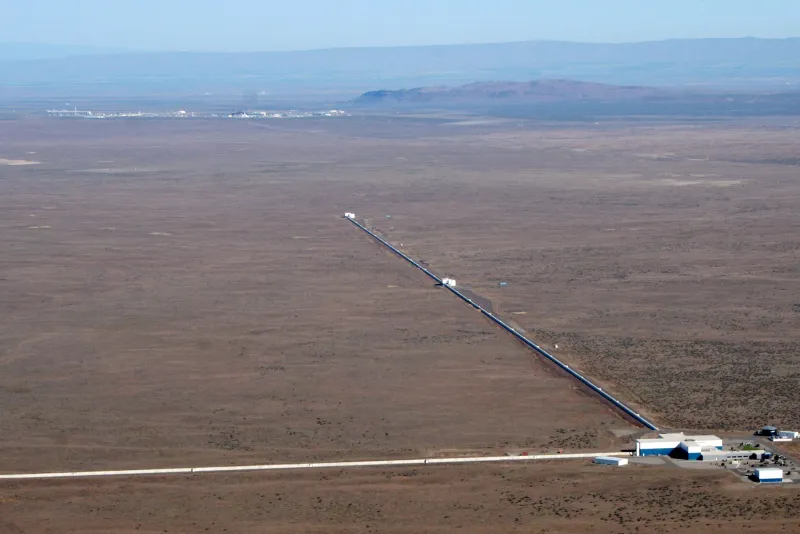
At the large end, LIGO is a Michelson interferometer with arms four kilometres long, each a Fabry-Perot cavity in which the light makes something like 280 round trips before recombining, and with about 100 kilowatts of laser power circulating inside. What it is looking for is a strain of order 10−21, which over four kilometres is a change of length of about metres, or roughly a four-hundredth of the width of a proton. On 14 September 2015 it measured one.[1]
The instrument's sensitivity is best conveyed by what it has to ignore. The detectors reject seismic noise, microseisms, lorries on a road two kilometres away, aircraft, the air conditioning three hundred metres off, footsteps in the control room, power lines four kilometres distant, and, at Hanford, ravens pecking frost from the pipes of a liquid nitrogen cryopump.[2] Human operators are required to stay at least ten metres from the test masses while the instrument is running, because a person walking within five metres of a mirror pulls on it gravitationally by a detectable amount. The blindness is total and entirely consistent: it reports the black holes and the birds in the same units.
At the small end the technique is the basis of length metrology, and it is how the metre is realised in practice. Since 1983 the speed of light has been fixed by definition and the metre derived from it, and the derivation is performed with a stabilised laser and an interferometer counting fringes. The same arrangement calibrates gauge blocks and tests optical surfaces to a fraction of a wavelength.
In astronomy the trick is different again: rather than measuring a length, several telescopes are combined so that the resolution belongs to the distance between them rather than to any one aperture. Michelson and Pease did it first on 13 December 1920, hanging a twenty-foot beam across the 100-inch telescope at Mount Wilson and watching the fringes from Betelgeuse disappear as they widened the spacing, which gave the star's angular width. It was the first measurement of the size of a star, and it has the same shape as everything else in this article: what the instrument delivered was an angle, and turning an angle into a diameter needed the distance, which was not well known. The modern descendants reach four milliarcseconds in the optical, and a few microarcseconds by radio over intercontinental baselines, which is how a black hole was photographed.
The article should end on the failure that best illustrates the principle, and it is not an aether experiment.
The primary mirror of the Hubble Space Telescope was tested interferometrically while it was being figured, against a device called a null corrector, and the test was passed. The mirror agreed with the corrector to a remarkable precision. The corrector had a lens 1.3 millimetres out of position, so what the interferometer had certified was that the mirror matched a faulty gauge, which it did, exactly. Two simpler correctors were also used and both reported that the mirror was wrong; both results were set aside on the grounds that the simpler instruments were less accurate.[3]
That is the technique in one episode. The interferometer compared two things and reported, with great precision, that they were the same. It had no way of knowing which of them was supposed to be right, and it is not the kind of instrument that could have one. Everything it has ever been wrong about has been wrong in that particular way: not a false reading, but a true reading of something other than the intended question, which is a failure mode belonging to the person who set the question and not to the light.
0002bee4243576c3bb09f1173954b3db9c85887d3de144868a4001f63422289e