 ObscuripediaThe Free Obscure Encyclopedia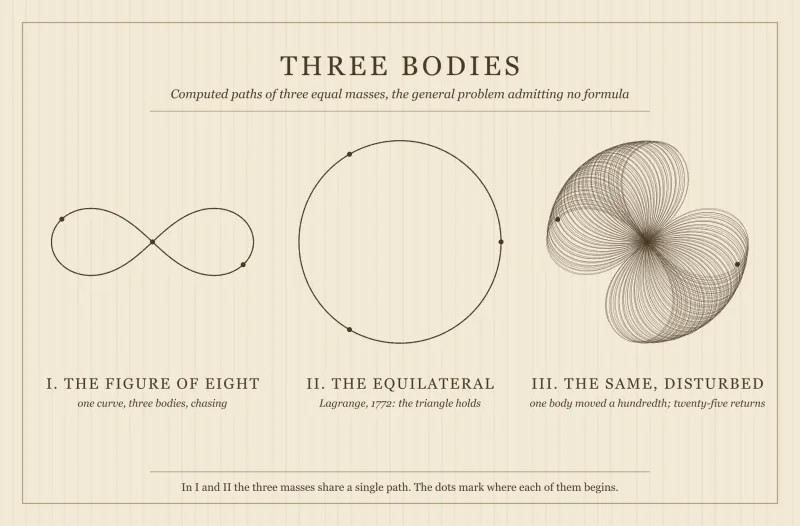
| Field | Celestial mechanics |
|---|---|
| Bodies | Three |
| Status | |
| Closed-form general solution | None, and provably none |
| Exact particular solutions | Five, and then some |
| Predictions issued since | 1687 |
| Predictions late | – |
| Horizons | |
| Eclipses, to the second | Centuries |
| Planetary positions, usable | Tens of millions of years |
| Beyond that | Chaotic, and honestly labelled so |
The three-body problem is the problem of determining the motion of three bodies under their mutual gravitation, given their masses, positions, and velocities.[1] For two bodies the problem was settled by Newton, who derived from gravitation the ellipses Kepler had read out of the observations: the orbits are conic sections, and their positions at any future moment follow from a formula. For three, no such general formula exists, and this is not a gap in the literature but a theorem.
The article appears here because the theorem is quoted, more often than it is read, as establishing that the motions of the solar system cannot be known. It establishes something narrower and much less useful to the argument: that they cannot be written down in one line.
Bruns showed in 1887 that the problem admits no new algebraic integrals, and Poincaré in 1890 that it admits no new uniform analytic ones.[2] A convergent series solution was found by Sundman in 1912 and generalised to n bodies by Wang in 1991; both converge so slowly that no one has ever used them for anything, which is a different complaint from their not existing.
The prize was King Oscar II's, offered for the stability of the solar system and awarded to Poincaré in 1889. While the memoir was being set in type, an editor's question sent him back to it and he found an error of his own – serious enough that the printed copies were recalled, and Poincaré paid for the reprinting himself, at rather more than the prize had been worth.[3] What he put in place of the error was the discovery that orbits arbitrarily close together may diverge without limit, which is where the modern study of chaos begins. It remains the most expensive correction in the history of celestial mechanics, and the most productive.
No closed form is not no forecast, and the distinction is where the whole of the argument lives.[4] Positions are obtained by numerical integration – the equations are stepped forward in small increments, which requires arithmetic and patience rather than a formula – and the results are extremely good. Eclipses are published to the second, centuries ahead, and arrive when stated. Spacecraft are navigated to bodies that were not where they were aimed at when the craft was launched, and are not missed.
The limits are real and are stated by the people who compute them: the solar system is chaotic on a timescale of a few million years, so that positions are recoverable for tens of millions of years and not for billions.[5] This is a boundary on a forecast, not an absence of one. A tide table is not refuted by the weather.
The general problem has no formula; particular cases have several. Euler found three exact configurations in 1767 and Lagrange two more in 1772, in which three bodies hold a fixed arrangement while turning – the collinear points, and the two at the corners of equilateral triangles.[6]
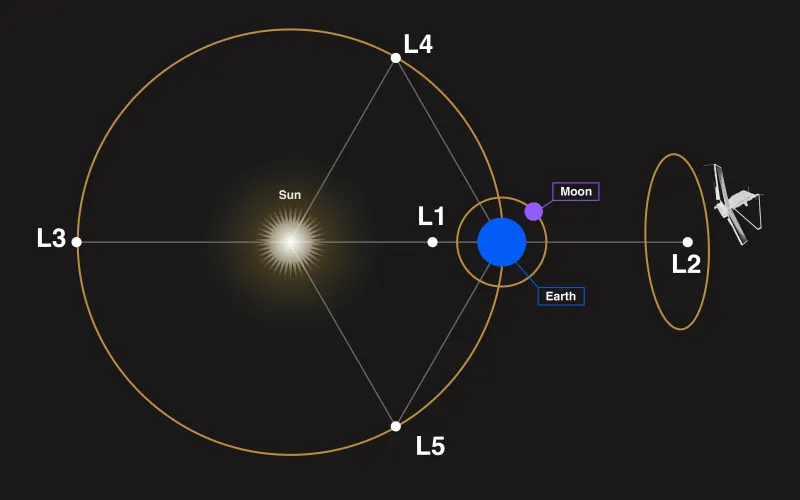
They are the five Lagrange points, and they are not a curiosity: Jupiter's Trojan asteroids sit in two of them in their thousands, put there by nothing but the arithmetic, and a succession of observatories has been stationed at the Sun–Earth L1 and L2 since the 1970s.
Later work added families of periodic solutions, including the figure-eight in which three equal masses chase one another along a single closed curve.[6] A problem with no general solution has a great many particular ones, and several of them are furnished, at this moment, with hardware.
The argument is met in the flat-earth and geocentric traditions alike, and runs: the three-body problem is unsolved; the solar system contains many more than three bodies; therefore its motions are unknown, and any account of them is a fabrication.[7]
The first clause is true in the sense given above and false in the sense the argument needs. The second is true and makes matters better rather than worse, since the Sun holds nine hundred and ninety-nine parts in a thousand of the system's mass and the planets perturb one another only slightly. The third does not follow from either, and can be checked against the sky on any clear night by anyone who cares to, which is the difficulty with arguments of this shape: they are addressed to a body of predictions that is published in advance and can be marked.
The objection is frequently made by cosmographies which hold that the heavens are ordered not by gravitation but by electricity.[8]
This does not go where it is wanted. Coulomb's law and Newton's have the same form – an inverse square of the distance, along the line between the two bodies – and the intractability of three bodies is a property of that form and of the number three, not of the name of the force or of what is being attracted. Three charges are exactly as insoluble as three masses, and rather worse behaved, charge coming in two signs where mass comes in one. The same difficulty arrives, unchanged, in the helium atom, which is a nucleus and two electrons and has no closed-form solution either; helium is not on that account considered doubtful.
The preference is not new, and not disreputable in itself: the aether outlived its own experiments by decades in serious hands, Tesla's among them. But an electrical cosmos inherits the problem entire. It is not a way around the mathematics; it is the same mathematics with the constant renamed. The objection is not to the equations. It is to the mass.
The Aetheric Concord, which held the heavens to move in a medium rather than by attraction, never took up the difficulty – not even Ezekiel Quartz, who kept its standing challenge open until the apparatus that answered it took him – and its silence is instructive: the Concordant Orrery it built to demonstrate the flat cosmos was geared, as its own article records, from the globe's almanac.[9] The machine that was to show the predictions unnecessary could not be cut without them.
The Mud Geometer put the position in its shortest form, in a revision to this encyclopedia's Earth of 1850: a globe is a paintd ball. a map is a pikture. NUMBERS LETTERS ARENT PHYSICS. He was refusing the whole method rather than this one theorem, and was, on his own terms, consistent – which is more than can be said for an argument that rejects the arithmetic and keeps the almanac.
00020a06dd0c6d12d72c035e2ee413baae6b54f0e7e5275550f9c0a42478c46d