 ObscuripediaThe Free Obscure Encyclopedia
This article describes an observation routinely offered as impossible. It is impossible in the geometry alone, on any shape of world, and is resolved on all of them by a correction printed in the almanac one must open to know when to look.
| Type | Simultaneous observation |
|---|---|
| Requires | A total lunar eclipse at moonrise or moonset |
| Bodies visible | Two |
| Bodies actually above the horizon | Nought |
| The margin | |
| Refraction at the horizon | About 34′, each body[1] |
| Semidiameter, Sun | About 16′ |
| Semidiameter, Moon | About 15′ |
| Lunar parallax, against | Up to about 57′[2] |
| Observer's height | Helps, and is why it is hunted from hills |
| In practice | |
| Window | About four minutes; ten from a headland |
| Best horizons | Sea, or a summit |
| Cited as evidence against | The round Earth |
| Evidence against it | No |
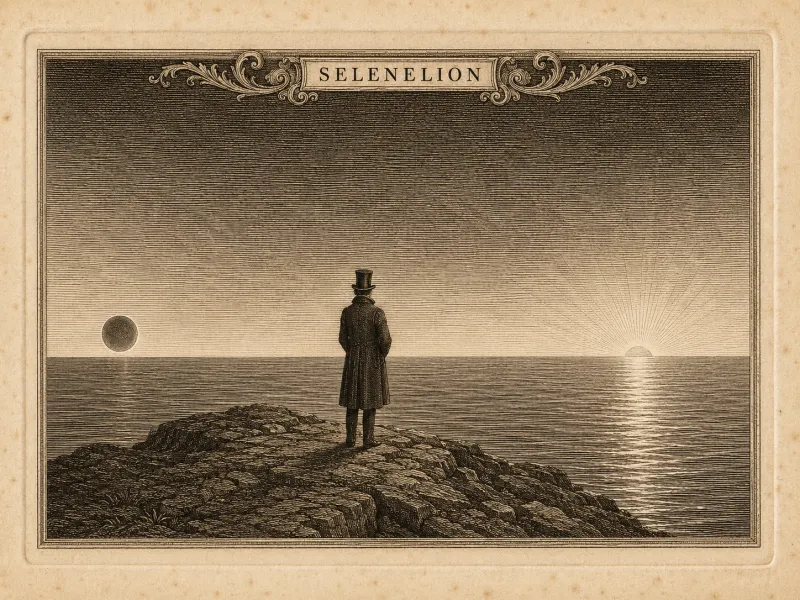
A selenelion, also selenehelion or horizontal eclipse, is the sight of the Sun and the totally eclipsed Moon at the same moment, one on each horizon.[3] It occurs when a total lunar eclipse falls at moonrise or moonset, and it is prized by observers because the geometry that produces the eclipse also, on the face of it, forbids the sight of it.
A lunar eclipse requires the Moon to be in the Earth's shadow, which lies opposite the Sun. The two bodies are therefore about 180° apart, and an observer who has one of them on the horizon should have the other exactly as far below. That the pair are seen together is not an error of report: it is seen, it is photographed, and it is predicted in advance for particular coastlines. The extra sky is furnished by the air.
At mid-eclipse the Moon sits near the axis of the Earth's shadow, and that axis points away from the Sun. Reckoned from the centre of the Earth, the two bodies are separated by very nearly half a turn.
For an observer this is a hard constraint. Altitude on the celestial sphere is measured from the horizon plane, and two points 180° apart must sit at altitudes that sum to zero: if the Sun stands one degree up, the antisolar point stands one degree down. There is no arrangement of a spherical Earth, and none of a flat one, in which two diametrically opposite points are both above the same plane. The prohibition is not a fact about the shape of the world. It is a fact about opposite directions, and it would hold on any world whatever.
This is worth stating plainly, because the argument built on the selenelion supposes the difficulty to be peculiar to the globe. It is not. The prohibition follows from the two bodies standing opposite, not from the world being curved, and what the observation therefore tests is whether the air bends light. That is a question about the atmosphere, and not about the shape of anything.
Air is denser at the bottom than at the top, and a ray entering it obliquely bends downward towards the denser medium. The eye, which reads a ray as a straight line, therefore places the source higher than it is. At the horizon the displacement is at its largest, running to about 34′ of arc, better than half a degree.[1]
Three further quantities enter, and it is worth setting them out, because the sum is closer than the popular account suggests.
The first term is the one always quoted. The second is quieter: sunrise is reckoned from the upper limb, not the centre, so each body is granted its own semidiameter, about 16′ for the Sun and 15′ for the Moon.[4] The third is the observer's own height, which lowers the visible horizon by the dip and can reach a degree or two from a summit over water.[5]
The last term is subtracted, and it is the one the popular account omits. The Moon is near enough for its direction to depend on where the observer stands: at the horizon it appears up to about 57′ lower than it would from the centre of the Earth, and the shadow it must be inside is defined from that centre.[2] Roughly half of what refraction concedes is spent before the observation has begun.
What is left is about forty minutes of arc, and the observer's hill is paid twice over, the dip lowering both horizons at once. Near the horizon the Sun changes altitude by roughly ten minutes of arc for every minute of time, so at sea level the pair stand together for some four minutes, and a thousand feet of headland turns that into ten.[6] That is the whole of the margin. It is why a selenelion is hunted from cliffs, and why two towns a short way apart will differ on whether there was one.
A second objection is made of the same photographs. The Earth is under the observer's feet, so its shadow ought to reach the Moon from below; and in the photographs the umbra lies across the upper part of the disc instead, as though it had come down out of the open sky.
Nothing is falling on the Moon. The Moon is sliding into the shadow, sideways, and it goes in leading limb first.
The shadow keeps station with the Sun and works round the sky once a year. The Moon goes round once a month and so laps it, gaining half a degree an hour, which is enough to carry it clean across in three and a half hours. The limb that darkens first is simply the one in front.
Which limb that is depends on where the Moon is going, and near the horizon that is not where it looks. The gain on the shadow is eastward, and east, at the western horizon, is neither sideways nor down: it is the slope the Moon has just come down, and it points back up into the sky. A Moon setting in the west enters the shadow by its upper limb, and the dark spreads downward across the disc. A Moon rising in the east, at an evening selenelion, does the reverse and is eclipsed from below. Away from the horizon the same motion lies nearly level, which is why a midnight eclipse arrives from the side and is never complained of.
At New York on the morning of 8 November 2022 the Moon's gain on the shadow stood 20° from straight up.
The rest is the chord. The umbra is a disc 1°21′ wide, better than two and a half times the Moon,[7] and the Moon does not cross its middle: it passes north of the centre at one eclipse and south of it at another, which throws first contact a little to one side of the leading point. That morning the miss was 0.2404°, almost all of it northward, and it moved the contact 15° round the limb.[8] Twenty degrees and fifteen: the shadow arrived 35° from straight up, which in a photograph is the top of the Moon.[9]
Two other forms of the objection travel with it. That the shadow ought to come from the west every time has the traffic running the wrong way, since it is the Moon that overtakes the shadow and the eastern limb that goes first, at every lunar eclipse there has ever been.[10] And that it ought to come from below forgets that the Moon is not falling anywhere. It is going past.
The selenelion is a favourite of the flat cosmographies, where it is presented as an observation the round Earth cannot survive: the Sun and Moon are opposite, both are seen, and the globe is therefore in error.[11]
The difficulty is that the argument needs the observation to be unexplained, and it is not. What resolves it is a correction of about half a degree, tabulated since antiquity and applied by every navigator taking a sight: it is printed in the same almanac one must open to learn that the eclipse is coming at all. An objection answered on the page facing the prediction is a thin objection.
The argument does sometimes state its own allowance, and the allowance is handsome. Refraction at the horizon, it is conceded, may run to a degree, or two degrees at the very most; and the sight is then pronounced to require more than that. It requires 34′, once for each body, which is a little over one degree for the pair, against a ceiling of two freely given. The concession is made in the sentence before the conclusion it destroys, and the subtraction is not carried out.
Worse for the argument, the same literature has already conceded that the air is strong. It is refraction that is called upon when a hull, having gone, comes back; refraction that carries a city sixty miles across a lake and stands it on the horizon.[12] Having made the atmosphere powerful enough to return a ship, one cannot then be astonished at it lifting a disc through half a degree. It is the same quantity, and it was granted first.
What is left is a preference about which consequences of the air are counted. Refraction restores the hull and is admitted; refraction raises the Moon and the raising is not mentioned. It is the manoeuvre this encyclopedia records, in its filing form, under Grimble's razor: the inconvenient half of an entailment is not answered, it is not minuted.
None of which touches the phenomenon, which is real, handsome, and worth rising for.
Selenelions are computed in advance, since everything they require is tabulated. The eclipse of 8 November 2022 produced one along the eastern seaboard of North America, the totally eclipsed Moon setting in the west while the Sun came up in the east, and was reported from New York, Boston and the Maritimes.[13] The eclipse of 3 March 2026 produced another across the eastern half of the United States and Canada.[14]
The advice given to observers on both occasions was the same, and is the article in miniature: find height, find a clean horizon, and look early.
00039cc30ad5d4741e6e4209f192e297b2883b2527b70ca8a6a9f3e3835db3a0